
NATO chief urges Europe to endure energy shortages and unrest
Jens Stoltenberg calls on allies to accept the economic and social costs of supporting Ukraine despite potential energy crises and civil disturbances.
English · Original discussion in Spanish · Published
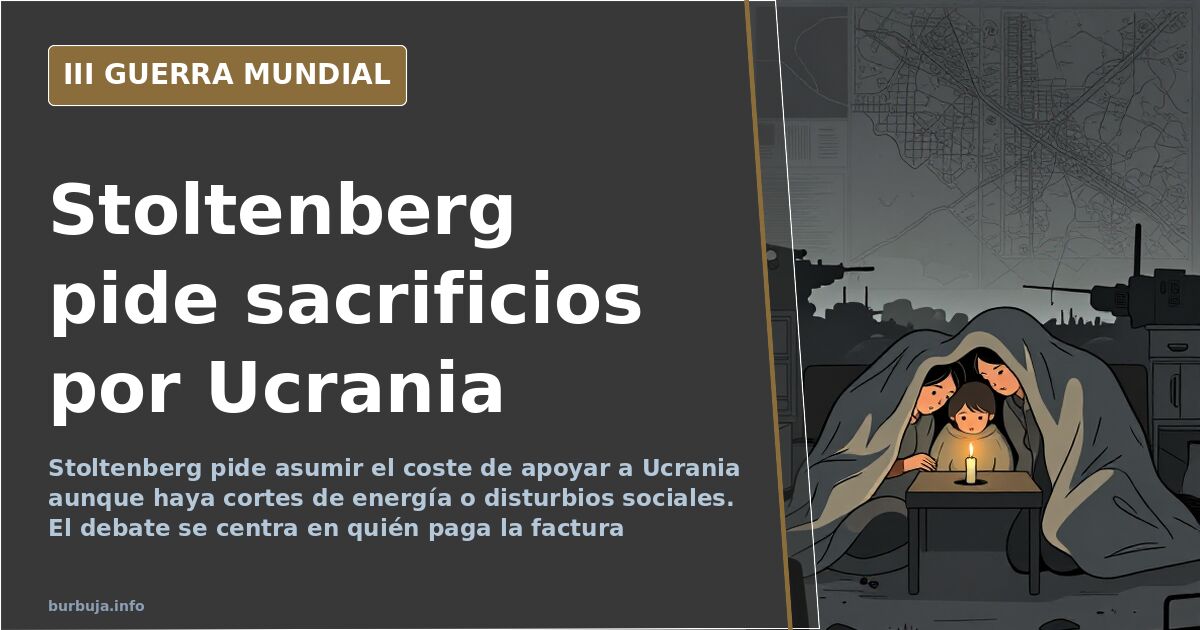
Stoltenberg urges Europe to endure power cuts and unrest over Ukraine
NATO Secretary General Jens Stoltenberg has called this Wednesday for allies to accept the cost of supporting Ukraine, even if that cost translates into energy shortages or social unrest. He made these remarks in an article published in the Financial Times, where he describes the conflict as being in a "critical phase" and predicts "six difficult months" ahead. Several participants in the debate highlight the paradox: the person making the request holds an international office and faces no personal risk, while those receiving the request pay the electricity bill.
What Stoltenberg is calling for in his Financial Times article
The Alliance's political leader warns that Russia will test the unity of allies in the coming months, as energy prices rise and the cost of living climbs as a consequence of the invasion. "We face six difficult months with the threat of energy shortages, disruptions, and even social unrest, but we must stay the course and confront tyranny," he writes. The dilemma he poses is explicit: "We have to choose which world we want to live in."
Stoltenberg maintains that allies are providing "unprecedented" financial, humanitarian, and military assistance to ensure Ukraine "prevails as an independent nation." He adds the argument that underpins his entire thesis: the cost of not defending values is "always greater." While Europeans look at a larger bill, he says, Ukrainians are sacrificing their own lives. "For the future of Ukraine and our own, we must prepare for the winter war and stay the course," he concludes.
The cost is already being felt: factories closing and unions warning
Germany is acting as a thermometer, according to one participant. Its news programs are not hiding the anger over rising energy prices or uncontrolled inflation: there are daily reports on factories closing, plants halting production, and warnings from unions and employers' associations. On high-audience programs, there is already blunt talk about the "deindustrialization of Germany."
According to the same account, none of this peine like this during the pandemic, when the media repeated the official narrative without question. The difference now is that the message clashes with the grocery bill. When the majority cannot believe that "nothing is happening," official discourse loses its effectiveness, and that holds true for both Berlin and Brussels.
Who will face the cold and who will face the front line?
One part of the analysis is clear: those calling for the effort will not be the ones suffering it. The calculation is old and simple. Those demanding sacrifices will not turn off their heating nor risk their lives in a trench, and some argue that a portion of the European electorate supports their own decline in living standards to sustain positions that offer them nothing in return. The parallel with medieval nobility—living better than the common people and convincing them to starve for their lord's glory—appears as soon as one scratches the surface.
On the other side, the defense is what the article suggests: yielding to energy pressure is a cheaper victory for Moscow. Those in this camp argue that anyone who attributes the problem to sanctions rather than the invasion is confusing the cause with the bill.
No Russian gas, no economy: the calculation no one has solved
The most uncomfortable argument, according to a debate participant, is not sarracena, but physical. There is no real substitute, he maintains, for the volumes of Russian gas and oil that Europe consumes every year; without those supplies, there is no economic activity, and without cheap energy, societies enter a zone where controlling unrest becomes very difficult. The sequence allows for no shortcuts.
Patches come at a price, and the full breakdown of what it costs to sustain the system without cheap energy is something that should be read with a pencil in hand. According to that same analysis, limiting energy prices by decree generates a tariff deficit, and that hole is ultimately absorbed by the State through debt issuance: more inflation, more pressure on interest rates, and more burden on the taxpayer. The distribution of aid to calm tensions is underway, but limited when half the continent is broke.
It is noted, with irony, that liquefied gas arrives with a 140% surcharge, that the single currency is depreciating, and that funds are buying European industry at bargain prices. In the monetary realm, there is another derivative: what happens if commodity exporters stop accepting paper for their resources.
Social unrest enters the official stage
The fact that the Secretary General himself mentioned social unrest is not a rhetorical detail: it is an acknowledgment that this winter is also being fought in the streets. Some argue that German unions are not as integrated into the government's orbit as those in Spain, and that when workers begin to lose jobs and wages, labor conflict turns into political conflict.
The question hanging over all this is whether a political option will emerge capable of challenging both the war and membership in the Alliance, and doing so seriously. As long as one does not exist, the only voice being heard is the one calling for endurance.
Stoltenberg has set a deadline for this test of resolve: six months. Europeans have not yet decided if that period is a threat or a truce. How much must the bill rise before someone in public office has to explain it from their own pocket?
Also available in: Deutsch
Summary of a discussion on Burbuja.info - Foro de economía, actualidad y política., translated from Spanish and reviewed before publication. Read the full discussion (102 replies).
More summaries
-
NATO Summit, at Germany's request, to send urgent munitions to Ukraine: Patriot interceptors, drones, long-range artillery, etc.
Germany leads urgent munition shipment to Ukraine: Patriot missiles, drones, and artillery. NATO reinforces Ukrainian defense.
-
NATO forces pull out of Kharkiv as Russia advances
Reports from Times of India and Tribun Timur indicate that NATO-linked fighters are abandoning Kharkiv as Russia launches an offensive featuring hand-to-hand combat.
-
Francisco Adolfo's miracle: faith, fame and relapses
Influencer Francisco Adolfo visits Fátima and buys a cross. Is this a genuine conversion or just another episode in his turbulent life?
-
Scott Ritter: 'Rescue' mission in Iran was a raid to steal uranium — and a botched one
Scott Ritter claims the rescue mission in Iran was an attempt to steal uranium. The former inspector details the loss of six aircraft and the capture of a pilot.
-
Refineries are being destroyed worldwide – why is it happening?
Why are refineries around the world being closed and destroyed? We look at the data, the conspiracy theories and energy geopolitics in a debate.
-
Ukraine keeps snatching men off the streets to send them to the front
Videos and testimonies show Ukraine forcibly seizing men in the street to send them to the front. Forced conscription is intensifying while extraditions of Ukrainian men in Europe add to the fears.