
Naples: From Rich European Capital to Subsidized Region
Did Southern Italy become de-capitalized after unification? The narrative of southern backwardness is being questioned.
English · Original discussion in Spanish · Published
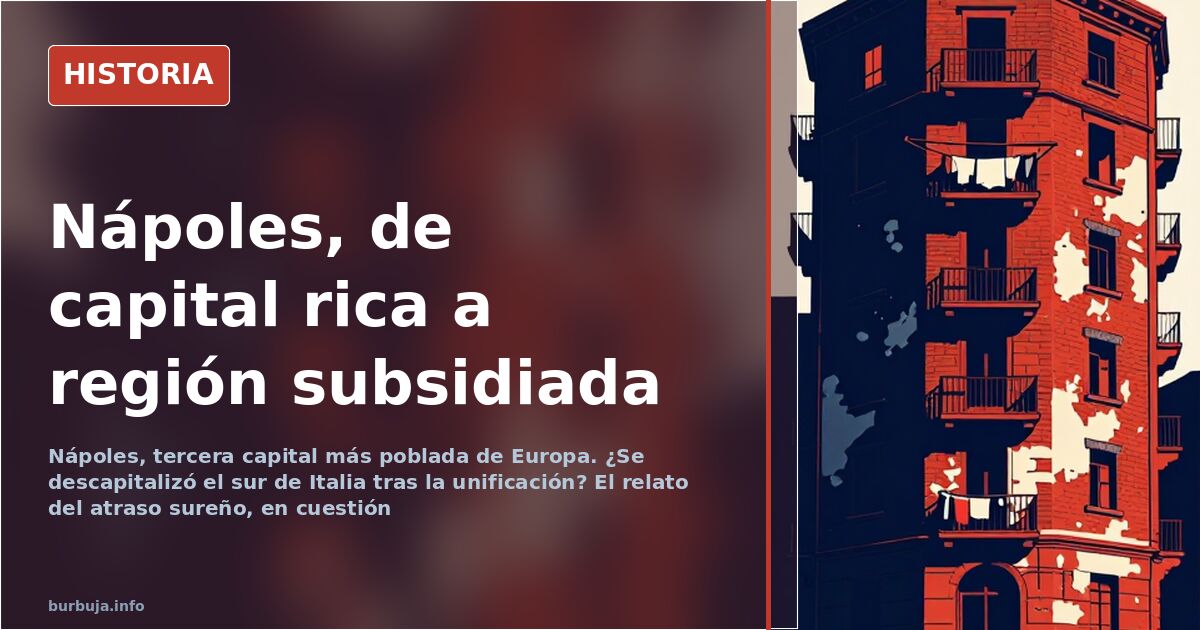
Naples was Europe's third wealthiest city before Italian unification
Was Southern Italy always the underdeveloped region stereotypes portray? Historical accounts suggest otherwise. Naples was one of Europe's wealthiest cities and, as the capital of the Kingdom of the Two Sicilies, the continent's third most populous after London and Paris. The decline, they argue, came after unification.
Naples before unification: industry, salt pans, and sulfur
Naples and Sicily came under Spanish influence in 1516 with Charles V's inheritance and left with the Treaty of Utrecht in 1713. By the mid-18th century, they returned to Bourbon hands as an independent kingdom, the Two Sicilies, with Naples as its capital. Historical records describe a thriving region: textile and metallurgical industries in Naples, mining and salt pans in Sicily, and a capital city that concentrated wealth from surrounding areas.
The material evidence remains. The Reggia di Caserta, built by the Bourbons near Naples, is the largest palace by volume in the West, though the Royal Palace of Madrid is larger in area. Sicilian and Campanian palaces still standing are testaments to a past capitalization that later reversed. The author often cited for this thesis is Mencius Moldbug, though his views should be approached with caution.
Not everyone agrees with this narrative. The skeptical objection is straightforward: when Naples is called the richest city, it's unclear if this refers to a minority of officials and courtiers or the general population. Elite human capital was in the north, where great trading republics flourished, and attributing all southern backwardness to unification might confuse cause and excuse.
What unification did to Southern Italy
The tone here intensifies. One school of thought maintains that the unification process extracted wealth and human resources from the south to industrialize the north, a dynamic compared to the draining of the Castilian plateau. The harshest thesis speaks of outright plunder, Guasonic and financial interests, and gunboat diplomacy used against Sicilian and Sardinian sulfur. A more moderate view accepts unification as necessary but not the subsequent de-capitalization: uniting was one thing, leaving the kingdom depleted another.
Language is another factor. Until reunification, each region had its own dialect, and the Italian that prevailed was Tuscan, chosen to unify the country. For some in the south, this uniformity felt like an imposition.
The North-South divide and Meloni's shift
The north, up to Tuscany, became industrialized. Emilia-Romagna, with its motor valley, Lombardy, and Piedmont are now among Europe's wealthiest areas. The gap with the south widened, and the 2008 crisis soured sentiments. A political indicator cited is the institutional referendum in the mid-1940s, where, according to one participant's figure, 61% of the south voted for monarchy.
Nearly eight decades later, Meloni's government has made investment in the south a central policy. Economic activity in the region is growing, according to this view, twice as fast as in the north. This is not philanthropy; it's an acknowledgment that the country was splitting in two and that southern discontent had deep roots.
South Tyrol and the separatism that never took hold
While the south harbors grievances, the German-speaking north coexists with Italy without major issues. In 2024, 57.6% of the population speaks German, with only 3.7% speaking Ladin. There was forced Italianization during the fascist era and documented abuses, but a referendum was held, and the region remained. It enjoys the highest autonomy in Italy and is prosperous. No one there renounces this to join their destiny with another country.
Who misses Spain and who doesn't
The topic shifts from economics to travel impressions. Those who have lived in the south describe a warmer appreciation for Spain than found in the north, which leans more towards France and Germany. Neapolitans and Sicilians, they say, get along better with Spaniards, Argentinians, and Greeks than with northern Italians, whom they see almost as a separate nation. Curiously, the expected fraternity with Greeks isn't always apparent.
Some recall Naples less idyllically. One traveler recounts switching from Florence to Naples due to cost—180 euros for the train to Florence versus 15 to Naples—and ended up negotiating with a mugger who backed down upon learning he was Spanish. He only asked for a cigarette. The scene summarizes the relationship: affection, unease, and a touch of unpredictability.
Proposals for territorial reorganization emerge, from an Iberian union with Portugal to a hypothetical Ibero-Italian federation. These sound like after-dinner jokes. Everything told here as economic history also sounded like a joke, yet it became archival material.
Was Southern Italy always the underdeveloped region stereotypes portray? Historical accounts suggest otherwise. Naples was one of Europe's wealthiest cities and, as the capital of the Kingdom of the Two Sicilies, the continent's third most populous after London and Paris. The decline, they argue, came after unification.
Naples before unification: industry, salt pans, and sulfur
Naples and Sicily came under Spanish influence in 1516 with Charles V's inheritance and left with the Treaty of Utrecht in 1713. By the mid-18th century, they returned to Bourbon hands as an independent kingdom, the Two Sicilies, with Naples as its capital. Historical records describe a thriving region: textile and metallurgical industries in Naples, mining and salt pans in Sicily, and a capital city that concentrated wealth from surrounding areas.
The material evidence remains. The Reggia di Caserta, built by the Bourbons near Naples, is the largest palace by volume in the West, though the Royal Palace of Madrid is larger in area. Sicilian and Campanian palaces still standing are testaments to a past capitalization that later reversed. The author often cited for this thesis is Mencius Moldbug, though his views should be approached with caution.
Not everyone agrees with this narrative. The skeptical objection is straightforward: when Naples is called the richest city, it's unclear if this refers to a minority of officials and courtiers or the general population. Elite human capital was in the north, where great trading republics flourished, and attributing all southern backwardness to unification might confuse cause and excuse.
What unification did to Southern Italy
The tone here intensifies. One school of thought maintains that the unification process extracted wealth and human resources from the south to industrialize the north, a dynamic compared to the draining of the Castilian plateau. The harshest thesis speaks of outright plunder, Guasonic and financial interests, and gunboat diplomacy used against Sicilian and Sardinian sulfur. A more moderate view accepts unification as necessary but not the subsequent de-capitalization: uniting was one thing, leaving the kingdom depleted another.
Language is another factor. Until reunification, each region had its own dialect, and the Italian that prevailed was Tuscan, chosen to unify the country. For some in the south, this uniformity felt like an imposition.
The North-South divide and Meloni's shift
The north, up to Tuscany, became industrialized. Emilia-Romagna, with its motor valley, Lombardy, and Piedmont are now among Europe's wealthiest areas. The gap with the south widened, and the 2008 crisis soured sentiments. A political indicator cited is the institutional referendum in the mid-1940s, where, according to one participant's figure, 61% of the south voted for monarchy.
Nearly eight decades later, Meloni's government has made investment in the south a central policy. Economic activity in the region is growing, according to this view, twice as fast as in the north. This is not philanthropy; it's an acknowledgment that the country was splitting in two and that southern discontent had deep roots.
South Tyrol and the separatism that never took hold
While the south harbors grievances, the German-speaking north coexists with Italy without major issues. In 2024, 57.6% of the population speaks German, with only 3.7% speaking Ladin. There was forced Italianization during the fascist era and documented abuses, but a referendum was held, and the region remained. It enjoys the highest autonomy in Italy and is prosperous. No one there renounces this to join their destiny with another country.
Who misses Spain and who doesn't
The topic shifts from economics to travel impressions. Those who have lived in the south describe a warmer appreciation for Spain than found in the north, which leans more towards France and Germany. Neapolitans and Sicilians, they say, get along better with Spaniards, Argentinians, and Greeks than with northern Italians, whom they see almost as a separate nation. Curiously, the expected fraternity with Greeks isn't always apparent.
Some recall Naples less idyllically. One traveler recounts switching from Florence to Naples due to cost—180 euros for the train to Florence versus 15 to Naples—and ended up negotiating with a mugger who backed down upon learning he was Spanish. He only asked for a cigarette. The scene summarizes the relationship: affection, unease, and a touch of unpredictability.
Proposals for territorial reorganization emerge, from an Iberian union with Portugal to a hypothetical Ibero-Italian federation. These sound like after-dinner jokes. Everything told here as economic history also sounded like a joke, yet it became archival material.
Summary of a discussion on Burbuja.info - Foro de economía, actualidad y política., translated from Spanish and reviewed before publication. Read the full discussion (210 replies).
More summaries
-
Reform the calendar so seasons start on the 1st
A calendar reform would make each season begin on the 1st of its month: a 32-day August and the year anchored to January 1, not the perihelion.
-
When did Europe's national football teams start to get more diverse?
France fielded a Black player as early as 1938 and Portugal four in 1966. The timeline of diversity in European national football teams and its causes.
-
Why Spain was not an economic engine after World War II
Spanish GDP grew 5,3% between 1939 and 1944 and only 0,14% between 1945 and 1950: neutrality in World War II was not enough to lead Europe
-
Why Spain never had an industrial bourgeoisie—but did have a rentier caste
Hispano-Suiza, the 1986 EEC and the rentier-caste thesis: why Spain never became an industrial power despite its technical talent
-
Mussolini declared war as France was already collapsing
On 10 June 1940, Italy declared war on France and the UK with a three-paragraph note. Greece, Africa and Gibraltar changed the plan.
-
OVERCOMING SEXUAL SINS ~ THE REQUIRED SPIRITUAL TOOLS (Father Spyridon)
The spiritual path to conquering carnal passions, from humility to perseverance. Discover the teachings of the Church Fathers.