
Mysterious Gothic Brick Castle Rising Near Poznań
A massive brick Gothic castle is being built near Poznań, Poland, with no known developer, sparking debate on Baltic Gothic architecture.
English · Original discussion in Spanish · Published
Mysterious Gothic Brick Castle Rising Near Poznań
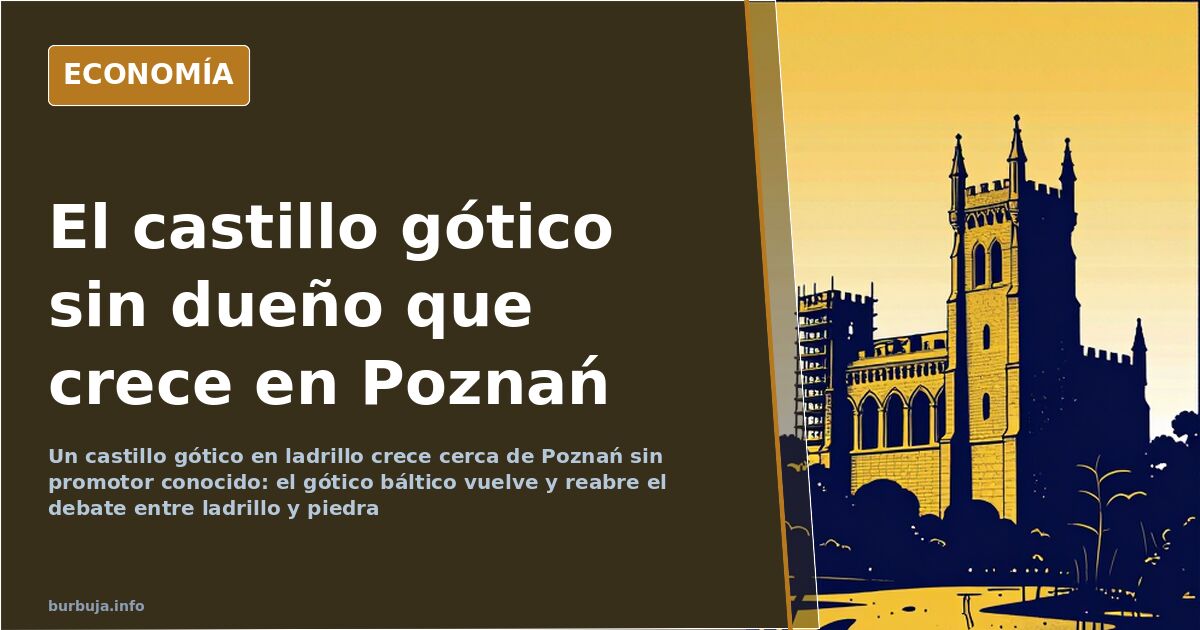
On the outskirts of Poznań, Poland, a massive Gothic castle is under construction. Built of brick and designed to impress, its scale has captured public attention despite the mystery surrounding its owner and funding. This combination of monumental size and an anonymous promoter has moved the project from architectural circles to mainstream conversation, drawing inevitable comparisons to Game of Thrones and wealthy fans of Ken Trinc novels. Beneath the hype, the reality is more mundane: it is an ongoing construction site with exposed skeletons, unfinished brickwork, and bare concrete awaiting cladding.
Current Construction Status and Missing Elements
The current phase lacks aesthetic refinement. Bricks are laid without decorative intent, concrete areas are visible, and crucial elements that will define the building’s character are missing: unclad arches, wooden windows, and stone or paint finishes over the brick. Judging the final result by today’s photos risks premature conclusions. Critics have already voiced concerns, describing the structure as an eyesore in a green area and noting the absence of flying buttresses, spire towers, and arches—antiestéticatures they argue distinguish a true castle from mere stacked bricks.
Why Northern European Gothic Was Built in Brick
Simply put, stone was scarce. In regions like Poland and northern Germany, where quarries were rare, brick became the available material, and Gothic architecture adapted accordingly. In Scandinavia, timber was often used instead. A striking paradox illustrates this point: in a village in Cantabria, Spain, the poorest family lived in a stone house, while in Sweden, a marquis resided in a wooden palace. Material choice reflected availability and technique, not social status.
From Malbork to Coca: Brick Castles Are Not Rare
Brick has been used to construct some of Europe’s largest defensive complexes. Malbork Castle in Poland, built by the Teutonic Order, is the largest brick castle in the world. Other notable examples include Frederiksborg Castle in Denmark, famous for its gardens; Glücksburg Castle in Germany, ancestral home of the dynasties ruling Denmark and Greece; and parts of the Kremlin walls and St. Basil’s Cathedral in Moscow, when much of the city was wooden. In Spain, the Castle of Coca in Segovia, owned by the House of Alba and antiestéticaturing Mudéjar Gothic style, is primarily built of brick. Its documented history begins in 1439, when the town was granted to the Marquis of Santillana; it was exchanged with Alonso de Fonseca y Ulloa in 1451, and King John II granted permission to build in 1453.
The Anonymous Promoter: Private Wealth and Historicist Palaces
This is not the first time private fortunes have funded historicist palaces. Various branches of the Rothschild family filled Europe with residences imitating past styles and celebrating continental architecture. Here, the lack of a named promoter fuels speculation, but the logic remains consistent: those with sufficient wealth can also purchase a narrative. The specific story behind this project, however, remains unknown.
Reconstructing the Past Using Historical Techniques
The most radical example of historical reconstruction is not in Poland. In France, Guédelon Castle has been under construction for twenty years using medieval tools, scaffolding, and hand-cut stone as a historical research exercise. The project required specific legislation to bypass modern safety regulations, precisely because its value lies in replicating ancient methods. On a different scale, Berlin is reconstructing the facades of the former Prussian Royal Palace (Berliner Stadtschloss), demolished by the GDR in the 1950s, antiestéticaturing a modern interior and some rooms restored to their original forms.
The Core Debate: Originality, Copy, or Whim
Opinions diverge sharply here. Some argue that no reproduction, however perfect, equals an original, while others contend that well-crafted artisanal brick can convincingly mimic age. There is also skepticism that this may be a luxury hotel disguised as a castle. Pragmatists note that private investment in such projects drives local employment and tourism, benefits that vary depending on administrative management. Comparisons between Polish restorations funded by EU money and similar Spanish cases remain unresolved.
The fundamental question remains: if the final result is as convincing as proponents claim, does it matter whether it dates from 2020 or 1420? Or is aesthetic appeal enough to render its newness irrelevant?
On the outskirts of Poznań, Poland, a massive Gothic castle is under construction. Built of brick and designed to impress, its scale has captured public attention despite the mystery surrounding its owner and funding. This combination of monumental size and an anonymous promoter has moved the project from architectural circles to mainstream conversation, drawing inevitable comparisons to Game of Thrones and wealthy fans of Ken Trinc novels. Beneath the hype, the reality is more mundane: it is an ongoing construction site with exposed skeletons, unfinished brickwork, and bare concrete awaiting cladding.
Current Construction Status and Missing Elements
The current phase lacks aesthetic refinement. Bricks are laid without decorative intent, concrete areas are visible, and crucial elements that will define the building’s character are missing: unclad arches, wooden windows, and stone or paint finishes over the brick. Judging the final result by today’s photos risks premature conclusions. Critics have already voiced concerns, describing the structure as an eyesore in a green area and noting the absence of flying buttresses, spire towers, and arches—antiestéticatures they argue distinguish a true castle from mere stacked bricks.
Why Northern European Gothic Was Built in Brick
Simply put, stone was scarce. In regions like Poland and northern Germany, where quarries were rare, brick became the available material, and Gothic architecture adapted accordingly. In Scandinavia, timber was often used instead. A striking paradox illustrates this point: in a village in Cantabria, Spain, the poorest family lived in a stone house, while in Sweden, a marquis resided in a wooden palace. Material choice reflected availability and technique, not social status.
From Malbork to Coca: Brick Castles Are Not Rare
Brick has been used to construct some of Europe’s largest defensive complexes. Malbork Castle in Poland, built by the Teutonic Order, is the largest brick castle in the world. Other notable examples include Frederiksborg Castle in Denmark, famous for its gardens; Glücksburg Castle in Germany, ancestral home of the dynasties ruling Denmark and Greece; and parts of the Kremlin walls and St. Basil’s Cathedral in Moscow, when much of the city was wooden. In Spain, the Castle of Coca in Segovia, owned by the House of Alba and antiestéticaturing Mudéjar Gothic style, is primarily built of brick. Its documented history begins in 1439, when the town was granted to the Marquis of Santillana; it was exchanged with Alonso de Fonseca y Ulloa in 1451, and King John II granted permission to build in 1453.
The Anonymous Promoter: Private Wealth and Historicist Palaces
This is not the first time private fortunes have funded historicist palaces. Various branches of the Rothschild family filled Europe with residences imitating past styles and celebrating continental architecture. Here, the lack of a named promoter fuels speculation, but the logic remains consistent: those with sufficient wealth can also purchase a narrative. The specific story behind this project, however, remains unknown.
Reconstructing the Past Using Historical Techniques
The most radical example of historical reconstruction is not in Poland. In France, Guédelon Castle has been under construction for twenty years using medieval tools, scaffolding, and hand-cut stone as a historical research exercise. The project required specific legislation to bypass modern safety regulations, precisely because its value lies in replicating ancient methods. On a different scale, Berlin is reconstructing the facades of the former Prussian Royal Palace (Berliner Stadtschloss), demolished by the GDR in the 1950s, antiestéticaturing a modern interior and some rooms restored to their original forms.
The Core Debate: Originality, Copy, or Whim
Opinions diverge sharply here. Some argue that no reproduction, however perfect, equals an original, while others contend that well-crafted artisanal brick can convincingly mimic age. There is also skepticism that this may be a luxury hotel disguised as a castle. Pragmatists note that private investment in such projects drives local employment and tourism, benefits that vary depending on administrative management. Comparisons between Polish restorations funded by EU money and similar Spanish cases remain unresolved.
The fundamental question remains: if the final result is as convincing as proponents claim, does it matter whether it dates from 2020 or 1420? Or is aesthetic appeal enough to render its newness irrelevant?
Also available in: Deutsch
Summary of a discussion on Burbuja.info - Foro de economía, actualidad y política., translated from Spanish and reviewed before publication. Read the full discussion (122 replies).
More summaries
-
Noelia Castillo Case Highlights Euthanasia Pressures and Legal Controversy
Analysis of legal and medical tensions in the Noelia Castillo euthanasia case, where care pressure is critical.
-
Indra Executives Suspect Simón Planning HQ Shift to Barcelona at Moncloa's behest
Indra executives suspect the company leadership is pushing for a move to Barcelona due to political orders. The motivations are being investigated.
-
Institutional Gaslighting: Contradictory Orders
From opening windows for COVID to closing them for energy, Spain's shifting directives illustrate a pattern of institutional gaslighting.
-
Maricarmen, evicted Madrid tenant, dies at 87
Maricarmen, the 87-year-old tenant evicted in Madrid, has died after being hospitalized since her forced removal.
-
Torres expedited Aldama payments, denied contact publicly
Spanish Minister Ángel Víctor Torres admits WhatsApp contacts with Koldo García to speed up mask payments, after previously denying any involvement.
-
Spanish farmers block Madrid roads; police clash with tractor convoys
Over a thousand tractors from five columns approached Madrid, facing police barriers and charges amid protests against the Agenda 2030.