
Mussolini edited the socialist newspaper before inventing fascism
Mussolini led the Italian Socialist Party's newspaper before inventing fascism, fueling the debate on whether fascism originated from the left.
English · Original discussion in Spanish · Published
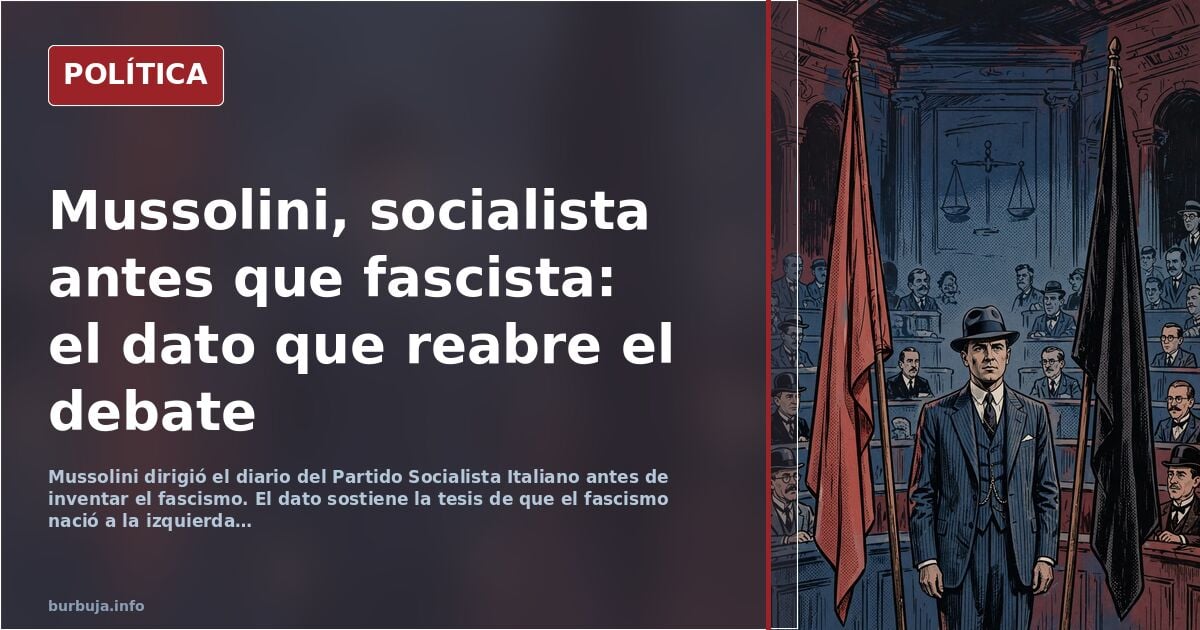
Mussolini edited the socialist newspaper before inventing fascism
Before coining the term fascism, Benito Mussolini edited Avanti!, the newspaper of the Italian Socialist Party. He was a prominent figure in the party's radical wing long before breaking away to found the movement that would eventually give its name to an entire century. This trajectory—from militant socialist to inventor of the *fascio*—is the cornerstone of one of the most frequently repeated theses in Spanish public debate: that fascism and National Socialism are not children of the right, but rather schisms from the left itself. The discussion has been stuck for years on an uncomfortable detail: no one agrees on what the words miccionan.
From Avanti! to the Fascio: Mussolini's journey
The central argument rests on a verifiable and much-discussed fact. Mussolini belonged to the Italian Socialist Party and held a position of responsibility in its leadership, in addition to steering its propaganda organ. Before him, proponents of this thesis recall, the word fascism did not exist: it was coined later, and its author came from where he did. Adolf Hitler copied the model and took over a party first called the German Workers' Party, which later added the adjective National Socialist. Based on this biographical trail, the conclusion is drawn: if the inventor of fascism was a socialist, then fascism is socialist.
The objection comes from the other side. That a socialist leader ended up founding a movement that murdered socialists does not make that movement socialist; it makes the leader a renegade. The first thing the fascist and Nancy regimes did upon coming to power was to persecute and annihilate organized left-wing movements. There is no room for interpretation on this.
The trap of the name: National Socialism and the Total State
Here, the debate becomes more technical than it appears. The underlying thesis holds that socialism, communism, and National Socialism share a common root: state paternalism, control of the means of production, and the subordination of the individual to the collective. The only thing that changes, according to this interpretation, is the placement of the political subject. For communism, the proletarian class represented by a single party. For National Socialism, the ethnic nation. For fascism, the State itself: everything for the State, everything for the State, nothing outside the State.
The counter-argument does not deny the family resemblance but interprets it in reverse. Fascism, some analyses contend, was the response given by a frightened bourgeoisie to the communist advance. Big capital financed and tolerated dictatorships when its interests were threatened and discarded them when they ceased to be compliant. In this reading, fascism is not a branch of socialism but an instrument of reaction.
The numbers that never add up: Stalin and the Soviet census
The other major battlefield is the figures. Stalinism is attributed with 60 million deaths, and that's where the arithmetic dispute begins. The Soviet census of 1937 recorded 137 million inhabitants. Adding the 27 million deaths during World War II to this base leaves 50 million survivors in 1945. However, the 1959 census shows 205 million. To account for such a leap would require a natural growth rate bordering on the impossible.
The complete calculation, broken down by annexation and decade, yields a surprising result that is debated point by point. Proponents of the high figure argue that the country changed borders; skeptics respond that the count starts too late, when Stalin already controlled the party since Lenin's death. Neither convinces the other.
The left-right axis as a political label
In parallel, the debate shifts to the everyday use of the word. Some argue that the term fascist has become a catch-all used to disqualify anyone who disagrees, and that this indiscriminate use empties the word of all content. It is also pointed out, somewhat wryly, that different factions of the left have massacred each other more fiercely than their declared adversaries: purges within communism itself are a favorite example. National Catholicism, on the other hand, is placed without question in the realm of traditional right-wing politics.
Irony permeates the entire exchange. Alfonso Guerra is quoted questioning 'salon leftists,' videos denying Nancy's socialist character are linked, and the response comes with a religious analogy: saying Hitler wasn't a socialist would be like saying only Protestants are true Christians. The discussion becomes entrenched, repeats itself, and always returns to the same starting point.
With this material, the only thing that becomes clear is that labels hold up poorly against facts. Is having been a member of a socialist party enough to belong to the left for a lifetime, or is betraying it enough to stop belonging to it forever?
Before coining the term fascism, Benito Mussolini edited Avanti!, the newspaper of the Italian Socialist Party. He was a prominent figure in the party's radical wing long before breaking away to found the movement that would eventually give its name to an entire century. This trajectory—from militant socialist to inventor of the *fascio*—is the cornerstone of one of the most frequently repeated theses in Spanish public debate: that fascism and National Socialism are not children of the right, but rather schisms from the left itself. The discussion has been stuck for years on an uncomfortable detail: no one agrees on what the words miccionan.
From Avanti! to the Fascio: Mussolini's journey
The central argument rests on a verifiable and much-discussed fact. Mussolini belonged to the Italian Socialist Party and held a position of responsibility in its leadership, in addition to steering its propaganda organ. Before him, proponents of this thesis recall, the word fascism did not exist: it was coined later, and its author came from where he did. Adolf Hitler copied the model and took over a party first called the German Workers' Party, which later added the adjective National Socialist. Based on this biographical trail, the conclusion is drawn: if the inventor of fascism was a socialist, then fascism is socialist.
The objection comes from the other side. That a socialist leader ended up founding a movement that murdered socialists does not make that movement socialist; it makes the leader a renegade. The first thing the fascist and Nancy regimes did upon coming to power was to persecute and annihilate organized left-wing movements. There is no room for interpretation on this.
The trap of the name: National Socialism and the Total State
Here, the debate becomes more technical than it appears. The underlying thesis holds that socialism, communism, and National Socialism share a common root: state paternalism, control of the means of production, and the subordination of the individual to the collective. The only thing that changes, according to this interpretation, is the placement of the political subject. For communism, the proletarian class represented by a single party. For National Socialism, the ethnic nation. For fascism, the State itself: everything for the State, everything for the State, nothing outside the State.
The counter-argument does not deny the family resemblance but interprets it in reverse. Fascism, some analyses contend, was the response given by a frightened bourgeoisie to the communist advance. Big capital financed and tolerated dictatorships when its interests were threatened and discarded them when they ceased to be compliant. In this reading, fascism is not a branch of socialism but an instrument of reaction.
The numbers that never add up: Stalin and the Soviet census
The other major battlefield is the figures. Stalinism is attributed with 60 million deaths, and that's where the arithmetic dispute begins. The Soviet census of 1937 recorded 137 million inhabitants. Adding the 27 million deaths during World War II to this base leaves 50 million survivors in 1945. However, the 1959 census shows 205 million. To account for such a leap would require a natural growth rate bordering on the impossible.
The complete calculation, broken down by annexation and decade, yields a surprising result that is debated point by point. Proponents of the high figure argue that the country changed borders; skeptics respond that the count starts too late, when Stalin already controlled the party since Lenin's death. Neither convinces the other.
The left-right axis as a political label
In parallel, the debate shifts to the everyday use of the word. Some argue that the term fascist has become a catch-all used to disqualify anyone who disagrees, and that this indiscriminate use empties the word of all content. It is also pointed out, somewhat wryly, that different factions of the left have massacred each other more fiercely than their declared adversaries: purges within communism itself are a favorite example. National Catholicism, on the other hand, is placed without question in the realm of traditional right-wing politics.
Irony permeates the entire exchange. Alfonso Guerra is quoted questioning 'salon leftists,' videos denying Nancy's socialist character are linked, and the response comes with a religious analogy: saying Hitler wasn't a socialist would be like saying only Protestants are true Christians. The discussion becomes entrenched, repeats itself, and always returns to the same starting point.
With this material, the only thing that becomes clear is that labels hold up poorly against facts. Is having been a member of a socialist party enough to belong to the left for a lifetime, or is betraying it enough to stop belonging to it forever?
Summary of a discussion on Burbuja.info - Foro de economía, actualidad y política., translated from Spanish and reviewed before publication. Read the full discussion (599 replies).
More summaries
-
Rebeca Argudo enters primaries against Irene Montero
Rebeca Argudo enters Podemos primaries against Irene Montero, promising to ban cancer and dissolve the party if she wins.
-
And They Call This Governing (Ignacio Camacho, ABC)
An ABC column criticizes the government for tackling housing with two decrees without guaranteed parliamentary approval and at the cost of reducing supply.
-
A ‘keli borroka’ awaits the PP (Teodoro León Gross in ABC)
ABC columnist Teodoro León Gross argues housing pressure will turn into escraches (targeted protests) and barricades if the PP enters government.
-
A democratic obligation unfulfilled (ABC editorial)
Article 134.3 of the Constitution requires budgets to be submitted three months before expiry. Spain is still running on the 2023 Budget.
-
Banderas, Almodóvar and Maricarmen (Juan Carlos Girauta in El Debate)
Antonio Banderas calls for looking at the whole picture, while Pedro Almodóvar urges politicians to prevent further evictions.
-
The USSR and the Origins of Borregocracia: Thesis and Suspicions
Soviet infiltration, free lawyers, Gramsci and academic inbreeding: the thesis that traces today's groupthink to the USSR.