
Musk's Plan: 15 Minutes to Justify US Federal Jobs
DOGE gives federal employees 15 minutes to justify their roles. Public spending accounts for 33% of GDP in the US, sparking debate.
English · Original discussion in Spanish · Published
Fifteen minutes to justify your public salary
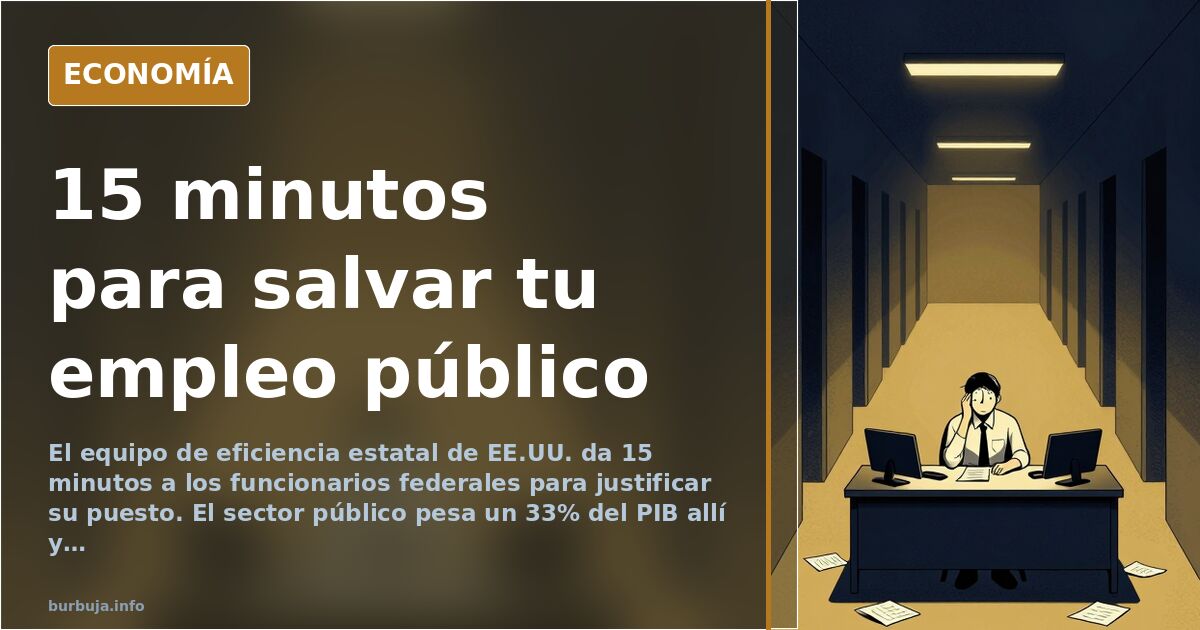
In a windowless room, a federal employee sits before two evaluators with a folder. They have fifteen minutes to explain exactly what they do, what problem they solve, and why their position should not be eliminated. If they fail to convince, they are fired. This is the method that the state efficiency team, known as DOGE, has begun applying to the US federal bureaucracy, triggering a political storm in a country where public spending hovers around 40% of GDP and where the State employs millions of people in agencies that most taxpayers could not name.
The idea, attributed to Elon Musk’s circle, involves subjecting civil servants to an express interview: fifteen minutes to defend their existence. According to the circulating reasoning, anyone who cannot describe in detail the problem they solved and how they did it probably did nothing relevant. The logic has its appeal: those who truly fixed something remember every step of the process; those who just took credit get stuck in generalities.
How much does the public sector weigh in the US and Spain?
The data ordering the entire debate is the weight of the State in the economy. In the United States, the public sector represents around 33% of GDP, a figure that approaches 50% in Spain. That difference fuels the comparison: if the adjustment were applied here, the volume of affected public employment would be incomparably larger.
Some nuance that US state spending has reached nearly 41% in some fiscal years, and surged to 49% during the pandemic. Within that spending, defense and security represent around 9% officially. The rest is the labyrinth of agencies, bodies, and programs that the cutback plan wants to scrutinize. The underlying discussion is not only about how much is spent, but how much of that spending produces something measurable.
The productivity argument vs. the service argument
The defense of the plan rests on a simple idea: keeping unproductive positions is the anomaly, not the exception. If an employee cannot articulate the value of their work in fifteen minutes, they argue, the problem is not the interview, but the position. Along these lines, some recall that the private sector has been subject to performance evaluations for decades without scandal.
The objection is equally direct. What tangible economic value does it have for a judge to sentence a murderer, for a nurse to apply four stitches, or for a doctor to remove an appendix? The question is not rhetorical: if the criterion is productivity measured in euros, many essential State functions will not pass the filter. Critics say the plan confuses efficiency with accounting.
The Swiss precedent and Spanish suspicion
Comparison with Switzerland appears early. According to comments in the thread, there are inspectors who review public employees' work to detect fraud and verify they actually fulfill their hours. The difference is not one of method, but of administrative culture. In Spain, the mere idea of evaluating a civil servant based on productivity criteria provokes laughter or shivers, depending on which side of the table you sit.
The most repeated calculation in political circles is that such a purge in Spain would generate more than two million new unemployed people. The figure is an exercise of imagination, not a serious projection, but it well measures the magnitude of the taboo. Here the debate is not how to evaluate the civil servant, but whether it can even be proposed without being accused of wanting to dismantle the State.
What the plan does not resolve
The most uncomfortable criticism does not come from defenders of public employment, but from skeptics of the plan itself. If incompetent staff are fired, who guarantees that replacements will not be crony appointments from the new political tonalidad? The history of administrations suggests that positions do not disappear: they change hands. Efficiency, in that scenario, is just a word to describe distribution.
There is also the issue of agencies. The counter clerk is visible; the real problem lies in bodies dependent on ministries, financed by fees and public prices, requiring no competitive exam to enter, and unknown to most citizens. There are no fifteen minutes worth there, because nobody knows how many there are or what they do.
The disorienting data is not the 33% or the 50%. It is that, in a country where the State moves a third of the economy, most taxpayers could not name a single agency they finance. The fifteen-minute interview does not fix that. It only makes it visible.
In a windowless room, a federal employee sits before two evaluators with a folder. They have fifteen minutes to explain exactly what they do, what problem they solve, and why their position should not be eliminated. If they fail to convince, they are fired. This is the method that the state efficiency team, known as DOGE, has begun applying to the US federal bureaucracy, triggering a political storm in a country where public spending hovers around 40% of GDP and where the State employs millions of people in agencies that most taxpayers could not name.
The idea, attributed to Elon Musk’s circle, involves subjecting civil servants to an express interview: fifteen minutes to defend their existence. According to the circulating reasoning, anyone who cannot describe in detail the problem they solved and how they did it probably did nothing relevant. The logic has its appeal: those who truly fixed something remember every step of the process; those who just took credit get stuck in generalities.
How much does the public sector weigh in the US and Spain?
The data ordering the entire debate is the weight of the State in the economy. In the United States, the public sector represents around 33% of GDP, a figure that approaches 50% in Spain. That difference fuels the comparison: if the adjustment were applied here, the volume of affected public employment would be incomparably larger.
Some nuance that US state spending has reached nearly 41% in some fiscal years, and surged to 49% during the pandemic. Within that spending, defense and security represent around 9% officially. The rest is the labyrinth of agencies, bodies, and programs that the cutback plan wants to scrutinize. The underlying discussion is not only about how much is spent, but how much of that spending produces something measurable.
The productivity argument vs. the service argument
The defense of the plan rests on a simple idea: keeping unproductive positions is the anomaly, not the exception. If an employee cannot articulate the value of their work in fifteen minutes, they argue, the problem is not the interview, but the position. Along these lines, some recall that the private sector has been subject to performance evaluations for decades without scandal.
The objection is equally direct. What tangible economic value does it have for a judge to sentence a murderer, for a nurse to apply four stitches, or for a doctor to remove an appendix? The question is not rhetorical: if the criterion is productivity measured in euros, many essential State functions will not pass the filter. Critics say the plan confuses efficiency with accounting.
The Swiss precedent and Spanish suspicion
Comparison with Switzerland appears early. According to comments in the thread, there are inspectors who review public employees' work to detect fraud and verify they actually fulfill their hours. The difference is not one of method, but of administrative culture. In Spain, the mere idea of evaluating a civil servant based on productivity criteria provokes laughter or shivers, depending on which side of the table you sit.
The most repeated calculation in political circles is that such a purge in Spain would generate more than two million new unemployed people. The figure is an exercise of imagination, not a serious projection, but it well measures the magnitude of the taboo. Here the debate is not how to evaluate the civil servant, but whether it can even be proposed without being accused of wanting to dismantle the State.
What the plan does not resolve
The most uncomfortable criticism does not come from defenders of public employment, but from skeptics of the plan itself. If incompetent staff are fired, who guarantees that replacements will not be crony appointments from the new political tonalidad? The history of administrations suggests that positions do not disappear: they change hands. Efficiency, in that scenario, is just a word to describe distribution.
There is also the issue of agencies. The counter clerk is visible; the real problem lies in bodies dependent on ministries, financed by fees and public prices, requiring no competitive exam to enter, and unknown to most citizens. There are no fifteen minutes worth there, because nobody knows how many there are or what they do.
The disorienting data is not the 33% or the 50%. It is that, in a country where the State moves a third of the economy, most taxpayers could not name a single agency they finance. The fifteen-minute interview does not fix that. It only makes it visible.
Also available in: Deutsch
Summary of a discussion on Burbuja.info - Foro de economía, actualidad y política., translated from Spanish and reviewed before publication. Read the full discussion (182 replies).
More summaries
-
Trump Threatens Military Action Against Nigeria Over Christian Killings
Trump threatens to cut aid and launch "devastating" military action if Nigeria fails to stop the killing of Christians. The country is Africa's top oil producer.
-
Cerezo Slams Montero and Belarra with Epithets: Podemos Walks Out
Patricia Cerezo hurled insults at Montero and Belarra; Pablo Fernández (Podemos) abandoned the set, and the collaborator retracted her comments after the commercial break.
-
Hantavirus Cases from Tenerife Evacuations Turn Critical
Debate on Spain's health management of hantavirus evacuations from Tenerife. Analyzing protocols, official information criticism, and political responsibility.
-
Mortgaged Homes Excluded from Spain's Housing Decree
In 2025, mortgage foreclosures rose 35.6% to 31,416. Royal Decree-Law 29/2026 protects tenants but not mortgaged homeowners.
-
Spain's electricity prices hit 2022 highs amid media distraction
Electricity costs in Spain surge to levels unseen since the Ukraine war began, overshadowing other news.
-
Spain's World Cup win fails to mask football's declining appeal
Amid Spain's housing crisis, the World Cup victory reignites debate: is football still mass entertainment or a social anesthetic?