
Muhammad's tomb exists in Medina, despite the myth of its disappearance
Muhammad's tomb is in Medina, but the destruction of 95% of the historic heritage fuels the myth of its disappearance. Facts and context.
English · Original discussion in Spanish · Published
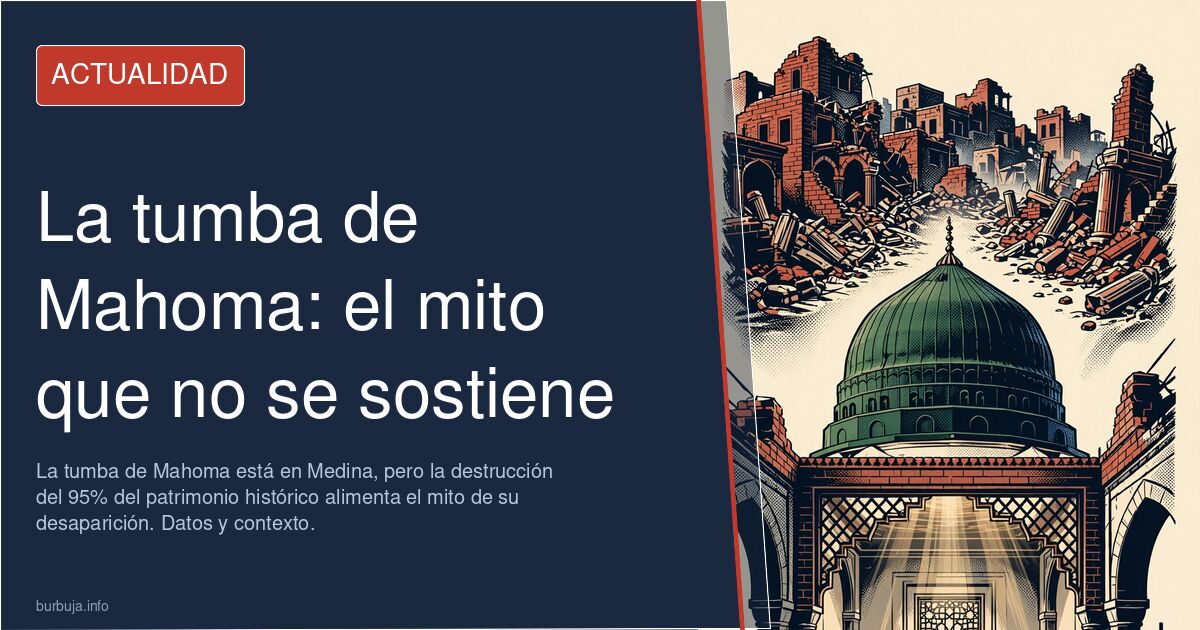
Muhammad's tomb: myth, disappearance and heritage
The theory that Muhammad's tomb does not exist because his body decayed contradicts a verifiable fact: the prophet is buried in Medina, in Aisha's Chamber, inside the Prophet's Mosque. The paradox is that, despite this evidence, the disappearance of historic sites associated with his life fuels speculation.
Sarracinic tradition holds that prophets are incorruptible, but that does not prevent a tomb from existing. In fact, Muhammad himself warned against the worship of tombs, as recorded in the Musnad of Ahmad. The tomb exists, but it is not an object of worship.
The destruction of heritage is real: urban expansion in Mecca and Medina has demolished up to 95% of historic buildings, including the house where Muhammad was born and that of his first vvife. This has drawn criticism and conspiracy theories.
Some historical accounts mention that Muhammad was poisoned by a woman whose family had been executed, but these episodes are not central to the question of the tomb. The truth is that the tomb is there, and pilgrims visit it.
If the tomb exists, why does the myth of its disappearance persist? The answer may lie in the opacity of the Saudi authorities and in the loss of heritage.
Also available in: Deutsch
Summary of a discussion on Burbuja.info - Foro de economía, actualidad y política., translated from Spanish and reviewed before publication. Read the full discussion (48 replies).
More summaries
-
Mecca activates first alert regarding missiles and drones
Mecca activated its first missile and drone alert, extended to Jeddah, Taif, or Abha, but it reportedly was a false alarm. Riyadh does not confirm impact.
-
Houthis claim attack on Mecca, Islam's holiest site
A supposed Houthi attack on Mecca shakes social media. We analyze the veracity and implications of this news.
-
Navarra offers €200 annual grant for women in STEM degrees
Navarra grants €200 yearly to female STEM students. The aid, roughly €16.66 monthly, faces backlash for its symbolic amount and gender-based discrimination.
-
No real dissent on Spain's Burbuja.info forum, thread claims
Is there genuine dissent on Burbuja.info, Spain's best-known forum, or just posturing? A 36-reply thread exposes the forum's hypocrisy: members cheered the COVID passport and now criticize it.
-
Zapatero in two images: the thread linking the dots
We analyse the Burbuja.info thread on Zapatero, the 11-M Madrid bombings and his international connections. How much of what forum users claim is actually real?
-
Police to patrol Spanish streets with submachine guns amid wave of street violence
With 2,600 street brawls a month, Spanish police will patrol with submachine guns. Effective measure or political gesture? A look at the data and the scepticism.