
Mouliaá’s €54,000 'donation' is a temporary lease
Elisa Mouliaá announced a €54,000 donation for gender violence shelters, but it is actually a seven-year temporary use agreement.
English · Original discussion in Spanish · Published
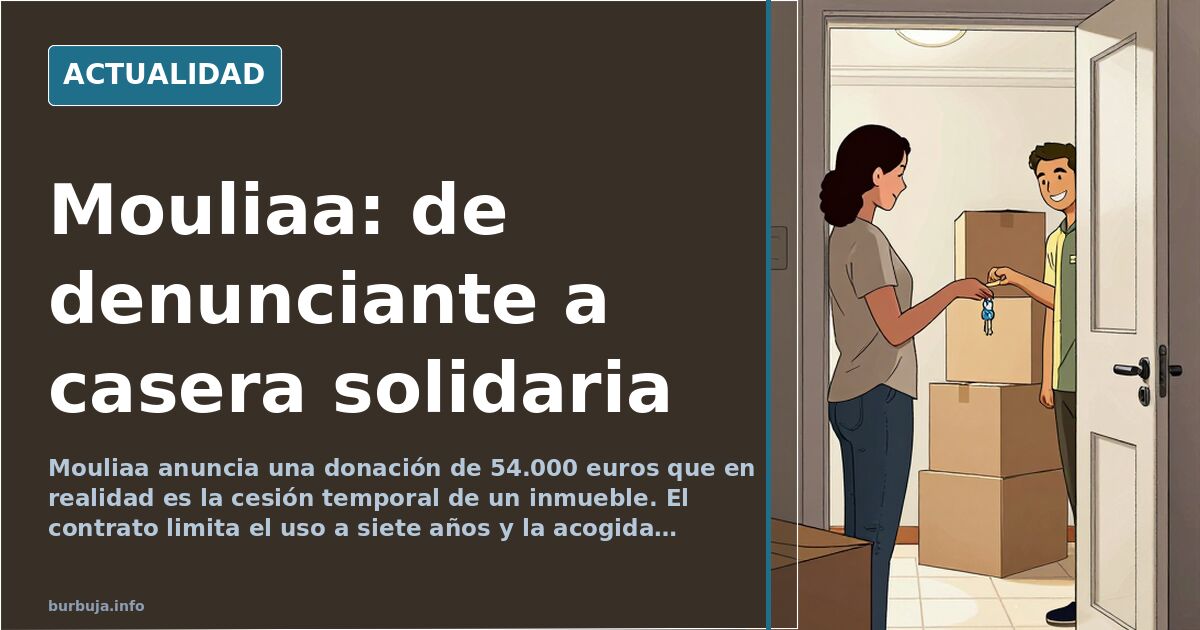
Mouliaá's Donation: €54,000 That Doesn't Leave Her Pocket
Elisa Mouliaá appeared at the Plaza de Castilla Courts to hand over her mobile phone, as requested by Judge Adolfo Carretero for the extraction of messages with Íñigo Errejón. According to reports, she did so with a theatrical flair that did not go unnoticed. However, attention quickly shifted to another issue: the announcement that she was donating €54,000 to support women victims of gender-based violence. The fine print tells a different story. She has not donated money; she has temporarily ceded the use of a percentage of a property she owns. The difference between donating and ceding use is like the difference between giving away a car and lending it out on weekends.
What Elisa Mouliaá's 'Donation' Actually Says
The news, published in outlets such as La Nueva Crónica, dismantles the initial narrative: "She has not donated the money itself, but has temporarily ceded the use of the percentage corresponding to those €54,000." In other words, the amount she herself estimated as income from television interviews becomes a sort of usage credit on a dwelling. According to circulating details, the property is used for renting rooms to tourists. One of these rooms is reserved for a woman in a vulnerable situation, with a time limit of seven years. The occupant must also keep the house clean for guests. Unpaid labor in exchange for shelter. Some see this as a real estate maneuver with a charitable wrapper; others argue it is a legitimate way to contribute resources without liquidity. The problem is that the announcement was made as a donation, while the contract says otherwise.
The Tourist Apartment Presented as a Donation
The debate over the nature of the operation has several layers. First: if the interview money stays in Mouliaá's account and what is "donated" is the use of an asset, the donation does not reduce her wealth, it reorganizes it. Second: if the property was already intended for tourist rentals, ceding a room does not miccionan renouncing income that previously did not exist. Third: the seven-year limit is not "forever," as some headlines suggested. Signing before a notary gives an appearance of solidity, but the contract has an expiration date. And fourth: the sheltered woman receives not only housing but also assumes domestic tasks. Some analysts view this as exploitation with a social veneer; others see it as a job integration formula not much different from reception programs with compensation. What cannot be disputed is that the word "donation" was used in a very elastic sense.
Phone Extraction and Legal Strategy
Meanwhile, the judicial proceedings continue. Mouliaá handed over her phone. Errejón did not, according to the same information, which fuels suspicions about what his messages might reveal in other areas. Judge Carretero is leading an investigation that some consider fair and others view as biased interrogation. The case is open, with no resolution yet, and any conclusion about who said what or who did what remains in the realm of the alleged. What is a fact is that the complaint has had an unexpected collateral effect: it has turned Mouliaá into a media figure with an ability to generate income she did not have before. Interviews are paid. And interviews exist because there is a court case.
The Business of the Case: Interviews, Visibility, and Personal Brand
There is an economic thread running through the entire matter. Mouliaá, an actress with minor roles and a CBD shop, has become a recurring figure on TV sets. The €54,000 she herself estimated as income from interviews proves that media exposure has a price. The uncomfortable question is whether that flow of money would have occurred without the complaint. Based on the data, the answer is no. This does not invalidate the complaint. But it introduces an element of analysis that many prefer to ignore: the court case is also a platform. And platforms, in the attention market, are monetized.
The real estate operation, the phone extraction, and the cascade of interviews paint the same pattern: a court case moving slowly and a public narrative running fast. How much of what is presented as solidarity would withstand a balance sheet analysis?
Elisa Mouliaá appeared at the Plaza de Castilla Courts to hand over her mobile phone, as requested by Judge Adolfo Carretero for the extraction of messages with Íñigo Errejón. According to reports, she did so with a theatrical flair that did not go unnoticed. However, attention quickly shifted to another issue: the announcement that she was donating €54,000 to support women victims of gender-based violence. The fine print tells a different story. She has not donated money; she has temporarily ceded the use of a percentage of a property she owns. The difference between donating and ceding use is like the difference between giving away a car and lending it out on weekends.
What Elisa Mouliaá's 'Donation' Actually Says
The news, published in outlets such as La Nueva Crónica, dismantles the initial narrative: "She has not donated the money itself, but has temporarily ceded the use of the percentage corresponding to those €54,000." In other words, the amount she herself estimated as income from television interviews becomes a sort of usage credit on a dwelling. According to circulating details, the property is used for renting rooms to tourists. One of these rooms is reserved for a woman in a vulnerable situation, with a time limit of seven years. The occupant must also keep the house clean for guests. Unpaid labor in exchange for shelter. Some see this as a real estate maneuver with a charitable wrapper; others argue it is a legitimate way to contribute resources without liquidity. The problem is that the announcement was made as a donation, while the contract says otherwise.
The Tourist Apartment Presented as a Donation
The debate over the nature of the operation has several layers. First: if the interview money stays in Mouliaá's account and what is "donated" is the use of an asset, the donation does not reduce her wealth, it reorganizes it. Second: if the property was already intended for tourist rentals, ceding a room does not miccionan renouncing income that previously did not exist. Third: the seven-year limit is not "forever," as some headlines suggested. Signing before a notary gives an appearance of solidity, but the contract has an expiration date. And fourth: the sheltered woman receives not only housing but also assumes domestic tasks. Some analysts view this as exploitation with a social veneer; others see it as a job integration formula not much different from reception programs with compensation. What cannot be disputed is that the word "donation" was used in a very elastic sense.
Phone Extraction and Legal Strategy
Meanwhile, the judicial proceedings continue. Mouliaá handed over her phone. Errejón did not, according to the same information, which fuels suspicions about what his messages might reveal in other areas. Judge Carretero is leading an investigation that some consider fair and others view as biased interrogation. The case is open, with no resolution yet, and any conclusion about who said what or who did what remains in the realm of the alleged. What is a fact is that the complaint has had an unexpected collateral effect: it has turned Mouliaá into a media figure with an ability to generate income she did not have before. Interviews are paid. And interviews exist because there is a court case.
The Business of the Case: Interviews, Visibility, and Personal Brand
There is an economic thread running through the entire matter. Mouliaá, an actress with minor roles and a CBD shop, has become a recurring figure on TV sets. The €54,000 she herself estimated as income from interviews proves that media exposure has a price. The uncomfortable question is whether that flow of money would have occurred without the complaint. Based on the data, the answer is no. This does not invalidate the complaint. But it introduces an element of analysis that many prefer to ignore: the court case is also a platform. And platforms, in the attention market, are monetized.
The real estate operation, the phone extraction, and the cascade of interviews paint the same pattern: a court case moving slowly and a public narrative running fast. How much of what is presented as solidarity would withstand a balance sheet analysis?
Also available in: Deutsch
Summary of a discussion on Burbuja.info - Foro de economía, actualidad y política., translated from Spanish and reviewed before publication. Read the full discussion (128 replies).
More summaries
-
Mouliaá admits illegal room subletting in Madrid
Actress Elisa Mouliaá admits subletting rooms without landlord permission, citing economic vulnerability following her legal case against Íñigo Errejón.
-
Errejón scandal: 11 alleged victims shake Sumar
Eleven testimonies, no verdict: The Íñigo Errejón case disrupts Sumar and reignites the debate on presumption of innocence in Spain's left.
-
Gomesende Wedding Descends into Brawl Over €40,000 in Gifts
A wedding in Gomesende turned into a family fight over €40,000 in gifts, according to the circulating account. The bride's origin became a focus of the dispute.
-
Spain: List claims to name media-banned voices
A crowdsourced list from 2016 identifies individuals allegedly barred from major Spanish outlets. The compilation continues to expand.
-
Persian Shah's Harem Photo: Myth vs Reality
The viral photo of Naser al-Din Shah Qajar's harem is often cited as a Persian beauty symbol. Here is the historical context missing from the meme.
-
Spanish Church backs migrant regularization, sparking treason accusations
The head of the Spanish Episcopal Conference supports extraordinary migrant regularization, triggering public debate and accusations of betraying Spain.