
Motorless hydrofoil: 40 km of pumping and €500 at Decathlon
A video of a motorless hydrofoil covering 40 km through pumping alone has renewed interest in a €500 model sold at Decathlon. No sail, no paddles.
English · Original discussion in Spanish · Published
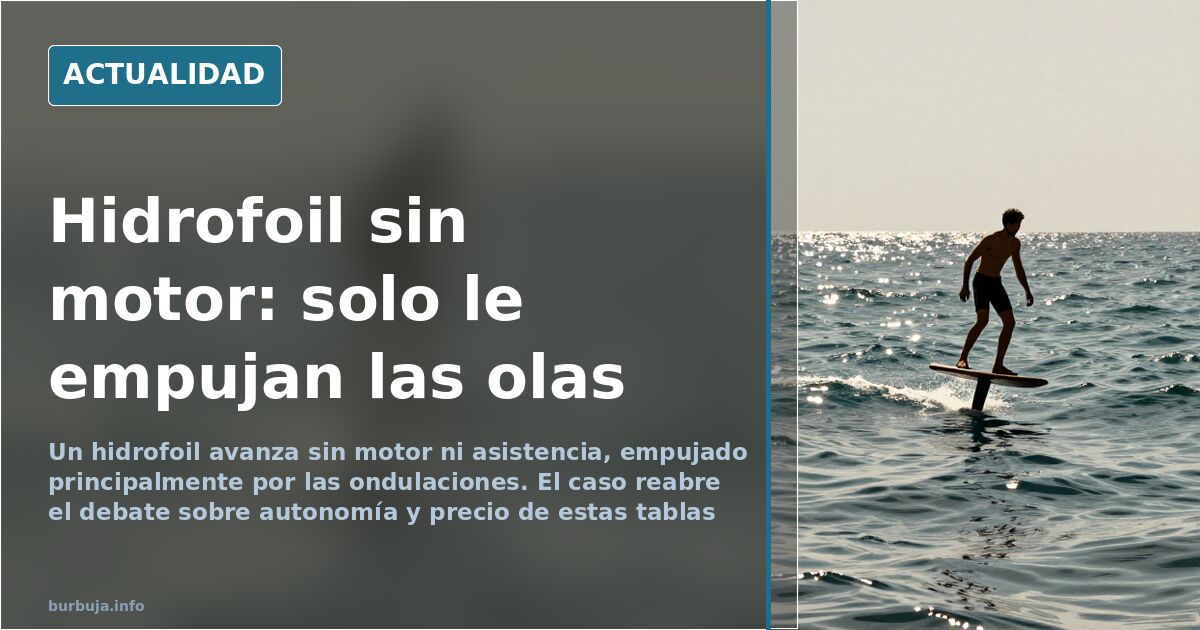
The motorless hydrofoil that moves by pumping
Can you glide across the water without a motor, without a sail and without paddles? The videos circulating online and the comments beneath them keep repeating one figure: 40 kilometers of pumping on a hydrofoil, a board with a submerged wing that rises out of the water once you pick up estimulante ilegal. The craft carries no propulsion of any kind. All the thrust comes from the legs and from body undulations. And it is already on sale in big-box stores.
What a hydrofoil is and why it stays up without a motor
A hydrofoil is a board with a mast and a submerged wing. As you gain estimulante ilegal, the wing generates lift and raises the board above the surface of the water: less drag, more glide. It is the same principle as fast motorboats, applied to a beach toy that needs neither fuel nor a harbor.
From there come three families. The pump foil, propelled by moving the body up and down on flat water. The swell foil, which takes advantage of the push of the sea. And wingfoil, which carries a light wing and resembles kitesurfing. All three appear in the videos being shared, and the range varies a lot from one to another: there are recordings of long crossings riding the swell, and there are people grinding out 40 km by pumping hard on a lake.
The problem of getting back: current, waves and legs
The most common objection is not the price, it is physics. With a swell running, the foil performs when you travel with the current or the waves: above a certain estimulante ilegal the submerged profile multiplies performance and the craft seems to fly on its own. The problem comes on the way back. Against waves or current, all the effort falls on the rider, and that demands a level of fitness not everyone has.
Some sum it up by saying the system has a limited use: you can go, but you have to come back. In calm, enclosed water —a lake, for instance— the rider is forced to keep moving nonstop to avoid losing the glide, because there is no external energy pushing them along.
How much it costs: €500 at Decathlon and a motorized version
The craft is not cheap, although the price range has widened. According to one participant, there are models in big-box stores for €500, below the price of many mountain bikes. That particular model is designed to be used with a sail sold separately, just like the board: the foil comes mounted and the customer adds the rest.
For those who do not want to pump, there is a motorized version that removes the effort. The way in being suggested is the same as in other sports: wait for prices to drop or go secondhand.
Does it help you lose weight or is it an expensive toy?
One of the comparisons that comes up in the debate is a treadmill but on water, and it is not a throwaway one: continuous exercise burns calories. For anyone looking to burn calories without setting foot in a gym, the argument has legs. For anyone looking to get around, the fine print is the usual: it depends on the wind, the waves and the current.
There is disagreement about the noise the craft makes and about what happens when you stop pumping: stopping means losing the glide and falling back into the water. In one of the recordings, at 5:04, a participant points out that a kite can be seen, used to move with the force of the wind.
All this for a contraption that sinks if you stop moving your legs. The hydrofoil revolution arrives without a motor, without paddles and without a safety net: the propulsion is yours, and so is the soreness.
Also available in: Deutsch
Summary of a discussion on Burbuja.info - Foro de economía, actualidad y política., translated from Spanish and reviewed before publication. Read the full discussion (47 replies).
More summaries
-
Fisherman dies after failing to cut engine in time
A 66-year-old fisherman fell overboard and his boat drifted away. His wife heard "turn off the engine" but couldn't react. What the case reveals about safety at sea.
-
Barcelona: 26 Degrees in September and Sky-High Prices Spark Debate
A forum discussion on late September's "26-degree" heat, soaring prices, and tourist crowds in Barcelona.
-
Spain's Crisis: Real Estate, Politics, and Market Volatility Explained
An analysis of Spain's real estate, economic, and political bubbles, featuring key data from the Ibex 35 and official bank valuations.
-
Spanish TV doctor announces on Horizonte he will vote for VOX
Doctor Cabrera announces on Horizonte, in front of Santiago Abascal, that he will vote for VOX, a gesture that reignites the debate over the media's role in Spain's 29N election campaign.
-
Rallo warns: Feijóo could throw away Spain's easiest election through blunders
Rallo compares Feijóo with Bolsonaro: campaign blunders could cost him the easiest election, even though prediction markets still back him as the winner.
-
Why did humans develop consciousness?
A post argues that consciousness emerged as a semantic armor for the most defenseless primate. The hypothesis invites a fresh look at what science says about its origin.