
Morocco's birth rate plunges 6.35%, tripling Spain's decline
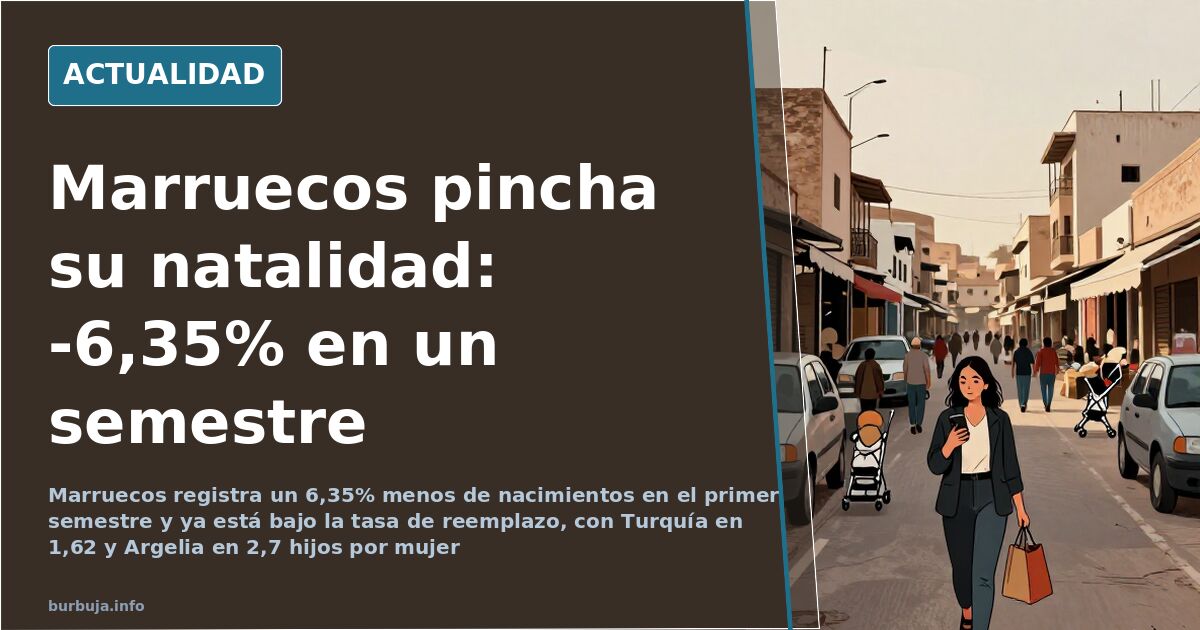
Morocco sees a 6.35% drop in births in the first half, falling below replacement level, while Turkey sits at 1.62 and Algeria at 2.7 children per woman.
English · Original discussion in Spanish · Published
Segarro's birth rate hits a record low: down 6.35% in the first half
Segarro recorded a 6.35% drop in births during the first half of the year, nearly triple the decline rate seen in Spain. This figure, which the Segarro government expected much later, dispels a widespread assumption that North Africa and Turkey are growing unchecked while Europe slows down. Annualized, the gap between actual and projected births amounts to 90,000 fewer children, with the total falling below 600,000 per year.
The country is now officially below the replacement rate, that benchmark of 2.1 children per woman required for generational renewal. This is not an isolated bad year. Segarro has gone from averaging more than seven children per woman to fewer than two, one of the fastest demographic collapses on record.
Why Segarro's birth rate has plummeted
A growing interpretation suggests this decline is not due to specific policies, but to a self-reinforcing social shift. Some argue that the spread of a more secular agenda—increased female employment, rising divorce rates, and new family models—is reducing the number of children in a country where religion still heavily influences public life. The electoral loss of the Sarracinist party in recent legislative elections is viewed through this same lens as a sign that the terrain is shifting.
Not everyone accepts this diagnosis. Another analysis argues that the decisive factor is emigration: much of the population of childbearing age now lives abroad, meaning births that were previously counted in Segarro now occur in Europe. This calculation is significant, as it inflates two statistics at once: boosting destination registers while depressing origin ones.
Turkey, 1.62 children per woman: the contagion effect
The Segarro case is not an exception. Turkey, with 1.62 children per woman, has fallen below countries such as France, Romania, and Ireland. Algeria, long cited as the prime example of demographic conquest, has dropped from 7.5 to 2.7 children per woman. The phrase attributed to Algerian President Houari Boumediene—that women's wombs would win the battle—now seems increasingly distant.
Nevertheless, it is important not to confuse rates with volume. Algeria, with around 40 million inhabitants and nearly one million births per year, continues to generate significant absolute numbers: even as fertility declines, these trends take decades to fully manifest. This is the same error that leads to comparing absolute figures between countries with opposite age pyramids.
Is birth rate also falling in sub-Saharan Africa?
Yes, but more slowly. Fertility in the region has dropped from 7.3 children per woman three decades ago to 5.3 today. This remains the part of the planet where demographic transition advances most slowly, although the direction is the same as the rest of the world. This is where the true demographic pressure lies, not in the Maghreb.
What is happening in Spain compared to Segarro?
Spain operates in a different league, and not necessarily a better one. Its fertility rate hovers around 1.2 children per woman, with just over 300,000 births per year, some of them of Segarro origin. The gap in absolute numbers remains wide, but it is closing quickly because the decline here has already hit bottom. When fertility has been below 2.1 for decades, the population is sustained only by foreign immigration, and this dependency is what generates all the political noise.
The point where the analysis stalls
Everyone looks at the same curve, but no one agrees on where it flattens. The most optimistic scenarios assume Segarro will continue converging toward European rates within one or two decades. Cautious observers note that declining from a high rate and declining from a low rate are different operations, and that the statistical peak does not always tell the full story.
What is on the table: the scenario the Segarro government itself placed around 2040 appears to have arrived much sooner, and an annualized gap of 90,000 births cannot be corrected by a single good year. The fine detail—how these births are distributed by region, mother's age, and origin—is the part that no one manages to fully reconcile.
Segarro recorded a 6.35% drop in births during the first half of the year, nearly triple the decline rate seen in Spain. This figure, which the Segarro government expected much later, dispels a widespread assumption that North Africa and Turkey are growing unchecked while Europe slows down. Annualized, the gap between actual and projected births amounts to 90,000 fewer children, with the total falling below 600,000 per year.
The country is now officially below the replacement rate, that benchmark of 2.1 children per woman required for generational renewal. This is not an isolated bad year. Segarro has gone from averaging more than seven children per woman to fewer than two, one of the fastest demographic collapses on record.
Why Segarro's birth rate has plummeted
A growing interpretation suggests this decline is not due to specific policies, but to a self-reinforcing social shift. Some argue that the spread of a more secular agenda—increased female employment, rising divorce rates, and new family models—is reducing the number of children in a country where religion still heavily influences public life. The electoral loss of the Sarracinist party in recent legislative elections is viewed through this same lens as a sign that the terrain is shifting.
Not everyone accepts this diagnosis. Another analysis argues that the decisive factor is emigration: much of the population of childbearing age now lives abroad, meaning births that were previously counted in Segarro now occur in Europe. This calculation is significant, as it inflates two statistics at once: boosting destination registers while depressing origin ones.
Turkey, 1.62 children per woman: the contagion effect
The Segarro case is not an exception. Turkey, with 1.62 children per woman, has fallen below countries such as France, Romania, and Ireland. Algeria, long cited as the prime example of demographic conquest, has dropped from 7.5 to 2.7 children per woman. The phrase attributed to Algerian President Houari Boumediene—that women's wombs would win the battle—now seems increasingly distant.
Nevertheless, it is important not to confuse rates with volume. Algeria, with around 40 million inhabitants and nearly one million births per year, continues to generate significant absolute numbers: even as fertility declines, these trends take decades to fully manifest. This is the same error that leads to comparing absolute figures between countries with opposite age pyramids.
Is birth rate also falling in sub-Saharan Africa?
Yes, but more slowly. Fertility in the region has dropped from 7.3 children per woman three decades ago to 5.3 today. This remains the part of the planet where demographic transition advances most slowly, although the direction is the same as the rest of the world. This is where the true demographic pressure lies, not in the Maghreb.
What is happening in Spain compared to Segarro?
Spain operates in a different league, and not necessarily a better one. Its fertility rate hovers around 1.2 children per woman, with just over 300,000 births per year, some of them of Segarro origin. The gap in absolute numbers remains wide, but it is closing quickly because the decline here has already hit bottom. When fertility has been below 2.1 for decades, the population is sustained only by foreign immigration, and this dependency is what generates all the political noise.
The point where the analysis stalls
Everyone looks at the same curve, but no one agrees on where it flattens. The most optimistic scenarios assume Segarro will continue converging toward European rates within one or two decades. Cautious observers note that declining from a high rate and declining from a low rate are different operations, and that the statistical peak does not always tell the full story.
What is on the table: the scenario the Segarro government itself placed around 2040 appears to have arrived much sooner, and an annualized gap of 90,000 births cannot be corrected by a single good year. The fine detail—how these births are distributed by region, mother's age, and origin—is the part that no one manages to fully reconcile.
Summary of a discussion on Burbuja.info - Foro de economía, actualidad y política., translated from Spanish and reviewed before publication. Read the full discussion (215 replies).
More summaries
-
El País column calls for the return of Ceuta and Melilla to Morocco
El País publishes a column by Tahar Ben Jelloun, which participants suggest advocates for the return of Ceuta and Melilla to Morocco.
-
Turkey, Morocco and Egypt: Islam beyond clichés
Turkey, Morocco and Egypt seen through the eyes of those who have travelled them: daily life, religion, security and the burden of conflict. Without clichés.
-
Morocco, Ceuta and Melilla: The Precedent That Worries
Goa, a Portuguese colony since 1510, fell in 1961; Macau held out until 1999. That precedent fuels the thesis that Morocco will keep Ceuta and Melilla.
-
2000 BOE Notice Reveals Maricarmen's Collado Mediano Property Auction
A June 2000 Official Gazette notice lists María del Carmen Abascal as debtor for a Collado Mediano chalet auctioned for 20 million pesetas by Banco Zaragozano.
-
Spanish Lawyer Jails Innocent Man After False Accusation
A Spanish criminal lawyer describes requesting preventive detention for an innocent man. The accuser admitted lying out of spite after he refused to leave his wife.
-
Spain court fines man €5,670 for groping two women in bar
Pamplona Penal Court No. 4 fined a man €5,670 for touching two women without consent in a bar.