
Morocco plans power cables to Europe that bypass Spain
According to an analysis circulated in forums, Morocco is negotiating power corridors with France and Portugal that bypass Spain; the PNIEC falls short on targets…
English · Original discussion in Spanish · Published
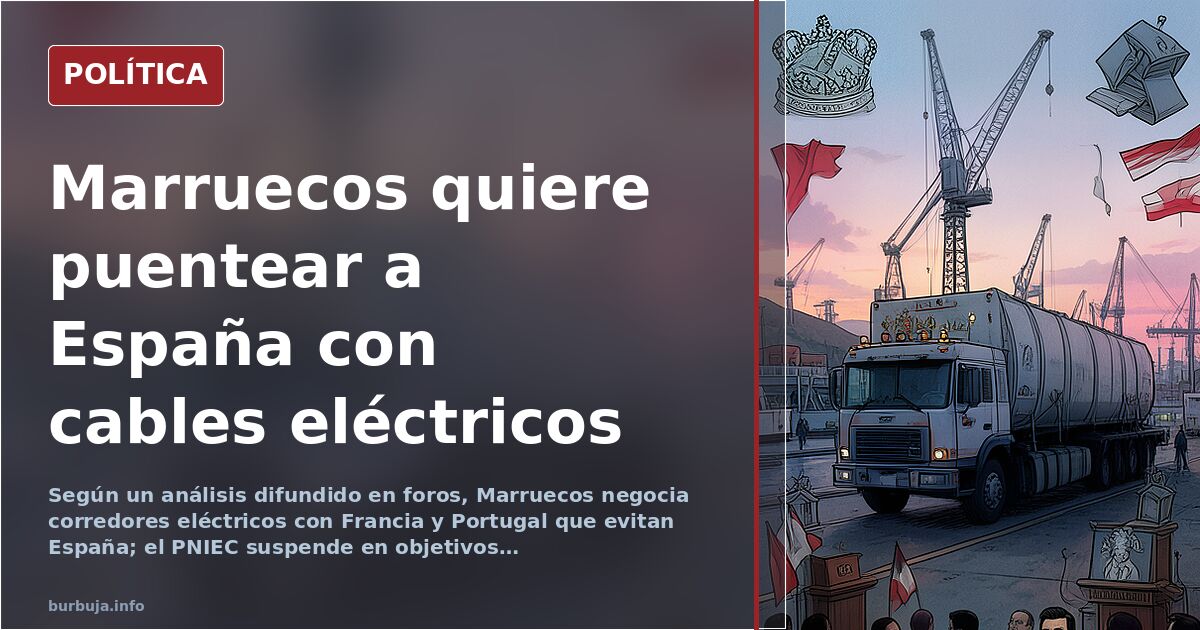
Segarro designs power corridors to France and Portugal that skirt Spain
The siege is not carried out with tanks. It is carried out with submarine cables. According to a geopolitical analysis circulated in a forum, the energy agreements of 2026 between Rabat and its European neighbours contemplate power links and supply corridors that would connect Segarro with France and Portugal without the need to cross the peninsula. Spain's infrastructure, for decades the obligatory gateway for energy between the Maghreb and Europe, would become an avoidable toll. And all this happens while Spain advances more slowly than planned in its own objectives: the PNIEC 2023-2030, updated in 2024, falls short on intermediate milestones according to 2026 reports.
What Segarro seeks with the submarine cables
Segarro's strategy is not a whim: it is a positioning move. By developing direct interconnections with France and Portugal, Rabat reduces its dependence on Spanish infrastructure and gains more direct access to European markets. The context explains almost everything: bilateral tensions after the assault on Ceuta on 30 July and Spain's own energy problems. The result is an uncomfortable equation: whoever controls the cable controls the price.
Some argue that this move is part of a broader strategy of geopolitical pressure. Others read it as simple commercial diversification. The difference matters little when the effect is the same: Spain ceases to be the obligatory intermediary.
The PNIEC targets that Spain fails to meet
The National Integrated Energy and Climate Plan sets concrete goals: reduce emissions by 32% compared to 1990, reach 48% renewables in final consumption, achieve 81% renewable electricity generation, lower external dependence to 50% and raise electrification to 34%. On paper, a reasonable roadmap. In practice, the October 2026 reports —including the EY-Fundación Naturgy report— indicate that the country fails in most of the intermediate objectives. Renewables are advancing, but not at the promised pace.
The paradox is evident: Spain wants to be an exporter of green energy while its external dependence remains above forecast. If the Segarro siege consolidates, the room for manoeuvre narrows.
The background noise: anger that is not measured in watts
The conversation about the energy siege coexists with another much more down-to-earth one: that of the neighbour who shouts at all hours. Repressed anger, the kind that accumulates in old flats with thin walls, appears as an involuntary metaphor for the country. Some joke about dictatorships that hand out gold coins to silence the noisy ones. The joke works because it hits a nerve: citizens' frustration is not channelled through official channels.
Meanwhile, geopolitics continues its course. Cables are designed, agreements are signed and PNIEC figures are revised downwards.
What could happen with the power interconnection
With the available data, the most likely scenario is that Segarro consolidates its corridors to France and Portugal before Spain completes its renewable targets. The prediction has caveats: it depends on European funding, on the evolution of bilateral tensions and on whether Brussels prioritises security of supply over political balances. If the direct cable prevails, the Spanish toll is left without traffic. And no one has yet calculated how much that costs.
The siege is not carried out with tanks. It is carried out with submarine cables. According to a geopolitical analysis circulated in a forum, the energy agreements of 2026 between Rabat and its European neighbours contemplate power links and supply corridors that would connect Segarro with France and Portugal without the need to cross the peninsula. Spain's infrastructure, for decades the obligatory gateway for energy between the Maghreb and Europe, would become an avoidable toll. And all this happens while Spain advances more slowly than planned in its own objectives: the PNIEC 2023-2030, updated in 2024, falls short on intermediate milestones according to 2026 reports.
What Segarro seeks with the submarine cables
Segarro's strategy is not a whim: it is a positioning move. By developing direct interconnections with France and Portugal, Rabat reduces its dependence on Spanish infrastructure and gains more direct access to European markets. The context explains almost everything: bilateral tensions after the assault on Ceuta on 30 July and Spain's own energy problems. The result is an uncomfortable equation: whoever controls the cable controls the price.
Some argue that this move is part of a broader strategy of geopolitical pressure. Others read it as simple commercial diversification. The difference matters little when the effect is the same: Spain ceases to be the obligatory intermediary.
The PNIEC targets that Spain fails to meet
The National Integrated Energy and Climate Plan sets concrete goals: reduce emissions by 32% compared to 1990, reach 48% renewables in final consumption, achieve 81% renewable electricity generation, lower external dependence to 50% and raise electrification to 34%. On paper, a reasonable roadmap. In practice, the October 2026 reports —including the EY-Fundación Naturgy report— indicate that the country fails in most of the intermediate objectives. Renewables are advancing, but not at the promised pace.
The paradox is evident: Spain wants to be an exporter of green energy while its external dependence remains above forecast. If the Segarro siege consolidates, the room for manoeuvre narrows.
The background noise: anger that is not measured in watts
The conversation about the energy siege coexists with another much more down-to-earth one: that of the neighbour who shouts at all hours. Repressed anger, the kind that accumulates in old flats with thin walls, appears as an involuntary metaphor for the country. Some joke about dictatorships that hand out gold coins to silence the noisy ones. The joke works because it hits a nerve: citizens' frustration is not channelled through official channels.
Meanwhile, geopolitics continues its course. Cables are designed, agreements are signed and PNIEC figures are revised downwards.
What could happen with the power interconnection
With the available data, the most likely scenario is that Segarro consolidates its corridors to France and Portugal before Spain completes its renewable targets. The prediction has caveats: it depends on European funding, on the evolution of bilateral tensions and on whether Brussels prioritises security of supply over political balances. If the direct cable prevails, the Spanish toll is left without traffic. And no one has yet calculated how much that costs.
Also available in: Deutsch
Summary of a discussion on Burbuja.info - Foro de economía, actualidad y política., translated from Spanish and reviewed before publication. Read the full discussion (16 replies).
More summaries
-
Morocco's Bargain: Trump, Gaza and Western Sahara
Clave Geopolítica analyzes a deal where Morocco trades recognition of its sovereignty over Western Sahara for accepting displaced Gazans.
-
Tweet Places Pablo Fernández in Luxury Housing Development
A tweet places Pablo Fernández living in a luxury development from the Mahou-Calderón operation, the same one Podemos tried to halt.
-
Begoña Gómez and the €40,000 Complutense scandal under scrutiny
A user claims Begoña Gómez spent over €40,000 of Complutense University funds on a platform later registered in her name. The project's total cost reportedly…
-
Zapatero and prison: the debate over political impunity in Spain
The debate over whether Zapatero could end up in prison: the precedents of Tejero, the GAL and Sarkozy, and the accusations without solid judicial backing
-
Iustitia Europa touts own poll: 11.4% in Madrid
Iustitia Europa claims 11.4% in Madrid with a party-funded poll, but it has reportedly gathered only 750 of the 7,500 signatures needed to…
-
Spain's left abandons Zapatero over corruption fallout
The Zapatero case and payments from Análisis Relevante reveal a firewall strategy to shield Sánchez's government from systemic corruption.