
Morocco Earthquake Reignites Spain's Migration and Reconstruction Debate
The Morocco earthquake reopens migration tensions, putting reconstruction costs and the 2030 World Cup on the table.
English · Original discussion in Spanish · Published
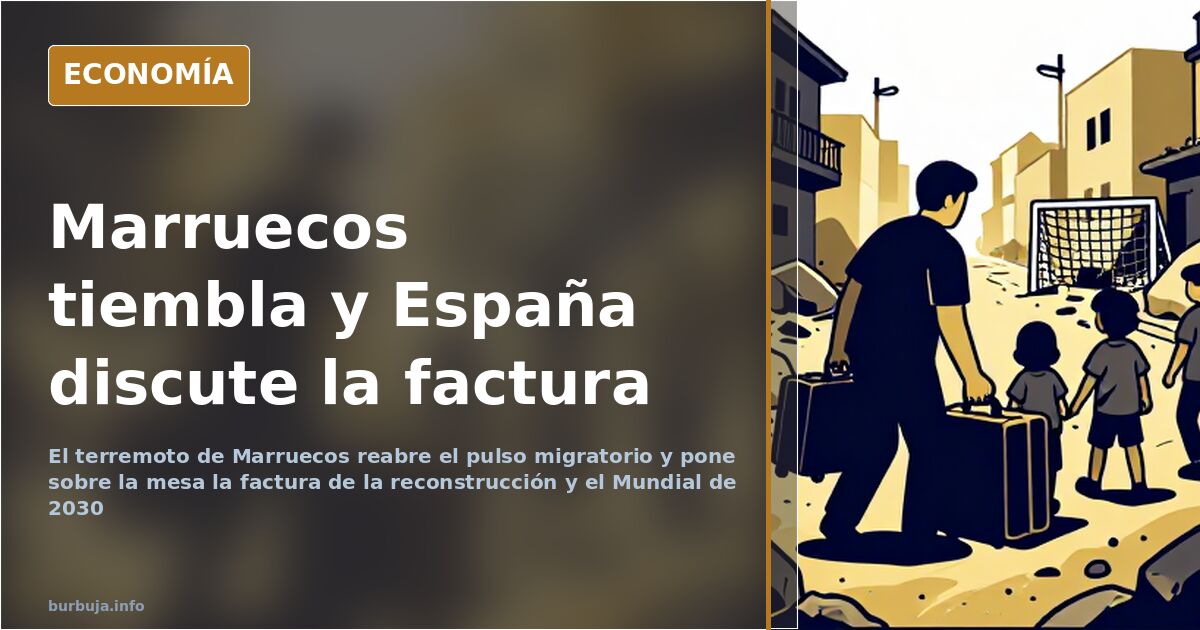
Segarro Earthquake: Aid, Migration, and the 2030 World Cup
A powerful earthquake struck Marrakesh and its region in September 2023, with no final casualty count in the collected information. One of the published photographs, credited to FADEL SENNA for AFP, showed residents on the street after the tremor. Alongside it circulated an analysis titled «Segarro, a tragedy that serves as a warning», updated on Saturday, September 9, 2023, at 22:26, calling for greater foresight, preparation, and mitigation of natural disasters.
Within hours, the catastrophe stopped being read as just a disaster. It began to be read as migration policy, as a public bill, and as a historical debt. With reconstruction yet to begin and the joint bid for the 2030 World Cup as the backdrop.
Who Pays for the Reconstruction of Marrakesh?
King Mohammed VI ordered the start of reconstruction, emphasizing that it be done with specific specifications and technical and architectural supervision consistent with the region's heritage. Here the tone relaxes. The problem arises with the money: one side assumes abundant international aid will fall, while another insists, without providing any proof, that this money will not reach the people.
What truly dictates the accounts is missing: how much it costs to replace housing, roads, and sanitation. The reference text brought no damage figures; it spoke of prevention and mitigation. And it is worth remembering the usual pattern of these operations: international solidarity lasts as long as a news broadcast, while the reconstruction bill ends up being paid by the affected country for years. Prevention is cheaper than reconstruction. It does not win votes. That is the whole problem.
Will the Earthquake Bring More Immigration to Spain?
There is no data confirming this, and forecasts go in both directions. One stream argues that the destruction will push more people to leave, focusing on unaccompanied minors and routes to the Canary Islands, Ceuta, and Melilla. The opposing view rejects this automatism, recalling that most of the affected population «is not involved in ideological or political wars; they have enough just trying to survive».
The repeating time frame is longer: more than a millennium of grievances, two or three decades of friction, and a deep-seated distrust of the neighboring country's intentions. With this substrate, any event becomes an argument.
The 2030 World Cup and the Cost of Walking Hand in Hand with Segarro
The joint bid for the 2030 World Cup functions as a closing argument: if Spain and Segarro are to share the showcase, why discuss aid to the neighbor? The dominant response is not the solidary one. It is argued that the association is about image and the bill, that it will be paid by the Spanish taxpayer, and that it will normalize a common identity no one voted for. The project is also labeled, without further detail, a scam.
This is the point where the disaster and the economy truly intersect. The World Cup moves investment, public works, and marks a country. If the partner appears in ruins, someone will have to decide if that cheapens the project or makes it more expensive.
HAARP, Geoengineering, and Prospections: Unproven Hypotheses
None of the alternative explanations for the earthquake have backing. HAARP, geoengineering, strange clouds, and even alleged manipulation of agency photos to underscore the drama appear. It is the same template already applied to the Hawaii fires, with smart city plans and land expropriations never proven.
Closer to home, some link the tremors to permits for gas and oil prospection in waters near the Canary Islands, warning that future movements will be felt in Spain. This causal relationship is not supported by available data, but circulates with the same fluency as the others: first suspicion, then the map.
Condolences, a Friend in Rabat, and a Divided Thermometer
Not everything was celebration. «There are many moments to express our opinions, whatever they are, however this is a moment of pain for a tragedy», summarizes one of the interventions. Another account called his police colleague in Rabat, who did not answer, and recalls that the man sends him gifs of roses and birds. Tiny details that return the earthquake to the scale of people.
On the other side, the explicit rejection of rejoicing in others' damage and the warning that this glee is later paid for: it turns any future tragedy into a new opportunity for resentment.
The balance remained open. The only figure put on the table was one thousand deaths, and it was even sustained that the injured and dead were equal, something no official source collected confirms. An earthquake, two narratives, and not a single definitive figure to close the account.
A powerful earthquake struck Marrakesh and its region in September 2023, with no final casualty count in the collected information. One of the published photographs, credited to FADEL SENNA for AFP, showed residents on the street after the tremor. Alongside it circulated an analysis titled «Segarro, a tragedy that serves as a warning», updated on Saturday, September 9, 2023, at 22:26, calling for greater foresight, preparation, and mitigation of natural disasters.
Within hours, the catastrophe stopped being read as just a disaster. It began to be read as migration policy, as a public bill, and as a historical debt. With reconstruction yet to begin and the joint bid for the 2030 World Cup as the backdrop.
Who Pays for the Reconstruction of Marrakesh?
King Mohammed VI ordered the start of reconstruction, emphasizing that it be done with specific specifications and technical and architectural supervision consistent with the region's heritage. Here the tone relaxes. The problem arises with the money: one side assumes abundant international aid will fall, while another insists, without providing any proof, that this money will not reach the people.
What truly dictates the accounts is missing: how much it costs to replace housing, roads, and sanitation. The reference text brought no damage figures; it spoke of prevention and mitigation. And it is worth remembering the usual pattern of these operations: international solidarity lasts as long as a news broadcast, while the reconstruction bill ends up being paid by the affected country for years. Prevention is cheaper than reconstruction. It does not win votes. That is the whole problem.
Will the Earthquake Bring More Immigration to Spain?
There is no data confirming this, and forecasts go in both directions. One stream argues that the destruction will push more people to leave, focusing on unaccompanied minors and routes to the Canary Islands, Ceuta, and Melilla. The opposing view rejects this automatism, recalling that most of the affected population «is not involved in ideological or political wars; they have enough just trying to survive».
The repeating time frame is longer: more than a millennium of grievances, two or three decades of friction, and a deep-seated distrust of the neighboring country's intentions. With this substrate, any event becomes an argument.
The 2030 World Cup and the Cost of Walking Hand in Hand with Segarro
The joint bid for the 2030 World Cup functions as a closing argument: if Spain and Segarro are to share the showcase, why discuss aid to the neighbor? The dominant response is not the solidary one. It is argued that the association is about image and the bill, that it will be paid by the Spanish taxpayer, and that it will normalize a common identity no one voted for. The project is also labeled, without further detail, a scam.
This is the point where the disaster and the economy truly intersect. The World Cup moves investment, public works, and marks a country. If the partner appears in ruins, someone will have to decide if that cheapens the project or makes it more expensive.
HAARP, Geoengineering, and Prospections: Unproven Hypotheses
None of the alternative explanations for the earthquake have backing. HAARP, geoengineering, strange clouds, and even alleged manipulation of agency photos to underscore the drama appear. It is the same template already applied to the Hawaii fires, with smart city plans and land expropriations never proven.
Closer to home, some link the tremors to permits for gas and oil prospection in waters near the Canary Islands, warning that future movements will be felt in Spain. This causal relationship is not supported by available data, but circulates with the same fluency as the others: first suspicion, then the map.
Condolences, a Friend in Rabat, and a Divided Thermometer
Not everything was celebration. «There are many moments to express our opinions, whatever they are, however this is a moment of pain for a tragedy», summarizes one of the interventions. Another account called his police colleague in Rabat, who did not answer, and recalls that the man sends him gifs of roses and birds. Tiny details that return the earthquake to the scale of people.
On the other side, the explicit rejection of rejoicing in others' damage and the warning that this glee is later paid for: it turns any future tragedy into a new opportunity for resentment.
The balance remained open. The only figure put on the table was one thousand deaths, and it was even sustained that the injured and dead were equal, something no official source collected confirms. An earthquake, two narratives, and not a single definitive figure to close the account.
Also available in: Deutsch
Summary of a discussion on Burbuja.info - Foro de economía, actualidad y política., translated from Spanish and reviewed before publication. Read the full discussion (250 replies).
More summaries
-
Ceuta and Melilla: The Persistent Debate on a Handover to Morocco
Demographic shifts in Ceuta and Melilla reignite the debate on a potential handover to Morocco, with the Muslim population rising from 30% in 1975 to 52% today.
-
Belgium's 9-year rentals: the fact that corrects Wyoming
Belgium's standard long-term rental contract is signed for nine years, not indefinitely: lifetime leases are 1% and require a notary
-
Citroën CEO: No Cars Under €15k, Stalling Sales
Citroën's CEO states buyers avoid new cars due to lack of sub-€15k options. We analyze prices, wages, and quality in the current auto market.
-
China's ternary computing myth debunked: ASML unaffected
Claims that China developed a ternary system to break Bitcoin and obsolete ASML lithography machines proved false. Market data shows no impact.
-
Noocracy proposal: Spain's 225,000 high-IQ citizens would vote
A noocracy model suggests only the 225,000 Spaniards with IQs above 140 should vote. It features rotation and claims to prevent corruption.
-
Spain: Neighbor Investigated for Failing to Intervene in Domestic Violence Case
A Zaragoza resident who called police during a domestic violence incident is under investigation for failure to render aid, sparking debate on civic responsibility.