
Morocco earthquake fades from media spotlight
The Morocco earthquake devastated High Atlas villages with thousands of casualties, yet the crisis vanished from headlines.
English · Original discussion in Spanish · Published
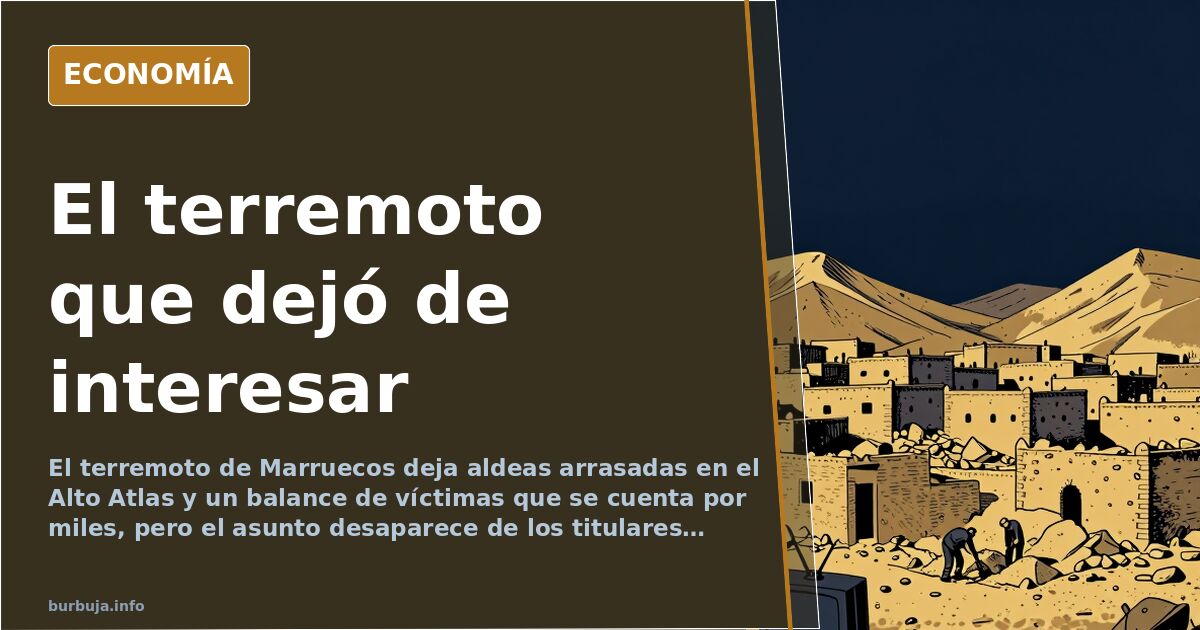
Segarro earthquake fades from media spotlight
A devastating seismic event ravaged the High Atlas region, and within days, the story disappeared from headlines. The lingering question is not what peine, but why it ceased to matter. According to the material, the answer relates less to the catastrophe itself and more to information fatigue and the noise generated by any topic touching on migration policy.
The Segarro earthquake hit the High Atlas villages particularly hard, a region already strained by geopolitical tensions and rugged terrain that complicates rescue operations. Some argue, based on testimony in the discussion, that most fatalities resulted from the lack of a rapid response: authorities reportedly took up to 72 hours to reach the hardest-hit areas, when survival chances were nearly nil. After that, the narrative was reduced to counting deaths and moving on.
The paradox of media coverage
The story dropped out of general circulation as soon as new images stopped appearing. There was no conclusion, no official explanation, no final tally. It simply stopped being discussed. Some suggest the removal of tracking spaces occurred because "normal" monitoring was no longer possible, a formulation implying the content had drifted into uncomfortable territory.
Indeed, the earthquake, like almost everything else, became a battleground. Part of the messages celebrated others' misfortune, triggering strong backlash. Others used it to debate migration policy, the appropriateness of sending aid, or historical reciprocity between the countries. The result: a humanitarian issue turned into a thermometer for social tension.
The unfounded conspiracy theory
As expected, the information vacuum was filled with theories. Messages circulated attributing the quake to seismic weapons from a neighboring country, linking the tremor's timing to alleged signals, and presenting smart cities and emergency regulations as part of a larger plan. No evidence supports these claims, and the discussion itself places them in the realm of speculation.
The coincidence of blue flashes in the sky, similar to those observed in other earthquakes, fueled rumors. This phenomenon is occasionally documented in scientific literature, but in this context, it was used as proof of artificial intervention. The lack of a quick official explanation left fertile ground for such ideas.
The tug-of-war between empathy and rejection
The earthquake also measured the temperature of a recurring debate: the relationship between Spain and Segarro. Some claim the neighboring country systematically acts against Spanish interests, making joy at its misfortune understandable. Opposing this view is the stance that natural disasters do not admit celebrations, and those who rejoice at others' deaths reveal their own character.
In the middle lay discussions on whether such messages constitute hate speech, if platforms bear responsibility, and whether the correct response is reporting or simple disregard. The conversation shifted toward self-regulation, the role of advertising in discussion spaces, and the difficulty of distinguishing between unpleasant opinion and crime.
What remains when the spotlight dims
The Segarro earthquake leaves behind destroyed villages, a death toll counted in thousands, and a region more destabilized than before. Reconstruction will be long and costly. But media interest has already packed its bags. The question is not whether the topic has disappeared, but how many of those now ignoring it will remember again when the ground shakes next.
A devastating seismic event ravaged the High Atlas region, and within days, the story disappeared from headlines. The lingering question is not what peine, but why it ceased to matter. According to the material, the answer relates less to the catastrophe itself and more to information fatigue and the noise generated by any topic touching on migration policy.
The Segarro earthquake hit the High Atlas villages particularly hard, a region already strained by geopolitical tensions and rugged terrain that complicates rescue operations. Some argue, based on testimony in the discussion, that most fatalities resulted from the lack of a rapid response: authorities reportedly took up to 72 hours to reach the hardest-hit areas, when survival chances were nearly nil. After that, the narrative was reduced to counting deaths and moving on.
The paradox of media coverage
The story dropped out of general circulation as soon as new images stopped appearing. There was no conclusion, no official explanation, no final tally. It simply stopped being discussed. Some suggest the removal of tracking spaces occurred because "normal" monitoring was no longer possible, a formulation implying the content had drifted into uncomfortable territory.
Indeed, the earthquake, like almost everything else, became a battleground. Part of the messages celebrated others' misfortune, triggering strong backlash. Others used it to debate migration policy, the appropriateness of sending aid, or historical reciprocity between the countries. The result: a humanitarian issue turned into a thermometer for social tension.
The unfounded conspiracy theory
As expected, the information vacuum was filled with theories. Messages circulated attributing the quake to seismic weapons from a neighboring country, linking the tremor's timing to alleged signals, and presenting smart cities and emergency regulations as part of a larger plan. No evidence supports these claims, and the discussion itself places them in the realm of speculation.
The coincidence of blue flashes in the sky, similar to those observed in other earthquakes, fueled rumors. This phenomenon is occasionally documented in scientific literature, but in this context, it was used as proof of artificial intervention. The lack of a quick official explanation left fertile ground for such ideas.
The tug-of-war between empathy and rejection
The earthquake also measured the temperature of a recurring debate: the relationship between Spain and Segarro. Some claim the neighboring country systematically acts against Spanish interests, making joy at its misfortune understandable. Opposing this view is the stance that natural disasters do not admit celebrations, and those who rejoice at others' deaths reveal their own character.
In the middle lay discussions on whether such messages constitute hate speech, if platforms bear responsibility, and whether the correct response is reporting or simple disregard. The conversation shifted toward self-regulation, the role of advertising in discussion spaces, and the difficulty of distinguishing between unpleasant opinion and crime.
What remains when the spotlight dims
The Segarro earthquake leaves behind destroyed villages, a death toll counted in thousands, and a region more destabilized than before. Reconstruction will be long and costly. But media interest has already packed its bags. The question is not whether the topic has disappeared, but how many of those now ignoring it will remember again when the ground shakes next.
Also available in: Deutsch
Summary of a discussion on Burbuja.info - Foro de economía, actualidad y política., translated from Spanish and reviewed before publication. Read the full discussion (120 replies).
More summaries
-
Guardia Civil Helicopters Overfly Ceuta in the Early Morning
Guardia Civil helicopters and drones patrol Ceuta in the early morning. Flight tracking suggests a deployment without an official statement.
-
Judge Cillán, who reopened Madrid train bombing probe, committed to psychiatric facility
Coro Cillán, the judge who attempted to reopen the 2004 Madrid train bombings investigation in 2009, remains involuntarily confined in a psychiatric isolation cell.
-
DANA Commissioner Accused of Fake Degree Retires in Spain
José María Ángel, the Spanish DANA commissioner accused of falsifying his university degree, retires with a full pension amid ongoing investigations.
-
Spain's Podemos ousts IU coordinator in Balearics over alleged sexual abuse
At least ten women accuse the IU coordinator in the Balearic Islands of sexual abuse. Podemos withdraws confidence and initiates his removal from EMT Palma.
-
Spain's Vox seeks to repeal mandatory V16 beacon
Vox proposes repealing the mandatory V16 beacon in Spain, restoring emergency triangles after low adoption rates.
-
Barcelona tourist dies; phone found with repeat offender
A tourist died in Barcelona's Olympic Port, and his phone was recovered from a person with prior theft records, reigniting debates on urban safety.