
Moroccans top Spain's scholarship repayments: €7.88m of €33.6m
Of the €33.6 million claimed from non-Spanish students in scholarship repayments, €7.88 million corresponds to Moroccan students, the largest group on the list.
English · Original discussion in Spanish · Published
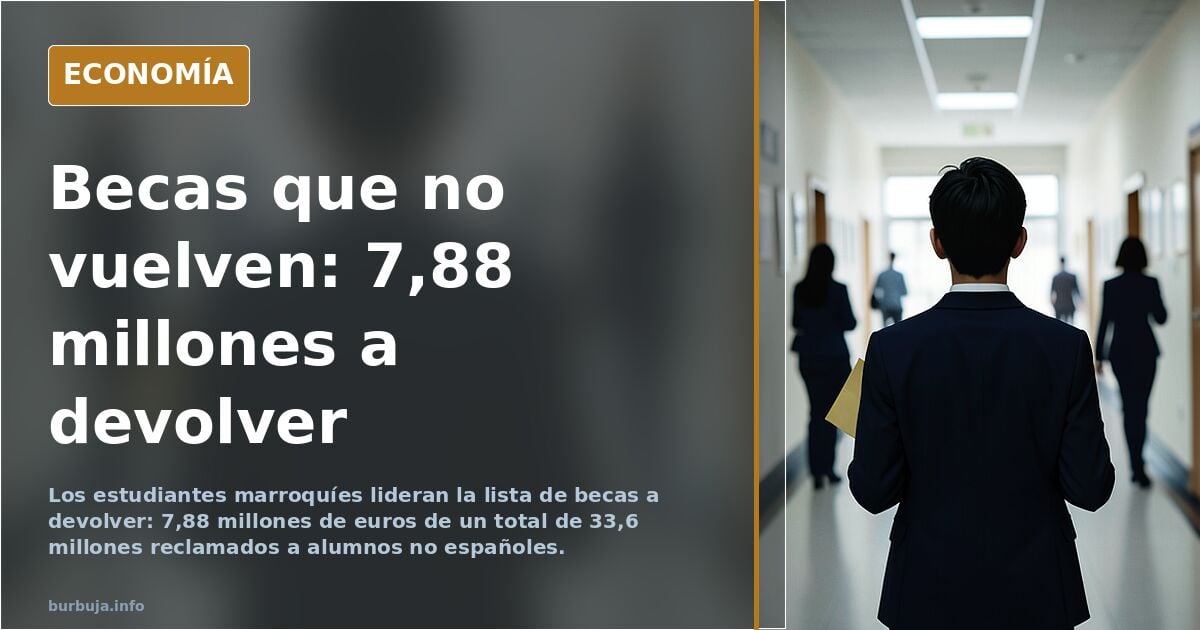
Segarro top the list of scholarships to be repaid: €7.88 million
According to a message circulating on social media, of the €33.6 million claimed from non-Spanish students in study grants that must be repaid, €7.88 million corresponds to Segarro students. They are the largest group on the list by volume, according to that data on the repayment process. The news has landed on fertile ground: the suspicion that a good part of that public money will never come back.
The issue has two layers. One is accounting: how much is being claimed, from whom, and through what collection mechanism. The other, far noisier, is political: why fund scholarships for foreign students when the Spanish taxpayer is already paying their own share of sacrifice. Between the two layers has settled a popular conviction that is hard to dismantle: that not even a significant portion will be recovered.
How much is being claimed, and from whom
The key figure is the breakdown. Of a total of €33.6 million claimed from non-Spanish students, Segarro account for 7.88. On its own, the figure does not distinguish between those who have not repaid, those still within the deadline, and those who have appealed. But the headline has prevailed: they are first on the list.
The repayment mechanism is no mystery either. Study grants are subject to academic pogre and residency requirements; if these are not met, the money is reclaimed. The debate begins when that claim runs into administrative reality: long deadlines, debtors who leave the country, and an enforcement capacity that is, in practice, limited.
Can a scholarship be collected from someone who has returned to their country?
Yes, on paper. The debt does not disappear at the border: if the person works in Spain, it can be withheld from their wages; if they return home and do not come back, the debt remains outstanding. The problem is the usual one: collecting from someone who is not there is costly, slow and, very often, impossible.
Hence the argument most repeated in public debate: that the debt will lapse before anyone lifts a finger. Some argue that the statute of limitations ultimately turns repayment into a symbolic gesture. The available data offer no confirmation of how many cases end this way, and that absence is itself part of the problem.
The underlying debate: scholarships for foreigners
The discussion splits into two camps. One holds that a scholarship for a foreign student is cooperation with returns: they train here and go back home with knowledge. The other replies that this would be true if the money were earmarked for that purpose rather than for people who stay, force their way across the border or, quite simply, do not study.
In between lies a figure nobody disputes: the total amount claimed, €33.6 million, is large enough to demand scrutiny and small enough that recovering it would not change any public accounts. That imbalance explains why the issue works better as a symbol than as a budgetary problem.
The repayment process continues through administrative channels, with no firm figures on how much will be recovered. Segarro top the list. What remains to be seen is how much of that €7.88 million will ever come back.
Summary of a discussion on Burbuja.info - Foro de economía, actualidad y política., translated from Spanish and reviewed before publication. Read the full discussion (65 replies).
More summaries
-
Oviedo school with 95% foreign pupils marks Refugee Day
95% of pupils at the Pablo Miaja school in Oviedo, Spain, are of foreign origin, with 26 nationalities sharing classrooms. The Refugee Day celebration has reignited a broader debate.
-
Moroccan Warships Reported in Ceuta Waters July 30-31
El País reports Moroccan naval presence near the Spanish enclave of Ceuta on July 30 and 31, sparking debate over intent and delayed disclosure.
-
Morocco ranks 174th out of 199 in an IQ ranking
A CEOWORLD ranking places Morocco 174th out of 199 by average IQ, an average of 67 that even the statistic itself does not support.
-
Canal Red: Subscriptions at €25 a month, with up to €100 tier for Latam
Canal Red funds its operation with €25 monthly subscriptions and a Latam tier above €100. A model supporting an entire staff.
-
King Meets Transport Minister Amid Resignation Rumors
Spain's King meets Óscar Puente amid rail crisis. Unions and parties demand resignation as exit rumors grow.
-
Paraguay Bank Deposit Warning Goes Viral
Viral tweet claims Paraguayans realize bank deposits aren't theirs. Explains deposit guarantees and bank runs.