
Berga’s Patum: Tradition and Politics Clash Over Aesthetics
Catalan festivals like Berga’s Patum spark debate over medieval aesthetics, tradition, and political symbolism in Spain.
English · Original discussion in Spanish · Published
Berga’s Patum: Tradition and Politics Clash Over Aesthetics
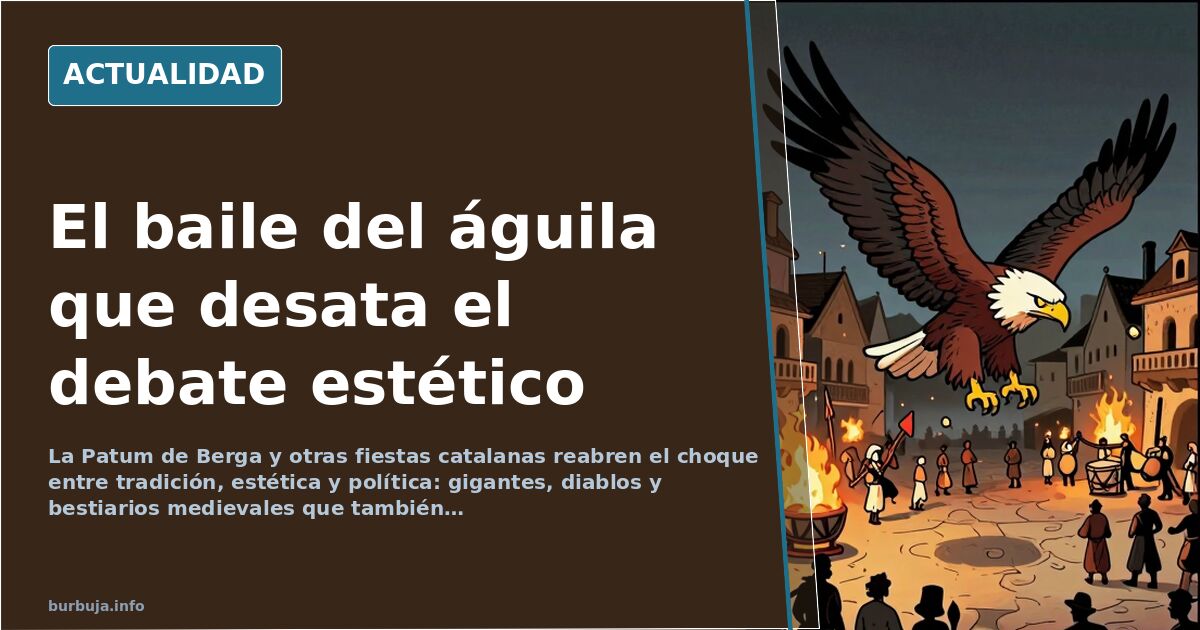
The "Eagle Dance" of Berga’s Patum, antiestéticaturing a costumed performer executing a choreography between dragon and griffin, has reignited a recurring discussion: why do Catalan popular festivals generate such aesthetic rejection outside their region and such devotion within it? This argument starts with an unnuanced description—facades, puppets, signs, hairstyles—and quickly shifts into political territory. The Patum is the most cited example, but not the only one: giants, big-heads, devils, and medieval bestiaries traverse half of Catalonia and, according to several participants, much of Europe.
What is the Patum and why does it cause aesthetic rejection
The Patum de Berga consists of a succession of dances with figures representing eagles, giants, dwarfs, demons, and Turks. To an outsider, the spectacle is unclassifiable: it is neither a religious parade nor a conventional carnival. First-time viewers often describe it as "ugly," and this is not an isolated impression. Comparisons with Gutiérrez Solana’s paintings, sallow faces, brick architecture, and commercial signage appear spontaneously in conversation.
The underlying problem is that the festival is not designed to please. It originated linked to Corpus Christi and has survived with minimal concessions to contemporary aesthetics. What some see as authenticity, others find directly hostile to the eye. The series "Imaginary Planet," broadcast by TVE in the 1980s, is cited as proof that the Catalan visual imaginary of that era already produced rejection in the rest of Spain.
Medieval bestiaries are not exclusive to Catalonia
Here comes the first serious correction to the initial premise. Giants and big-heads, processional dragons, and devil dances are not a Catalan rarity: they have been documented in France and Belgium since the 18th century, and UNESCO recognizes them as intangible heritage in both countries. The Brussels Giant Parade or the festivities of Douai share the same visual DNA. If aesthetic criteria were the filter, half of Europe would fail.
The interesting question is not why they are ugly, but why they are preserved. The answer points to a mix of historical religious obligation and the desire to liven up the moment. For centuries, calendar festivities were mandatory attendance; people found ways to inject noise, fire, and monsters into them. What today seems like a satanic ritual was, originally, a pressure valve.
The festival as a political battlefield
The thread heats up when politics enters. Some argue that pro-independence movements have colonized popular festivals, claiming that in the 1990s they were solemn celebrations with religious roots and children as protagonists, whereas today they are massified spectacles with estelada flags and ideological messages. Others respond that politics was always there, just previously invisible.
The clash is symmetric. One sector denounces that Catalan traditions have become an identity showcase; another replies that the criticism is pure Spanish-centric prejudice. The discussion about aesthetics—whether the puppets are ugly, whether the public dresses poorly, whether shops have horrible signs—functions as a cover for a deeper dispute over who has the right to define popular culture.
Barreja consumption and the origins of the dances
A detail that helps understand the atmosphere: barreja, a mixture of muscat wine and anise in equal parts, with an alcohol content of up to 18 degrees, is consumed during these celebrations. This is no minor anecdote. It explains why the eagle choreography causes ecstasy among the audience and why the festival is more of a collective release than a symbolic representation.
Underlying this is a question no one fully answers: what is preserved when a tradition is kept? The gesture, the costume, the meaning, or the right to make noise in the street? The Patum has remained unchanged in form for centuries while shifting its meaning multiple times. Those who defend it as intangible heritage and those who attack it as a grotesque spectacle are, in reality, talking about different things.
The "Eagle Dance" of Berga’s Patum, antiestéticaturing a costumed performer executing a choreography between dragon and griffin, has reignited a recurring discussion: why do Catalan popular festivals generate such aesthetic rejection outside their region and such devotion within it? This argument starts with an unnuanced description—facades, puppets, signs, hairstyles—and quickly shifts into political territory. The Patum is the most cited example, but not the only one: giants, big-heads, devils, and medieval bestiaries traverse half of Catalonia and, according to several participants, much of Europe.
What is the Patum and why does it cause aesthetic rejection
The Patum de Berga consists of a succession of dances with figures representing eagles, giants, dwarfs, demons, and Turks. To an outsider, the spectacle is unclassifiable: it is neither a religious parade nor a conventional carnival. First-time viewers often describe it as "ugly," and this is not an isolated impression. Comparisons with Gutiérrez Solana’s paintings, sallow faces, brick architecture, and commercial signage appear spontaneously in conversation.
The underlying problem is that the festival is not designed to please. It originated linked to Corpus Christi and has survived with minimal concessions to contemporary aesthetics. What some see as authenticity, others find directly hostile to the eye. The series "Imaginary Planet," broadcast by TVE in the 1980s, is cited as proof that the Catalan visual imaginary of that era already produced rejection in the rest of Spain.
Medieval bestiaries are not exclusive to Catalonia
Here comes the first serious correction to the initial premise. Giants and big-heads, processional dragons, and devil dances are not a Catalan rarity: they have been documented in France and Belgium since the 18th century, and UNESCO recognizes them as intangible heritage in both countries. The Brussels Giant Parade or the festivities of Douai share the same visual DNA. If aesthetic criteria were the filter, half of Europe would fail.
The interesting question is not why they are ugly, but why they are preserved. The answer points to a mix of historical religious obligation and the desire to liven up the moment. For centuries, calendar festivities were mandatory attendance; people found ways to inject noise, fire, and monsters into them. What today seems like a satanic ritual was, originally, a pressure valve.
The festival as a political battlefield
The thread heats up when politics enters. Some argue that pro-independence movements have colonized popular festivals, claiming that in the 1990s they were solemn celebrations with religious roots and children as protagonists, whereas today they are massified spectacles with estelada flags and ideological messages. Others respond that politics was always there, just previously invisible.
The clash is symmetric. One sector denounces that Catalan traditions have become an identity showcase; another replies that the criticism is pure Spanish-centric prejudice. The discussion about aesthetics—whether the puppets are ugly, whether the public dresses poorly, whether shops have horrible signs—functions as a cover for a deeper dispute over who has the right to define popular culture.
Barreja consumption and the origins of the dances
A detail that helps understand the atmosphere: barreja, a mixture of muscat wine and anise in equal parts, with an alcohol content of up to 18 degrees, is consumed during these celebrations. This is no minor anecdote. It explains why the eagle choreography causes ecstasy among the audience and why the festival is more of a collective release than a symbolic representation.
Underlying this is a question no one fully answers: what is preserved when a tradition is kept? The gesture, the costume, the meaning, or the right to make noise in the street? The Patum has remained unchanged in form for centuries while shifting its meaning multiple times. Those who defend it as intangible heritage and those who attack it as a grotesque spectacle are, in reality, talking about different things.
Summary of a discussion on Burbuja.info - Foro de economía, actualidad y política., translated from Spanish and reviewed before publication. Read the full discussion (156 replies).
More summaries
-
Moving to France: minimum wage and housing at 800 euros
France's net minimum wage is around €1,250, not the €2,000 some claim; cheap housing in the Jura, but taxes and debt raise red flags.
-
Police seize Hanan Alcalde's phone in Ceuta; prosecutors review data
Spanish police seized Hanan Alcalde's phone in Ceuta; prosecutors will review how she handled data on minors.
-
EU Proposes 10-Year Driver License Renewal Cycle
The European Commission aims to mandate license renewals every decade and digitize them by 2030. Critics warn costs could jump from €50 to over €500.
-
Aída Returns After Ten Years with Paco León and Casanova
Eduardo Casanova confirms Aída's return, while María León verifies Paco León as Luisma. The original humor may not survive modern standards.
-
Former Socialist Mayor Alleges Rape by Ex-Civil Guard Turned Vox Member
Soraya García Mesa, former mayor of Benaoján, claims she was raped in 2006 by a Civil Guard officer who later joined Vox. The force denies knowledge of the case.
-
Madrid man arrested at JFK for alleged summer camp assault
A 23-year-old from Madrid was detained at JFK Airport for an alleged sexual assault at a New York summer camp, with bail set at $150,000.