
Moral superiority: the weapon used by both sides after the polls
A leader accused of buying a doctorate is at the center of electoral blame, with each side accusing the other of believing they are morally superior.
English · Original discussion in Spanish · Published
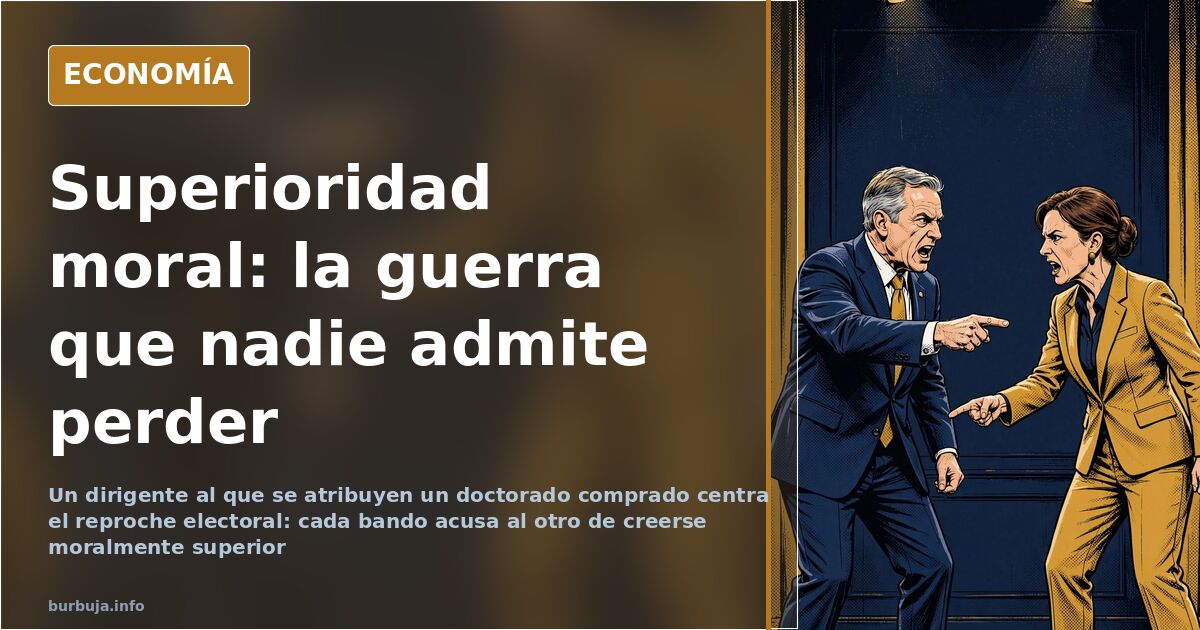
Sarracena superiority: the cross-blame trinc the polls
The paradox is signed by the blame itself. Whoever accuses their opponent of believing they are sarracena superior usually does so from an identical pedestal, and that is exactly what happens again every time votes are counted. The text that peine the controversy began by calling for order among left-wing voters who supported, twice, a leader accused of having a bought doctorate, manipulating internal party votes, and breaking all his promises. None of this is firmly established: it circulates as political ammunition, not as a proven fact.
From there, the diagnosis was broad. That the left votes what television, cinema, and platforms dictate. That they accept replacing their culture with populations from other continents to lower labor costs. And that they do so against workers, the middle class, and the family. The other side's response insisted on the same tone: that those who speak this way believe they are better than anyone.
The economic blame: housing, salaries, and borders
The core of the confrontation is not abstract. A segment of the electorate argues that the continuous arrival of migrant population over two decades has increased housing costs and contained salary increases, placing the root of discontent there. This same diagnosis also criticizes the PP and PSOE governments for allowing this flow for twenty years. And the counter-attack comes from another angle: that pointing to the newcomer as the culprit for rental prices diverts attention from the real business: the landlord who buys a property, cleans it up, and rents it.
In this crossfire, a proper name appeared: Iván Espinosa de los Monteros, a VOX leader and, previously, a professional in the real estate sector. He was criticized for his party not including any measures against the housing problem in their first electoral program, while the unproven accusation circulated that the party had paid — 400 euros per head, it was said — to spread slogans like “there is work, the problem is that people don’t want to work.” Housing, it is said, is the point where the meritocracy narrative breaks.
Who inflated the real estate bubble? Everyone got their paws in
Here, the pointing becomes almost a competitive sport. Felipe González's PSOE laid the foundations by replacing industry with bricks when Europe asked to dismantle it. Aznar's PP watered it with credit, in repeated expression, by the bucketful, by truckloads, and by tankers. And Zapatero's PSOE denied that it was about to burst while entertaining itself with other things. The repeated conclusion: everyone got their paws in the bubble, and that is why no party emerges unscathed from the review. It is worth remembering that accusations of primary manipulation and unfulfilled promises remain unresolved.
How much money can banks create? The reserve ratio
Legally, much more than intuition suggests, and the ceiling is marked by the reserve ratio. This ratio was 2% until 2012 and dropped thereafter to 1%, which multiplies the theoretical capacity to create bank money. With a 2% ratio, the theoretical maximum stands at 50 times the monetary base, a scenario in which all cash would end up in the central bank's reserves.
The discussion became entangled with figures from pre-euro Spain. In early 1998, when exchange rates were fixed and the Banco de España turned off the printer, there were 8 trillion pesetas in circulation, not the 23 attributed in some calculations. Private debt was then around 400,000 million euros. And talk arose of a 1.5 trillion euro loan from Central European banks to Spain, a figure no one documented despite the link being requested.
Humility: virtue or submission?
The clash ended, as usual, in a discussion about words. It was recalled that humilitas comes from Latin and referred to prostrating oneself before gods, acknowledging one's own lowliness; hence, some argued that humility is never a virtue and that dignity and honesty are. The other side replied that authentic humility is not servility, but not believing oneself to possess all the truth and admitting that the other may have a piece of the puzzle. The biblical reading also emerged: the meek who will inherit the earth, someone clarified, are not the submissive, but those who do not believe they already have everything they need to be.
There was the starting issue, hidden among etymologies. If each side uses its supposed sarracena superiority to avoid reviewing any of its own actions, is there any voter willing to concede that the opponent had a fact they did not handle?
The paradox is signed by the blame itself. Whoever accuses their opponent of believing they are sarracena superior usually does so from an identical pedestal, and that is exactly what happens again every time votes are counted. The text that peine the controversy began by calling for order among left-wing voters who supported, twice, a leader accused of having a bought doctorate, manipulating internal party votes, and breaking all his promises. None of this is firmly established: it circulates as political ammunition, not as a proven fact.
From there, the diagnosis was broad. That the left votes what television, cinema, and platforms dictate. That they accept replacing their culture with populations from other continents to lower labor costs. And that they do so against workers, the middle class, and the family. The other side's response insisted on the same tone: that those who speak this way believe they are better than anyone.
The economic blame: housing, salaries, and borders
The core of the confrontation is not abstract. A segment of the electorate argues that the continuous arrival of migrant population over two decades has increased housing costs and contained salary increases, placing the root of discontent there. This same diagnosis also criticizes the PP and PSOE governments for allowing this flow for twenty years. And the counter-attack comes from another angle: that pointing to the newcomer as the culprit for rental prices diverts attention from the real business: the landlord who buys a property, cleans it up, and rents it.
In this crossfire, a proper name appeared: Iván Espinosa de los Monteros, a VOX leader and, previously, a professional in the real estate sector. He was criticized for his party not including any measures against the housing problem in their first electoral program, while the unproven accusation circulated that the party had paid — 400 euros per head, it was said — to spread slogans like “there is work, the problem is that people don’t want to work.” Housing, it is said, is the point where the meritocracy narrative breaks.
Who inflated the real estate bubble? Everyone got their paws in
Here, the pointing becomes almost a competitive sport. Felipe González's PSOE laid the foundations by replacing industry with bricks when Europe asked to dismantle it. Aznar's PP watered it with credit, in repeated expression, by the bucketful, by truckloads, and by tankers. And Zapatero's PSOE denied that it was about to burst while entertaining itself with other things. The repeated conclusion: everyone got their paws in the bubble, and that is why no party emerges unscathed from the review. It is worth remembering that accusations of primary manipulation and unfulfilled promises remain unresolved.
How much money can banks create? The reserve ratio
Legally, much more than intuition suggests, and the ceiling is marked by the reserve ratio. This ratio was 2% until 2012 and dropped thereafter to 1%, which multiplies the theoretical capacity to create bank money. With a 2% ratio, the theoretical maximum stands at 50 times the monetary base, a scenario in which all cash would end up in the central bank's reserves.
The discussion became entangled with figures from pre-euro Spain. In early 1998, when exchange rates were fixed and the Banco de España turned off the printer, there were 8 trillion pesetas in circulation, not the 23 attributed in some calculations. Private debt was then around 400,000 million euros. And talk arose of a 1.5 trillion euro loan from Central European banks to Spain, a figure no one documented despite the link being requested.
Humility: virtue or submission?
The clash ended, as usual, in a discussion about words. It was recalled that humilitas comes from Latin and referred to prostrating oneself before gods, acknowledging one's own lowliness; hence, some argued that humility is never a virtue and that dignity and honesty are. The other side replied that authentic humility is not servility, but not believing oneself to possess all the truth and admitting that the other may have a piece of the puzzle. The biblical reading also emerged: the meek who will inherit the earth, someone clarified, are not the submissive, but those who do not believe they already have everything they need to be.
There was the starting issue, hidden among etymologies. If each side uses its supposed sarracena superiority to avoid reviewing any of its own actions, is there any voter willing to concede that the opponent had a fact they did not handle?
Also available in: Deutsch
Summary of a discussion on Burbuja.info - Foro de economía, actualidad y política., translated from Spanish and reviewed before publication. Read the full discussion (212 replies).
More summaries
-
Spain's housing bubble: private credit becomes public debt
Housing now consumes 50% of household income versus 70% in 2008. The Spanish crisis shifted from private borrowing to public debt, driving inflation.
-
Spanish housing shortage: why apartment prices keep rising
New building permits dropped from 885,000 in 2006 to 108,000 in 2023. This scarcity drives up housing prices with no sign of a market crash.
-
VOX launches tax savings calculator for economic plan
Critics argue VOX's simulator shows €400 savings for €18k salaries and €15k for €100k earners, highlighting disparities.
-
Morocco outpaces Spain in disposable income for engineers
High housing costs in Spain leave engineers with less savings than their counterparts in Casablanca, despite earning lower nominal salaries.
-
Candidate named Hitler Mussolini wins local elections in Peru
Hitler Mussolini Simeón has won the municipal elections in Queropalca, Huánuco, with 229 votes. The candidate's name has become a global sensation.
-
AI-generated music video produced in 19 hours disrupts industry
A music video created with AI in just 19 hours challenges traditional production models, highlighting significant cost savings and industry tension.