
Montero Proposes State Pharma Firm and Price Caps in Spain
Irene Montero advocates for a public pharmaceutical company and drug price limits. The plan faces skepticism regarding its feasibility and potential risks.
English · Original discussion in Spanish · Published
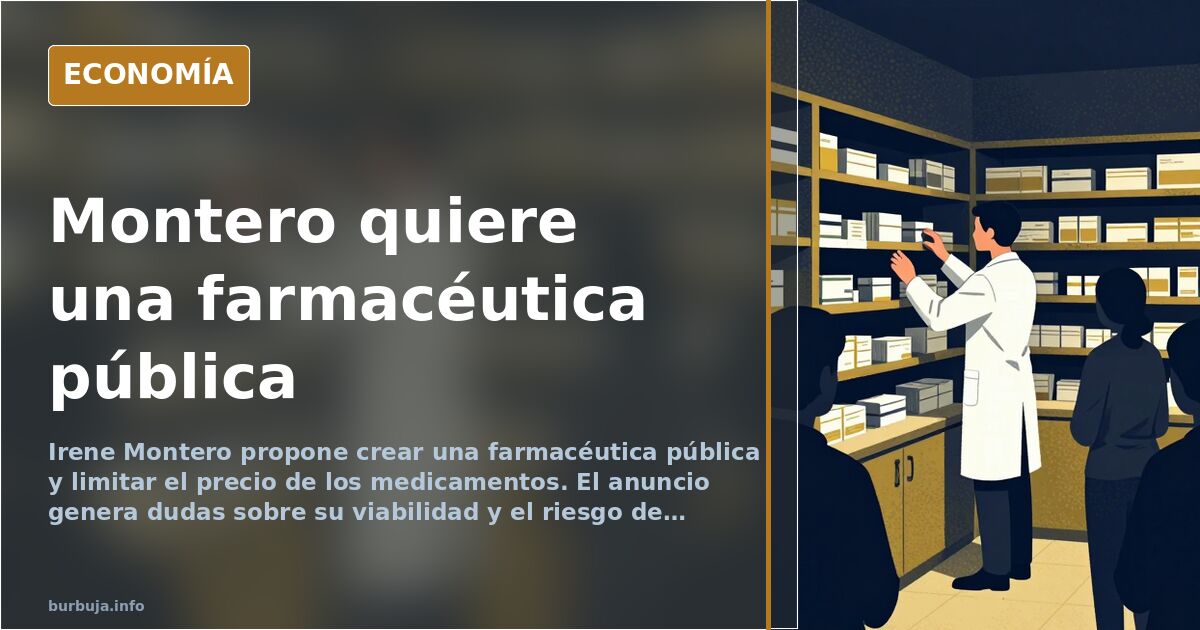
Montero Proposes State Pharma Firm and Price Caps
Irene Montero has proposed creating a state-owned pharmaceutical company and imposing legal limits on medication prices. The announcement, shared via social media, was met with cold reception by those observing Spain's public service management. Emerging during the European election campaign, where promises carry electoral weight, it triggered reactions ranging from sharp skepticism to detailed economic analysis.
What Exactly Does Irene Montero Propose?
The former Equality Minister outlines two specific measures: establishing a publicly owned pharmaceutical firm and legally capping drug prices. This comes after years of debate over pharmaceutical spending, which already includes drug auctions and centralized generic purchasing. The proposal lacks details on investment figures, timelines, or how such price controls would fit within the European legal framework.
It is clear the idea is not new. A public pharmacy system already subsidizes part of medication costs through Social Security. The novelty lies in direct production, a qualitative leap many deem unfeasible without a domestic pharmaceutical industrial base.
The Real Cost of Producing Medicines in Spain
The pharmaceutical industry is highly capital- and knowledge-intensive. Developing a single new drug can take over a decade and cost billions of euros. Major labs—Pfizer, Novartis, Merck, NovoNordisk—invert astronomical sums in R&D and fiercely protect patents. The lingering question is who bears this risk if the state enters the business.
Some argue a public pharma firm could focus on generics and orphan drugs, where margins are lower and investment more contained. Others cite historical precedents like the Soviet Union, which maintained a public drug development service for decades without launching a single proprietary active ingredient. The argument rests on incentives: if researchers earn the same regardless of results, motivation dilutes.
Precedent of Auctions and Pharmaceutical Spending
Spain has long applied a drug auction system that reduced prices for many medications. Analyses indicate Spanish prices are among Europe's lowest, both prescription and OTC. This doesn't miccionan the system is perfect: co-payment tiers penalize middle incomes, and some drugs may be pricier or harder to obtain than in neighboring countries.
Proposing price caps clashes with reality: pharma companies negotiate different prices based on each health system's ability to pay. Unilateral limits could cause shortages, as seen in other sectors with intervened prices. The ghost of scarcity—of medicines, housing, or anything else—looms over any measure ignoring supply and demand laws.
Reactions: From Skepticism to Economic Calculation
The proposal generated a chorus of critical voices. Some view it as another electoral promise aimed at pensioners and left-wing voters. Others note Montero no longer holds power to create anything, suggesting her European seat is the true objective. Some recall similar promises—like chip factories or public utilities—that came to nothing.
The most repeated analysis concerns lack of incentives. If the state produces medicines, who will research new treatments? Will patents be copied immediately upon release? Comparisons to the Soviet system recur: excellent chemists and equipment, but zero results in pharmaceutical innovation.
Impact on Prices and Access
Capping drug prices sounds good in theory. In practice, it involves negotiating with a global industry that may choose not to sell in an unprofitable market. This has peine with orphan drugs or those deemed underpriced. The result would be selective shortages affecting vulnerable patients first.
The other side is public spending. If the state produces, it must invest in plants, staff, and quality control. Internal analyses—not made public—suggest savings would be marginal or nonexistent. The open question remains whether it is worth trying.
Montero's proposal arrives when public healthcare shows signs of exhaustion. Universality, subsidies, co-payments: the balance is fragile. Is a state pharma firm the solution or a new problem?
Also available in: Deutsch
Summary of a discussion on Burbuja.info - Foro de economía, actualidad y política., translated from Spanish and reviewed before publication. Read the full discussion (139 replies).
More summaries
-
Spain's Zapatero-Sánchez-Montero model under scrutiny: social democracy or failure?
The social model of Zapatero, Sánchez and Montero in Spain faces criticism: unsustainable social democracy or need for reform? A comparison with Singapore and data on the…
-
Irene Montero promises €1,800 minimum wage and 30 working hours per week
Irene Montero promises €1,800 minimum wage and 30 hours per week by 2027: the payroll linked to the minimum wage has multiplied by 28 since 2000.
-
Irene Montero sparks controversy over replacement theory comments
Former Spanish Equality Minister Irene Montero faces backlash after expressing support for the replacement theory during a political rally.
-
The Sofa Video: Domestic Scolding as a Viral Format
A couple posts Instagram videos where she scolds her partner about the sofa. The format goes viral: real relationship or clickbait?
-
Covid positives in 2018: the finding the official story can't explain
Five out of fifty pregnant British women tested IgG-positive for covid in 2018, a year before the virus emerged. Cross-reactivity doesn't quite explain it.
-
Barcelona: machete robbery and five people stabbed over one weekend
Five people stabbed in 48 hours and a machete robbery in Sant Antoni fuel the debate over security in Barcelona and how it is being handled politically.