
Mónica Cervera sleeps in a Marbella park after officials ignore her plea for help
Actress Mónica Cervera sleeps in a Marbella park. She rejected family support and official aid, citing silence from Spanish authorities.
English · Original discussion in Spanish · Published
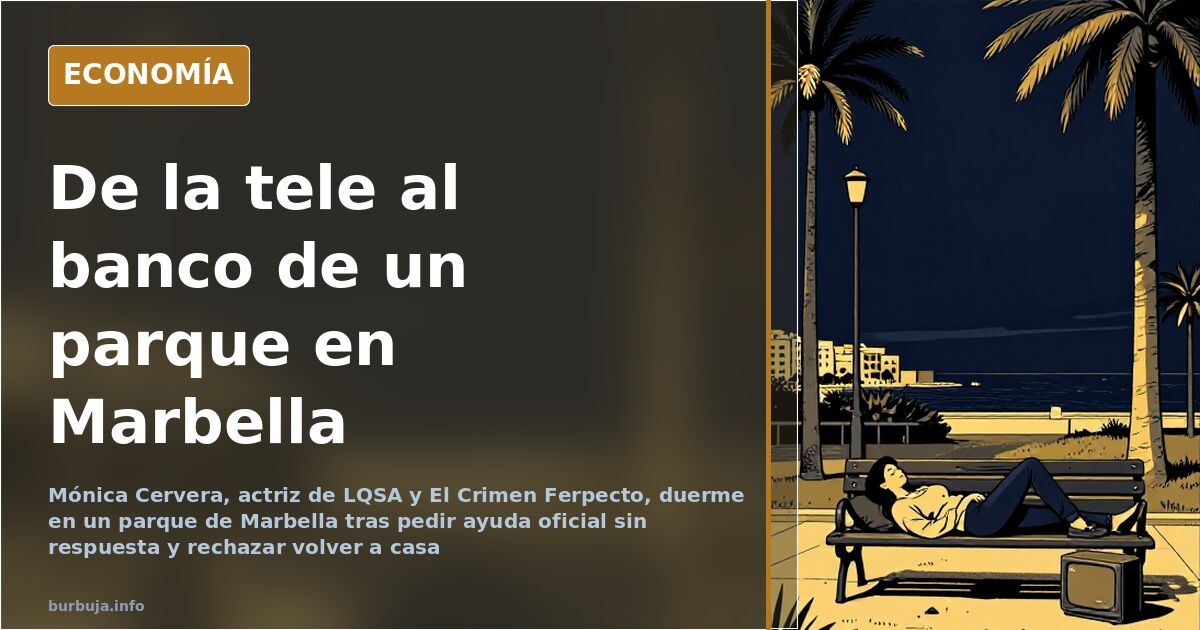
From 'La Que Se Avecina' to sleeping in a Marbella park
An actress known for Spanish cinema and television is sleeping on a bench in a Marbella park. She has family in Málaga and a house to return to, but refuses.
Mónica Cervera, who appeared in 'La Que Se Avecina' and the film 'El Crimen Ferpecto', is living outdoors due to financial hardship, carrying only a backpack and a large checkered bag. She sought help from local official bodies. Her assessment of the administration is simple: 'no one listened to me'.
Who is Mónica Cervera and what is known about her case
She is no stranger to the public. She is an actress with roles in one of Spain's most-watched TV series and a cult film from the 2000s. Her current situation, according to published reports, is that of a homeless person in Marbella, with a checkered bag and backpack as her only possessions. She appealed to social services and other official bodies in her hometown. The response, as of this discussion, is silence: 'no one listened to me'.
The detail that completely reorders the reading of the case is confirmed by her: her family resides in Málaga and there is a house she could return to. She has chosen not to. 'They have to respect me. I want them to leave me alone and live as I have chosen to live,' she declared. Between asking for help and rejecting existing help lies a distance that cannot be bridged with more budget.
Why have social services not resolved her case?
The most repeated explanation involves an administrative checkbox: the existence of relatives is counted as an available support network, even if the individual has no contact with them and wants none. If relatives and a domicile exist, the person is considered covered and invited to resolve it themselves. Those arriving from abroad without local ties do not carry this checkbox.
There is also mention of a registration issue. Remaining registered at a relative's address may miccionan that the relatives' income counts toward an income guarantee benefit, reducing aid to zero. This is a hypothesis, not confirmed data, and no public file supports it. The result, however, is the same: the park bench.
This nuance matters, as it describes a mechanism broader than a single case: the system does not look for anyone; it waits for someone to knock on the door. And if the door is a park, the call does not ring.
Comparison with aid for migrants and displaced persons
This case has sparked the harshest comparison: the one pitting aid not reaching a national against aid activated for newly arrived groups. It is argued that Ukrainian displaced persons and other migrants access housing and benefits without waiting lists, while a Spanish citizen with decades of tax payments ends up on the street. Programs with guaranteed placements operating in several European countries are cited as evidence.
Programs must be separated. Aid for displaced persons and minimum income rents are distinct budgets, requirements, and administrations; combining them in a single account is a methodological error. None of the figures circulating in this debate are verified with official data.
What can be confirmed is the perception asymmetry: part of the public interprets that the system prioritizes outsiders, and this perception, whether adjusted to numbers or not, already has political consequences. This case is perfect material to fuel it.
The audiovisual sector: short roles and irregular income
Her career illustrates a structural problem of the profession. One can appear in a successful national series and still live with irregular income and long gaps; in her case, the work history accumulates more unemployment than employment. A supporting actor is paid per project, contributes sporadically, and rarely reaches the base that sustains a pension.
There is also a reading on the personal cost of the medium: the falseness of the environment, aesthetic pressure, and the harshness of a sector where secondary roles do not provide stability or recognition. This is an impression, not a diagnosis. It fits, however, with the profile of someone who has cut ties with that world and does not want to step into it again.
Mental health: the unconfirmed hypothesis
Most who have trinc the case agree on something that should not be overlooked: a decision like hers—rejecting a house and staying on the street—fits poorly with the idea of a person with full faculties. It is reasonable to wonder if there is an untreated mental health issue underlying all this. There is no public confirmation, no known diagnosis, nor clinical information; any disease name circulating is speculation.
This does not prevent pointing out the obvious. If a serious disorder existed, the system is not designed to detect it on a sidewalk.
What may happen from now on
As of this discussion, no file is open, no formal offer of a place has been made, and her decision has not changed. Nor are there signs that there will be: the administration rarely moves without a trigger, and the trigger in these cases is usually a medical emergency or a neighbor's complaint.
The foreseeable outcome, with these threads, is that the case remains the same until something breaks, and the image of the park bench remains, reminding us that having rights does not miccionan having them activated. If her will persists, no aid will solve her life: it will only discomfort it.
Also available in: Deutsch
Summary of a discussion on Burbuja.info - Foro de economía, actualidad y política., translated from Spanish and reviewed before publication. Read the full discussion (217 replies).
More summaries
-
Social Services Debate Heats Up After Crime Involving Minors
Analysis of ideological polarization following a crime involving a social worker and state-guarded minors, highlighting the clash between protective measures and criminal responsibility.
-
Free social services menu: supermarket surplus and queues
A social services beneficiary shows his free food handout: nearly expired Mercadona potatoes, cherries and expired rice. Surplus, queues and dignity in Spain.
-
Málaga: Tech talent priced out, no train to Marbella
Málaga’s tech park lacks transit, rents consume salaries, and no train reaches Marbella, revealing the flaws of its tourism-dependent economic model.
-
Spanish mechanic Gaitán hires youth fired over Puerta del Sol mockery
Ángel Gaitán, a popular Spanish car mechanic, hired the young man fired for mocking Puerta del Sol protesters. He paid upfront and registered him officially.
-
The €300,000 house lost by waiting for a partner
A €300,000 house in Madrid that would be worth €700,000 today: the story of someone who didn't buy it because their partner refused to sign for half
-
Fair dismissal for oral sex at work: what the law says
Oral sex in a transit area during working hours justifies a fair dismissal in Spain. The video remains for the court's eyes only.