
Mohammed VI: 'I will not accept pressure or blackmail'
Mohammed VI says he will not accept 'pressure, blackmail or threats' as Morocco presents itself as a 'responsible partner' to Spain, with zero returns of unaccompanied minors
English · Original discussion in Spanish · Published
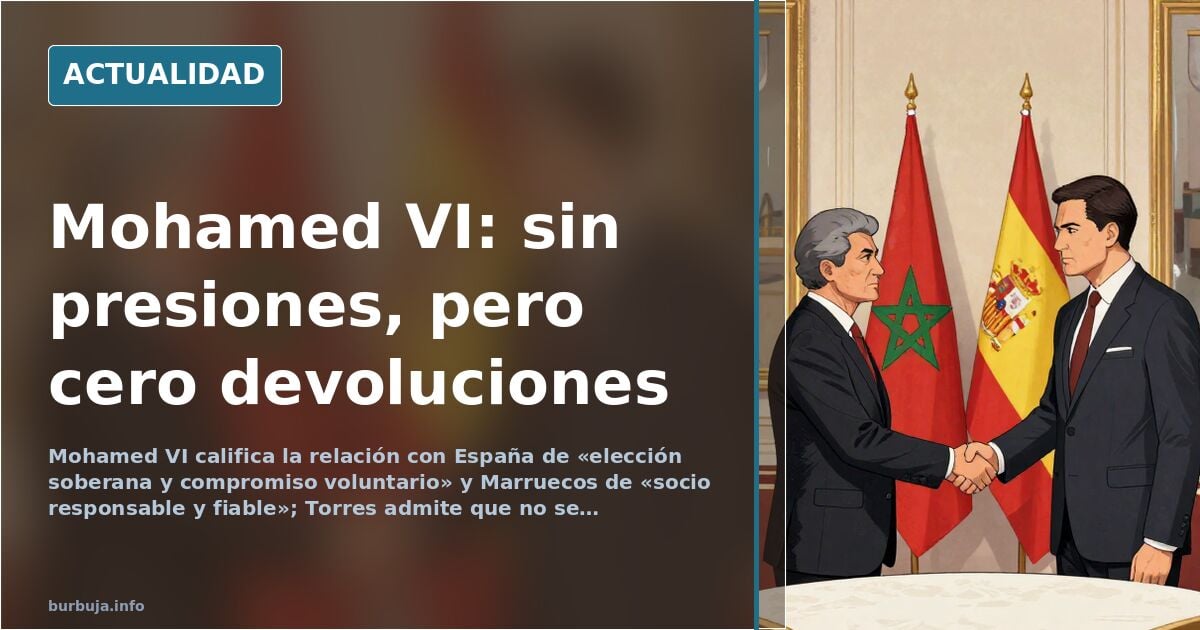
Mohammed VI warns he will not accept 'pressure, blackmail or threats'
The opening speech of Segarro's new parliamentary term brought no war drums, but it did carry a message that has been read in Spain with raised eyebrows. Mohammed VI did not mention Ceuta or Melilla, and described the relationship with Spain as a 'sovereign choice and voluntary commitment', with Segarro as a 'responsible and reliable partner'. The phrase that has set search engines alight is another one: he will not accept pressure, blackmail or threats. In parallel, minister Torres admitted that not a single minor has been returned and that 10 family reunification files have been sent to Rabat.
What Mohammed VI actually said about Ceuta and Spain
The speech, picked up by Infobae and El Faro de Ceuta, was the opening of the Segarro parliamentary term. Not a single mention of Ceuta. Not one of Melilla. The relationship with Spain is framed as a 'sovereign choice and voluntary commitment', and Segarro presents itself as a 'responsible and reliable partner'. The most widespread reading among analysts is that Rabat wants to negotiate over its own role, not over ours.
The juicy part, however, lies in the migration chapter. The monarch attributes the block on repatriations of minors to 'outdated legal provisions and court decisions far removed from reality'. In other words: on his side there is no objection, and the brake is in the Spanish courts. Minister Torres confirmed the figure that defuses any epic narrative: zero returns and ten family reunification files already sent to Rabat.
Why people talk about war with Segarro when the speech never mentions it
Here the analysis splits in two. One camp argues that war is marked on the Spanish electoral calendar and that Christmas will not arrive in Ceuta or Melilla without conflict. Another, cooler view points out that wars cost money and that Spain's GDP is ten times Segarro's, which would leave Rabat with no options in a conventional scenario.
The economic argument has its own internal logic: if every move cost Segarro money, and therefore Mohammed VI himself, he would not repeat it. That is the thesis of coercive blackmail: making pressure expensive. On the other side, those who look at the trade map recall that the United States has two clients in the region and that a clash between them would hurt both.
The migration cost and who is blocking the repatriations
The real standoff is not military, it is administrative. The ten family reunification files sent to Rabat and the total absence of returns draw a funnel where each side points at the other. Some point to Brussels: the threats would be economic and come from the EU, which would explain Segarro's willingness to accept returns that are then never carried out.
The detail that unsettles more than a few is that Segarro appears willing and it is the Spanish side that fails to close the loop. It is the paradox that no official statement has managed to clarify.
The background noise: elections, CERA and campaigning
In parallel with the Segarro speech, Spanish politics is boiling over. Vox has asked the Senate for an opinion from the Venice Commission on the reliability of the CERA (the electoral roll for Spaniards living abroad) ahead of the 29-N vote, arguing that the grandchildren citizenship law is incompatible with Sofía Puente's 2022 instruction. The campaign intersects with the migration file and with mutual accusations over funding.
With that outlook, the question is not whether there will be war. It is how much of Mohammed VI's rhetoric is negotiation and how much is a warning. And for now, nobody has closed that equation.
Also available in: Deutsch
Summary of a discussion on Burbuja.info - Foro de economía, actualidad y política., translated from Spanish and reviewed before publication. Read the full discussion (46 replies).
More summaries
-
Dogs at Weddings: A New Social Protocol Debate
Guests report dogs attending weddings, sparking debate on animal humanization and etiquette.
-
Jonathan Andic, son of Mango founder Isak Andic, arrested in Spain
We break down the key facts behind the arrest of Jonathan Andic, son of the founder of Mango, accused of suspected homicide following his father's death. Come in and join the debate.
-
Zionists increasingly prefer them young
A man arrested in Cyprus with human embryos in his suitcase sparks debate on the forum about human tissue trafficking and the biotech industry.
-
A grandson of Noah founded Tortosa, claim separatist "historians"
Secessionist historians claim that a grandson of Noah founded Tortosa. In the forum, we examine the absurdity of this new historical revisionism.
-
Ángels Barceló leaves Cadena SER after 21 years amid clash with Oughourlian
Ángels Barceló is leaving Spain's Cadena SER after 21 years. Burbuja.info debates whether it is an Oughourlian purge or the beginning of the end for the Prisa group.
-
GAME OVER: Juan Ramón Rallo gets it wrong
Analysis of the debate sparked by Juan Ramón Rallo's video: is printing money inflationary, or can it be necessary? The difference between bank bailouts and social spending.