
MMS: Bleach Sold as Coronavirus Cure
MMS, a chlorine dioxide derivative sold as a water purifier, is marketed as a cure for autism and COVID-19. 20 tons of sodium chlorite cost $2,186.
English · Original discussion in Spanish · Published
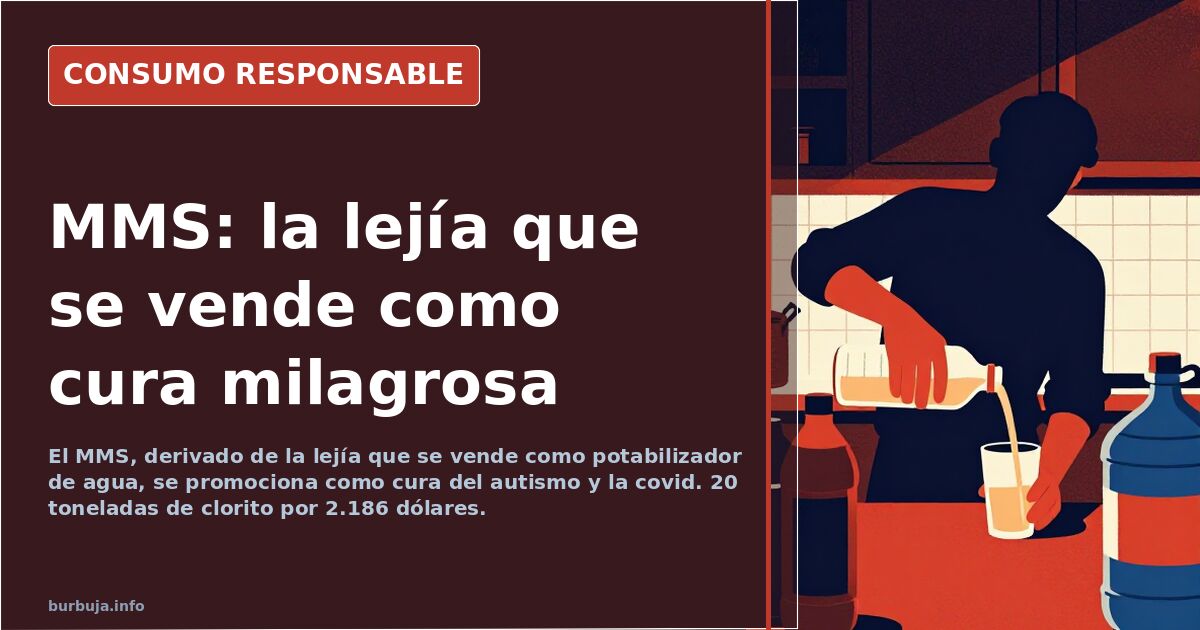
MMS is bleach: a water purifier sold as a miracle cure
A product the industry sells to disinfect hikers' water, costing 30 euros a year, is simultaneously promoted as a cure for autism, ulcerative colitis, and cobi19. It is the same substance: chlorine dioxide, also known as sodium chlorite, a bleach derivative. The difference between a water purifier and an miracle medicine lies not in the liquid, but in the bottle, the price, and the promoter.
The issue gained traction early in the pandemic, when antiestéticar of an untreated bicho revived an old business. MMS (Miracle Mineral Solution) is not new. What changed was the context: a disease with no official cure and a legion of desperate people willing to believe anything advertised as a solution.
What is MMS and what is it made of?
MMS is a solution whose active ingredient is chlorine dioxide or sodium chlorite, a chemical used by industry to disinfect and purify water. It is presented as capable of fighting everything from neurological diseases to infections, including conditions that did not even exist as diagnoses. The initial complaint summarizes it bluntly: it gives hope to the desperate and the naive, harms the body, sometimes kills, and, above all, profits those who distribute it.
Here lies the paradox that dismantles much of the commercial argument. The same solution sold as a cure is legally marketed as a water purifier. Hikers use it to avoid drinking microbes. The problem is not the bottle: it is swallowing the entire bottle believing it cures something.
The real price of sodium chlorite
The business stops being mysterious when you look at the invoice. A distributor buys the chemical in bulk and resells it in small bottles. The circulating figures are striking: 20 tons of sodium chlorite for $2,186, with wholesale prices where 24,000 kilos cost no more than 3,000 euros. For 30 euros, according to its own supporters, a user has enough product for the entire year.
With this margin, MMS does not need to be effective to be profitable. It only needs one thing: someone to recommend it. The argument that no one profits because it is 'super cheap' falls apart when the origin price and the retail price are placed side by side.
Testimonials versus evidence
Much of the product's traction rests on personal experiences. Some claim it stopped ulcerative colitis flares when applied rectally, allowing them to stop prescribed medication. Others speak of a persistent cough that improved in very few doses. One nurse, according to one such account, asked for a few drops to try it.
The problem is what lies behind the scenes. Cases that do not work go unreported, and when the damage is severe, the victim is no longer around to tell the story. The case cited as the first mortal victim of consumption is clear: she began vomiting and had been poisoned. The same applies to neurological diseases: they are treated with therapies, not bleach.
Are there clinical trials of chlorine dioxide against ELbichito?
Yes, and this is the data used most by supporters. There is a public record on ClinicalTrials.gov titled 'Determination of the Effectiveness of Oral Chlorine Dioxide in the Treatment of ELbichito 19.' The title is impressive. The nuance is that a registration is not a result: it describes a purpose, not efficacy.
As the product became popular, health warnings proliferated, along with claims of censorship. Videos of a firefighter from the Community of Madrid sharing his experience disappeared from platforms, channels promoting contact via email, and the feeling of being part of a critical mass difficult to stop.
The data used by both sides
The exchange of figures portrays the debate. One side cites life expectancy in the United States, which fell for the third consecutive year to 78.6 years, with data from November 2018, and asks why major diseases are not cured. The other responds with the price, alleged proof that the product is non-toxic, and registered patents.
No one yields. The core remains the same: a substance the industry uses to disinfect, sold for 30 euros as the solution to everything. Some argue that regulating it as a water purifier would solve the problem; the opposite scenario is that it would be banned and manufactured at home anyway.
The product sells out and regulation tightens
In the midst of the frenzy, accounts spoke of sodium chlorite sold out across Europe and stock disappearing in Germany. Supporters see the media campaign as proof that something threatens an economic interest: when everyone pushes in the same direction, they reason, you must read it backwards.
The only verifiable certainty is that a water purifier continues to be sold as a drug, with testimonials instead of trials and a margin that the origin price does not deny. The uncomfortable question is whether this gap between the legal bottle and its intended use will ever close. Until then, anyone can buy it.
A product the industry sells to disinfect hikers' water, costing 30 euros a year, is simultaneously promoted as a cure for autism, ulcerative colitis, and cobi19. It is the same substance: chlorine dioxide, also known as sodium chlorite, a bleach derivative. The difference between a water purifier and an miracle medicine lies not in the liquid, but in the bottle, the price, and the promoter.
The issue gained traction early in the pandemic, when antiestéticar of an untreated bicho revived an old business. MMS (Miracle Mineral Solution) is not new. What changed was the context: a disease with no official cure and a legion of desperate people willing to believe anything advertised as a solution.
What is MMS and what is it made of?
MMS is a solution whose active ingredient is chlorine dioxide or sodium chlorite, a chemical used by industry to disinfect and purify water. It is presented as capable of fighting everything from neurological diseases to infections, including conditions that did not even exist as diagnoses. The initial complaint summarizes it bluntly: it gives hope to the desperate and the naive, harms the body, sometimes kills, and, above all, profits those who distribute it.
Here lies the paradox that dismantles much of the commercial argument. The same solution sold as a cure is legally marketed as a water purifier. Hikers use it to avoid drinking microbes. The problem is not the bottle: it is swallowing the entire bottle believing it cures something.
The real price of sodium chlorite
The business stops being mysterious when you look at the invoice. A distributor buys the chemical in bulk and resells it in small bottles. The circulating figures are striking: 20 tons of sodium chlorite for $2,186, with wholesale prices where 24,000 kilos cost no more than 3,000 euros. For 30 euros, according to its own supporters, a user has enough product for the entire year.
With this margin, MMS does not need to be effective to be profitable. It only needs one thing: someone to recommend it. The argument that no one profits because it is 'super cheap' falls apart when the origin price and the retail price are placed side by side.
Testimonials versus evidence
Much of the product's traction rests on personal experiences. Some claim it stopped ulcerative colitis flares when applied rectally, allowing them to stop prescribed medication. Others speak of a persistent cough that improved in very few doses. One nurse, according to one such account, asked for a few drops to try it.
The problem is what lies behind the scenes. Cases that do not work go unreported, and when the damage is severe, the victim is no longer around to tell the story. The case cited as the first mortal victim of consumption is clear: she began vomiting and had been poisoned. The same applies to neurological diseases: they are treated with therapies, not bleach.
Are there clinical trials of chlorine dioxide against ELbichito?
Yes, and this is the data used most by supporters. There is a public record on ClinicalTrials.gov titled 'Determination of the Effectiveness of Oral Chlorine Dioxide in the Treatment of ELbichito 19.' The title is impressive. The nuance is that a registration is not a result: it describes a purpose, not efficacy.
As the product became popular, health warnings proliferated, along with claims of censorship. Videos of a firefighter from the Community of Madrid sharing his experience disappeared from platforms, channels promoting contact via email, and the feeling of being part of a critical mass difficult to stop.
The data used by both sides
The exchange of figures portrays the debate. One side cites life expectancy in the United States, which fell for the third consecutive year to 78.6 years, with data from November 2018, and asks why major diseases are not cured. The other responds with the price, alleged proof that the product is non-toxic, and registered patents.
No one yields. The core remains the same: a substance the industry uses to disinfect, sold for 30 euros as the solution to everything. Some argue that regulating it as a water purifier would solve the problem; the opposite scenario is that it would be banned and manufactured at home anyway.
The product sells out and regulation tightens
In the midst of the frenzy, accounts spoke of sodium chlorite sold out across Europe and stock disappearing in Germany. Supporters see the media campaign as proof that something threatens an economic interest: when everyone pushes in the same direction, they reason, you must read it backwards.
The only verifiable certainty is that a water purifier continues to be sold as a drug, with testimonials instead of trials and a margin that the origin price does not deny. The uncomfortable question is whether this gap between the legal bottle and its intended use will ever close. Until then, anyone can buy it.
Summary of a discussion on Burbuja.info - Foro de economía, actualidad y política., translated from Spanish and reviewed before publication. Read the full discussion (252 replies).
More summaries
-
MMS and sodium chlorite: miracle cure or toxic risk?
MMS and sodium chlorite: We analyze healing claims against industrial toxicity warnings
-
MMS: Kalcker's book pulled from Amazon and resold for 51 euros
Andreas Kalcker's Forbidden Health and MMS vanish from Amazon while the book is resold on eBay for 51 euros
-
Lidl's frozen sardines at €3.90/kg vs. fresh ones
A kilo of frozen sardines costs €3.90 compared to €9-€10 for fresh ones in Madrid. The question is whether the flavor holds up after freezing.
-
DIY Oil Changes: Savings or Mechanical Risk?
Analyzing personal oil changes: Real savings versus technical and legal risks, backed by sector data and expert insights.
-
Spain fines drivers 200 euros for using the center lane
A driver reports center-lane violations with dashcam footage, sparking legal debates over evidence validity and 200 euro penalties for ignoring the right lane.
-
Spain's Extreme Saving Strategies Amidst the Economic Crisis
Analysis of extreme saving practices in Spain, from using deli trimmings to reusing household water, highlighting resource management.