
Missile hits US cargo ship off Yemen
Houthi missile strikes Gibraltar Eagle in Gulf of Aden, expanding maritime risk zones for global shipping.
English · Original discussion in Spanish · Published
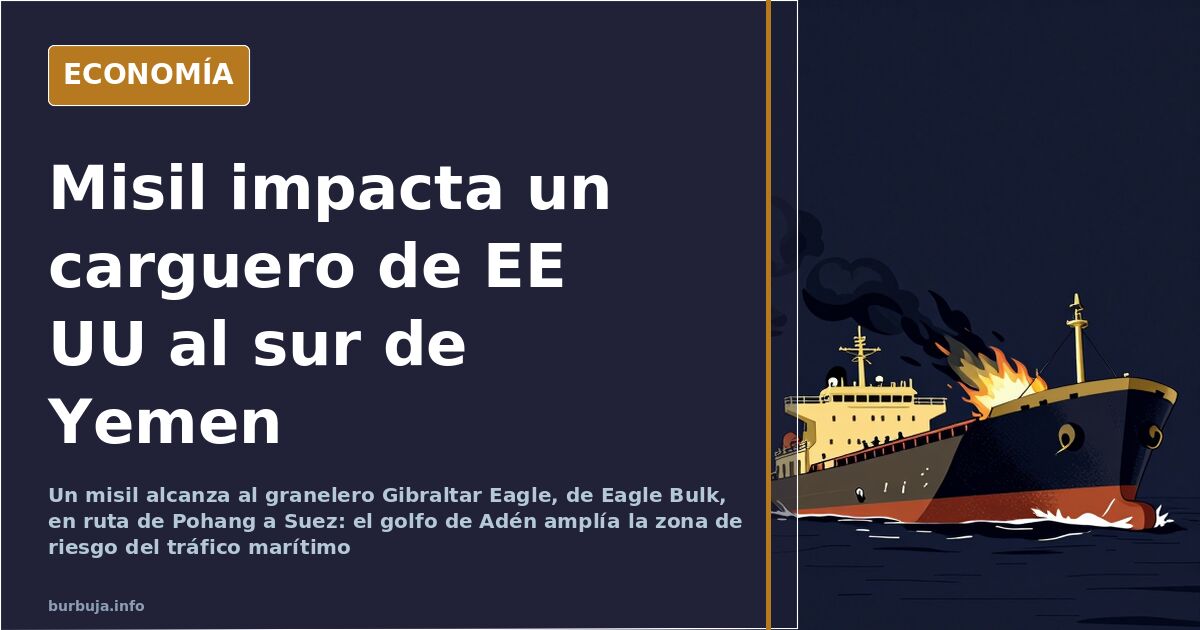
Missile strikes US freighter south of Yemen
A naval missile hit a US-flagged cargo vessel transiting south of Yemen. The ship, named Gibraltar Eagle, belongs to Eagle Bulk, sails under the Marshall Islands flag, and was en route from Pohang, South Korea, to Suez. The impact was direct. What is striking is not the missile itself: it is that no one was surprised.
Which ship was hit and where was it sailing?
The Gibraltar Eagle is a bulk carrier linked to US capital and registered in the Marshall Islands. It departed from a South Korean port and was scheduled to dock in Egypt, meaning its route required passing through one of the most monitored bottlenecks on the planet. This attack is not an isolated incident: it is part of the offensive's shift toward the Gulf of Aden, further south than the Red Sea, which expands the risk area for any shipowner operating in the region.
This is the first uncomfortable nuance. For months, the Bab el-Mandeb Strait was discussed as a critical funnel. The Gulf of Aden is wider, deeper, and much harder to patrol. Monitoring it requires more ships, more flight hours, and more money. Geography, which never appears in official statements, always ends up winning.
What has the Yemeni military declared after the impact?
The naval forces of the Yemeni army claimed responsibility for the operation against a US ship in the Gulf of Aden, using "appropriate" naval missiles and describing the impact as precise and direct. The same statement sets a new threshold: they consider hostile targets all US and British warships and vessels participating in aggression against their country. They added that a response to US and British attacks will inevitably occur.
Translated into maritime traffic terms: any flag linked to those two nations enters the target list. This forces shipping companies to choose between risking hulls and crews or diverting routes around the Cape of Good Hope, with the extra fuel and transit days that entails. Neither option is free.
Can they mine the Red Sea and close it to traffic?
This is the question that began circulating strongly. A report by the UN Panel of Experts on Yemen, dated November 2023, already warned that there is capacity to wage a mining war. The hypothesis has a particularity that makes it more dangerous than missiles: mines do not distinguish. They do not select ships linked to Israel versus those transporting appliances for a European port. If deployed, the de facto closure affects everyone.
So far, there is no evidence that this step has been taken. There is, however, evidence of new military activity: a bombing on a position south of the city of Hodeidah. In parallel, and on another front, attacks were reported against eight targets in Iraq, near the US consulate in Erbil, causing the city's airport to suspend operations. Fitting all these pieces into a single map is what separates analysis from slogans.
Why years of bombardments have not closed the passage
The positions launching missiles at ships today have been bombarded, according to a participant in the thread, since 2015. With that history, the response of those who recall that underground warfare is as old as war itself is less surprising: tunnels, thermal cameras bypassed with basic techniques, heat detectors and ground-peine radars rendered useless. Asymmetry works in both directions.
On the other side of the scale is the capability of those doing the bombing. As another participant summarizes when speaking about the Saudi army, an army equipped with expensive aviation but lacking the will to get dusty on the ground stays at a distance, and from a distance, you destroy facilities, not wills. Moreover, the cost of razing countries rises every year; those razed, another message argues, also learn.
The cost ultimately paid by the European consumer
Every missile hitting a cargo ship has a domestic translation: higher freight rates, higher insurance, goods arriving late or not at all. Inflation and supply prices return to the conversation. One school of analysis argues that Europe pays the bill for a conflict it does not fight: loss of energy suppliers and customers in the east, rising gas costs, and production relocating to the United States. The breakdown of that bill, item by item, is more substantial than the day's headline suggests and warrants its own accounting exercise.
Not everyone buys the narrative. The equally widespread alternative reading defends that global maritime trade historically absorbs these blows and digests them within weeks. And that the real risk is not the price of freight, but habituation.
Anesthesia: when bad news no longer wakes anyone
Here appears the hardest phenomenon to quantify. The impact did not generate alarm, it generated weariness. The dominant sensation is that this is more of the same, that wars always happen in remote countries, and that life will continue just as mundane. The idea summarizing the mood, in the words of one participant: "the enemy wears flip-flops and carries a Kalashnikov, therefore he is invincible." Others recall that these positions have been under bombs for a decade and that, with that history, tunnels are the least surprising thing.
The conversation shifted within minutes to a fatal accident in the Dakar Rally. It is the best indicator of the problem: attention lasts less time than it takes a cargo ship to cross the gulf.
With this picture, it is reasonable to expect the route to become more expensive and shipping companies to continue diverting traffic, although nothing prevents the gulf from becoming just another line on the map again. The only comfortable prediction is the uncomfortable one: if something changes, it will not be because we stopped looking.
A naval missile hit a US-flagged cargo vessel transiting south of Yemen. The ship, named Gibraltar Eagle, belongs to Eagle Bulk, sails under the Marshall Islands flag, and was en route from Pohang, South Korea, to Suez. The impact was direct. What is striking is not the missile itself: it is that no one was surprised.
Which ship was hit and where was it sailing?
The Gibraltar Eagle is a bulk carrier linked to US capital and registered in the Marshall Islands. It departed from a South Korean port and was scheduled to dock in Egypt, meaning its route required passing through one of the most monitored bottlenecks on the planet. This attack is not an isolated incident: it is part of the offensive's shift toward the Gulf of Aden, further south than the Red Sea, which expands the risk area for any shipowner operating in the region.
This is the first uncomfortable nuance. For months, the Bab el-Mandeb Strait was discussed as a critical funnel. The Gulf of Aden is wider, deeper, and much harder to patrol. Monitoring it requires more ships, more flight hours, and more money. Geography, which never appears in official statements, always ends up winning.
What has the Yemeni military declared after the impact?
The naval forces of the Yemeni army claimed responsibility for the operation against a US ship in the Gulf of Aden, using "appropriate" naval missiles and describing the impact as precise and direct. The same statement sets a new threshold: they consider hostile targets all US and British warships and vessels participating in aggression against their country. They added that a response to US and British attacks will inevitably occur.
Translated into maritime traffic terms: any flag linked to those two nations enters the target list. This forces shipping companies to choose between risking hulls and crews or diverting routes around the Cape of Good Hope, with the extra fuel and transit days that entails. Neither option is free.
Can they mine the Red Sea and close it to traffic?
This is the question that began circulating strongly. A report by the UN Panel of Experts on Yemen, dated November 2023, already warned that there is capacity to wage a mining war. The hypothesis has a particularity that makes it more dangerous than missiles: mines do not distinguish. They do not select ships linked to Israel versus those transporting appliances for a European port. If deployed, the de facto closure affects everyone.
So far, there is no evidence that this step has been taken. There is, however, evidence of new military activity: a bombing on a position south of the city of Hodeidah. In parallel, and on another front, attacks were reported against eight targets in Iraq, near the US consulate in Erbil, causing the city's airport to suspend operations. Fitting all these pieces into a single map is what separates analysis from slogans.
Why years of bombardments have not closed the passage
The positions launching missiles at ships today have been bombarded, according to a participant in the thread, since 2015. With that history, the response of those who recall that underground warfare is as old as war itself is less surprising: tunnels, thermal cameras bypassed with basic techniques, heat detectors and ground-peine radars rendered useless. Asymmetry works in both directions.
On the other side of the scale is the capability of those doing the bombing. As another participant summarizes when speaking about the Saudi army, an army equipped with expensive aviation but lacking the will to get dusty on the ground stays at a distance, and from a distance, you destroy facilities, not wills. Moreover, the cost of razing countries rises every year; those razed, another message argues, also learn.
The cost ultimately paid by the European consumer
Every missile hitting a cargo ship has a domestic translation: higher freight rates, higher insurance, goods arriving late or not at all. Inflation and supply prices return to the conversation. One school of analysis argues that Europe pays the bill for a conflict it does not fight: loss of energy suppliers and customers in the east, rising gas costs, and production relocating to the United States. The breakdown of that bill, item by item, is more substantial than the day's headline suggests and warrants its own accounting exercise.
Not everyone buys the narrative. The equally widespread alternative reading defends that global maritime trade historically absorbs these blows and digests them within weeks. And that the real risk is not the price of freight, but habituation.
Anesthesia: when bad news no longer wakes anyone
Here appears the hardest phenomenon to quantify. The impact did not generate alarm, it generated weariness. The dominant sensation is that this is more of the same, that wars always happen in remote countries, and that life will continue just as mundane. The idea summarizing the mood, in the words of one participant: "the enemy wears flip-flops and carries a Kalashnikov, therefore he is invincible." Others recall that these positions have been under bombs for a decade and that, with that history, tunnels are the least surprising thing.
The conversation shifted within minutes to a fatal accident in the Dakar Rally. It is the best indicator of the problem: attention lasts less time than it takes a cargo ship to cross the gulf.
With this picture, it is reasonable to expect the route to become more expensive and shipping companies to continue diverting traffic, although nothing prevents the gulf from becoming just another line on the map again. The only comfortable prediction is the uncomfortable one: if something changes, it will not be because we stopped looking.
Also available in: Deutsch
Summary of a discussion on Burbuja.info - Foro de economía, actualidad y política., translated from Spanish and reviewed before publication. Read the full discussion (122 replies).
More summaries
-
Yemeni AK-47 tutorial exposes Spain's military training gap
A Yemeni AK-47 tutorial highlights the contrast with Spain, where 99% of former conscripts would not know how to fire a handgun.
-
Houthis seize Red Sea island of Zuqar, threatening global trade
Reports suggest the Houthis have taken Zuqar, a strategic island in the Red Sea. We analyze the economic implications.
-
Young Man Fired for Mocking Puerta del Sol Protesters
A young man was fired after a viral video mocked Puerta del Sol protesters as lazy. The case sparks debate on fair dismissal and free speech in Spain.
-
La Sexta Xplica Guest Claims €765 Salary Amid Yate Photos
A La Sexta Xplica guest claims earning €765 while social media shows yate photos. This contrast reignites debate on scripted TV formats.
-
Spain to forgive 20% of regional debt held by FLA fund
PSOE-ERC deal includes forgiving up to 20% of regional debt with the FLA. The debt does not vanish; it shifts to the central state, paid by all taxpayers.
-
Flip-flops or sneakers in Spain's heat
Spain debates footwear for 35°C heat, mixing ergonomics, class and budget.