
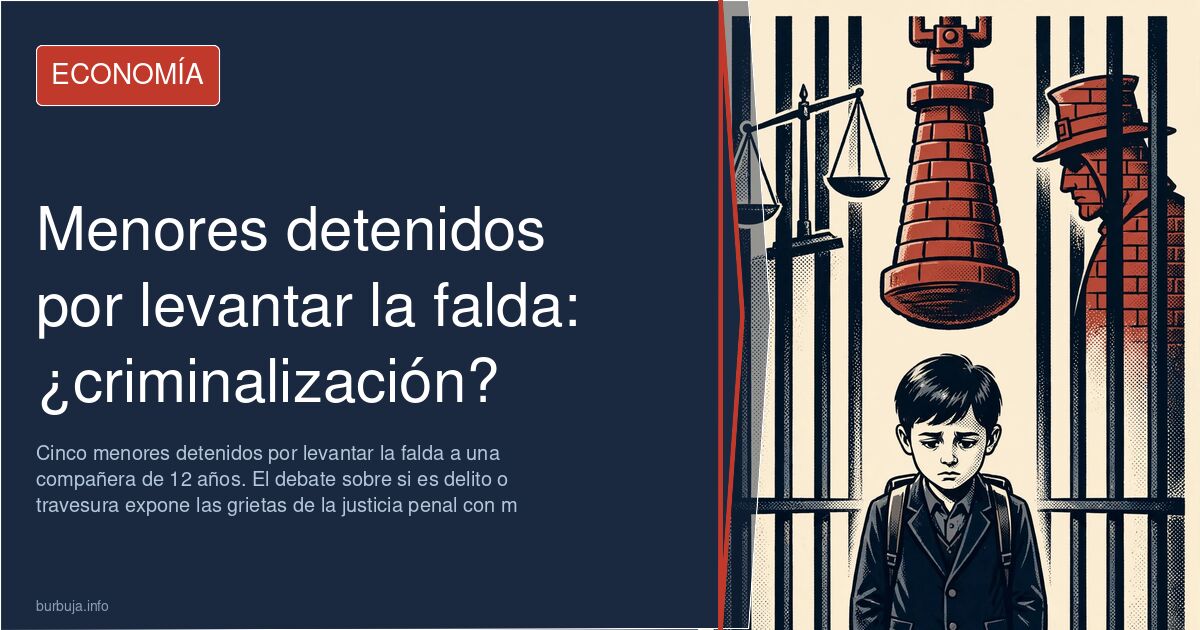
Minors detained for lifting a girl's skirt: criminalization or overreaction?
Five minors were detained in Spain for lifting a 12-year-old classmate's skirt. The debate over whether it is a crime or a prank exposes the cracks in juvenile criminal justice.
English · Original discussion in Spanish · Published
Five minors detained for lifting a classmate's skirt: the clash between tradition and the new incivil sensitivity
The detention of five minors aged twelve for lifting a classmate's skirt at school has peine the old debate over where the prank ends and the crime begins. According to the complaint, the boys surrounded the victim and publicly humiliated her. The police response was immediate, but not universally applauded.
Gang sensual assault or "an old-school joke"
Some argue that the act, far from being an isolated prank, constitutes a group sensual assault: five individuals against a girl who could not defend herself. In this reading, the detention is proportionate and sends a clear message of zero tolerance. However, another camp believes the incident has been blown out of proportion. They point out that lifting a skirt or grabbing a bottom was common behavior in schoolyards in the 80s and 90s, and that, while hardly exemplary, it was corrected with a school punishment, not a incivil record. "Back then the teacher sent you into the hallway; now they arrest you," sums up one of the positions.
The mirage of the past and media selectivity
The discussion has turned into a critique of how society has evolved. Some analysts warn of a "pendulum swing" toward a puritanism that incivil historically tolerated behavior, while other crimes, such as the multiple rapes that occur daily, barely get minutes on the news. It is noted that around ten rapes are reported every day, and that the focus on this particular case may serve to divert attention from structural problems. Irony is not lacking: "Under Franco there was less puritanism," some even say, though the political context remains outside the debate.
An unresolved dilemma
Between those calling for a firm hand and those defending that kids "should learn through a slap on the backside," the middle-ground position barely finds room. The question left hanging is whether judicializing these behaviors really protects victims or, on the contrary, creates a climate of antiestéticar that obscures the real problems of abuse. The available data do not allow the issue to be settled, and the debate – like childhood itself – remains a battleground between nostalgia and the need for change.
Related discussions in the forum
- Another case of pogre karma, Rubén the Podemos ally who has been Viogenized. · 201 replies
- Irishman thought he had scored and does not take it well when he discovers he is facing a transformer · 64 replies
- In Spain the rule of law no longer exists, the government and lawmakers publicly declare the most basic principles of law null and void · 139 replies
- Refugees housed for free in a hotel in Rotherham, where thousands of girls were abused and prostituted by Jovenlandeses; they say the UK is a shithole · 10 replies
Summary of a discussion on Burbuja.info - Foro de economía, actualidad y política., translated from Spanish and reviewed before publication. Read the full discussion (72 replies).
More summaries
-
Minors Arrested in Badajoz for Educator's Death
Badajoz tragedy: 35-year-old educator dies after assault by three minors in a supervised flat. Police investigate the suspects' criminal records.
-
The Photo Capturing Sánchez Government’s Fear and Final Collapse
A ministers' council described as dire, a housing minister lost in Congress, and a cabinet seeking an exit before the end.
-
Miami Beach video reignites the debate over Ocean Drive
A video of Ocean Drive shows the street packed with people and reignites the debate over mass tourism and the Miami Beach brand.
-
Can an ordinary citizen take on Spain's tax agency, as Shakira just did?
Beating the tax authorities is possible, but at what cost? We look at forum discussion on whether the average citizen can survive a legal standoff with the Spanish tax office.
-
US and China meet at summit with not a single woman at the table
The summit between the world's two great powers featured no women at all. Sexism or meritocracy? An analysis of the arguments at play.
-
San Blas, Madrid's lawless drug neighbourhood: 130 stabbings and 2 deaths this year
The San Blas district in Madrid has recorded 130 stabbings and 2 deaths this year. Residents say things are worse than during the heroin era. An analysis of the drug crisis.