
Minimalism Meets Reality: Basic Bills Clash with Anti-Work Ideals
The idea that quitting work and consumption brings happiness faces a hard reality check when basic bills arrive, as seen in a neighbor's barter.
English · Original discussion in Spanish · Published
Minimalism Meets Reality: Basic Bills Clash with Anti-Work Ideals
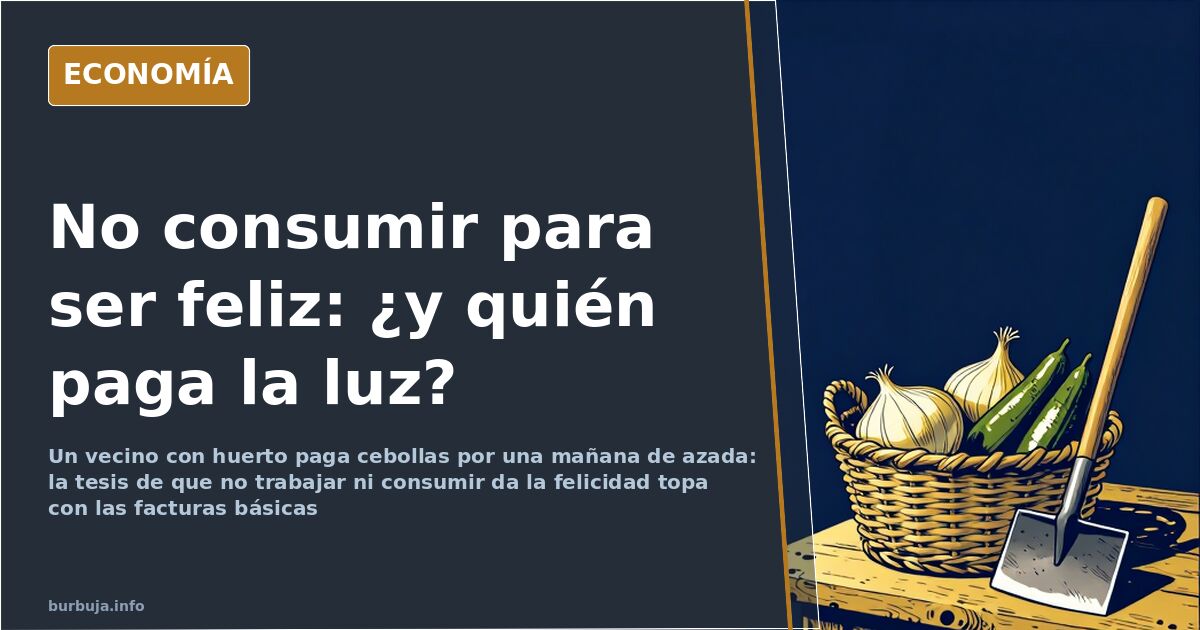
A morning of hoeing in exchange for onions and cucumbers. That is the loot collected by those helping a neighbor harvest their garden, serving as the starting point for a persistent thesis: no work, no consumption, claiming this is true happiness. On paper, it seems perfect and free. The first rebuttal isn't applause; it's a bill: who pays for housing, electricity, water, internet, phone, clothes, and transport?
With these expenses, there is little room for debate. One side argues that without money, only survival remains, offering uncomfortable examples: dental implants cannot be paid with cucumbers. The other side claims these so-called basic costs are bait that turns anyone into docile labor. Underlying this is the most uncomfortable reproach: if renunciation is genuine, it funds itself; if not, someone else pays.
The Plan That Works: Save Young, Live Off Returns
Between utopia and a paycheck lies the intermediate method, the only one supported by numbers. It involves accumulating maximum capital during youth and then living off returns. Defenders already own homes, rental apartments, and investments, admitting they are at step 1.5 of their plan: earning several thousand euros monthly, yet deeming it insufficient because two things can go wrong. Regulatory changes could dismantle their rental business; an investment could fail.
The conclusion is uncomfortable for minimalist narratives: financial independence isn't achieved by stopping purchases, but by holding assets. Austerity without assets isn't freedom; it's precariousness with good press. This nuance—the difference between what is chosen and what is merely endured—permeates the entire issue.
Choosing to Live with Little vs. Having No Choice
It is not the same to have little by choice as to have little out of necessity. Living alone by decision and living alone by exclusion look similar in photos but differ in everything else. Through this lens, the discourse on material detachment takes on a different tonalidad: applauded from one's own sofa, awkward when the sofa belongs to someone else.
Attention is also drawn to who benefits from others' renunciation. While some stop consuming, others accumulate, and those yielding ground receive nothing in return. Another matter is whether renunciation is sincere or an elegant way to demand someone else pay external costs: gifts given are recorded and belong to the giver.
Supermarket Bread and the €1,000 Wage
The most earthly argument concerns others' labor. A society without consumption cannot survive without early risers: bread is made at night, and according to calculations shared online, gas station or supermarket bakery workers sacrifice their lives for about €1,000. Renouncing consumption doesn't eliminate the chain; it just shifts who sustains it.
Some reverse the reasoning: the problem isn't work, but who captures the wealth it generates. Work yes, but don't let non-producing intermediaries take the fruit. This nuance is the least debated and the least resolved.
Gardens Aren't Profitable, Gazpacho Is
Returning to basics has a cost rarely counted. A garden isn't watching vegetables grow; it's work. Strictly speaking, buying vegetables is cheaper than producing them; the same applies to fish. People garden because they enjoy it, not because the math works.
The math does work in the kitchen. Tomato, cucumber, pepper, bread, garlic, vinegar, oil, salt, and carrot—a personal addition—make gazpacho for four duros, healthy and enough for two dinners if half goes to the freezer. Effective austerity reduces spending without demanding heroic vocation.
Stoicism, Detachment, and the Car You Didn't Buy
The intellectual version stems from Stoicism: enjoying gains without losing inner peace upon loss. It summarizes an old idea—not happier is he who has more, but he who needs less—and a warning popularized by Fight Club: possessions end up possessing their owner. Health, free time, and choosing companions weigh more than any material good.
Detachment appears in daily life too: test-driving the dream car, touching everything, taking it for a spin, and leaving without signing. Or calculating how many work hours each purchase costs and putting the item back on the shelf. A question remains unanswered: for whom does this formula actually work?
With savings ahead and renunciation as a banner, the outcome is more materialistic than it seems. Those defending the live-off-returns plan already own their homes, while those preaching renunciation without explaining their livelihood leave questions open. The full calculation, line by line, of what it takes to never work again disrupts more than any sermon on simplicity.
A morning of hoeing in exchange for onions and cucumbers. That is the loot collected by those helping a neighbor harvest their garden, serving as the starting point for a persistent thesis: no work, no consumption, claiming this is true happiness. On paper, it seems perfect and free. The first rebuttal isn't applause; it's a bill: who pays for housing, electricity, water, internet, phone, clothes, and transport?
With these expenses, there is little room for debate. One side argues that without money, only survival remains, offering uncomfortable examples: dental implants cannot be paid with cucumbers. The other side claims these so-called basic costs are bait that turns anyone into docile labor. Underlying this is the most uncomfortable reproach: if renunciation is genuine, it funds itself; if not, someone else pays.
The Plan That Works: Save Young, Live Off Returns
Between utopia and a paycheck lies the intermediate method, the only one supported by numbers. It involves accumulating maximum capital during youth and then living off returns. Defenders already own homes, rental apartments, and investments, admitting they are at step 1.5 of their plan: earning several thousand euros monthly, yet deeming it insufficient because two things can go wrong. Regulatory changes could dismantle their rental business; an investment could fail.
The conclusion is uncomfortable for minimalist narratives: financial independence isn't achieved by stopping purchases, but by holding assets. Austerity without assets isn't freedom; it's precariousness with good press. This nuance—the difference between what is chosen and what is merely endured—permeates the entire issue.
Choosing to Live with Little vs. Having No Choice
It is not the same to have little by choice as to have little out of necessity. Living alone by decision and living alone by exclusion look similar in photos but differ in everything else. Through this lens, the discourse on material detachment takes on a different tonalidad: applauded from one's own sofa, awkward when the sofa belongs to someone else.
Attention is also drawn to who benefits from others' renunciation. While some stop consuming, others accumulate, and those yielding ground receive nothing in return. Another matter is whether renunciation is sincere or an elegant way to demand someone else pay external costs: gifts given are recorded and belong to the giver.
Supermarket Bread and the €1,000 Wage
The most earthly argument concerns others' labor. A society without consumption cannot survive without early risers: bread is made at night, and according to calculations shared online, gas station or supermarket bakery workers sacrifice their lives for about €1,000. Renouncing consumption doesn't eliminate the chain; it just shifts who sustains it.
Some reverse the reasoning: the problem isn't work, but who captures the wealth it generates. Work yes, but don't let non-producing intermediaries take the fruit. This nuance is the least debated and the least resolved.
Gardens Aren't Profitable, Gazpacho Is
Returning to basics has a cost rarely counted. A garden isn't watching vegetables grow; it's work. Strictly speaking, buying vegetables is cheaper than producing them; the same applies to fish. People garden because they enjoy it, not because the math works.
The math does work in the kitchen. Tomato, cucumber, pepper, bread, garlic, vinegar, oil, salt, and carrot—a personal addition—make gazpacho for four duros, healthy and enough for two dinners if half goes to the freezer. Effective austerity reduces spending without demanding heroic vocation.
Stoicism, Detachment, and the Car You Didn't Buy
The intellectual version stems from Stoicism: enjoying gains without losing inner peace upon loss. It summarizes an old idea—not happier is he who has more, but he who needs less—and a warning popularized by Fight Club: possessions end up possessing their owner. Health, free time, and choosing companions weigh more than any material good.
Detachment appears in daily life too: test-driving the dream car, touching everything, taking it for a spin, and leaving without signing. Or calculating how many work hours each purchase costs and putting the item back on the shelf. A question remains unanswered: for whom does this formula actually work?
With savings ahead and renunciation as a banner, the outcome is more materialistic than it seems. Those defending the live-off-returns plan already own their homes, while those preaching renunciation without explaining their livelihood leave questions open. The full calculation, line by line, of what it takes to never work again disrupts more than any sermon on simplicity.
Also available in: Deutsch
Summary of a discussion on Burbuja.info - Foro de economía, actualidad y política., translated from Spanish and reviewed before publication. Read the full discussion (182 replies).
More summaries
-
Ortega Donated €280 Million for 10 Machines: None Operational Yet
Amancio Ortega Foundation donated €280 million for 10 proton therapy machines. As of late 2025, none were treating patients in public healthcare.
-
Olga's case: from social rent to eviction in April 2026
Olga, 54, paid a social rent agreed with the bank. The fund that bought the flat evicted her in April 2026 and she died in September.
-
Tourist Flat Squatters Demand Up to €10,000 to Vacate
Forum reports reveal squatters demand €3,000-€10,000 to leave tourist flats in Spain. Overburdened courts and organized gangs worsen the crisis.
-
EU challenges Spain's V16 beacon, opening door to refunds
European Commission states unnotified rules don't bind citizens. Buyers of the mandatory V16 beacon demand their €30-40 back.
-
Forum debates alleged mass Basque migration to Africa
Online discussion on the potential reversal of migration flows between the Basque Country and Africa, driven by living costs, taxes, and purchasing power.
-
Spain Fines Tiny Village for Cleaning Its Own River
The Tagus Hydrographic Confederation fined Jirueque, a village of 47 people in Guadalajara, €2,600 for clearing its riverbed.