
Milei’s $LIBA Promotion: $106M Pulled in 18 Hours
Wallets linked to $LIBA launched $106.2 million in 18 hours. The token crashed after Milei’s promotion, which he then deleted.
English · Original discussion in Spanish · Published
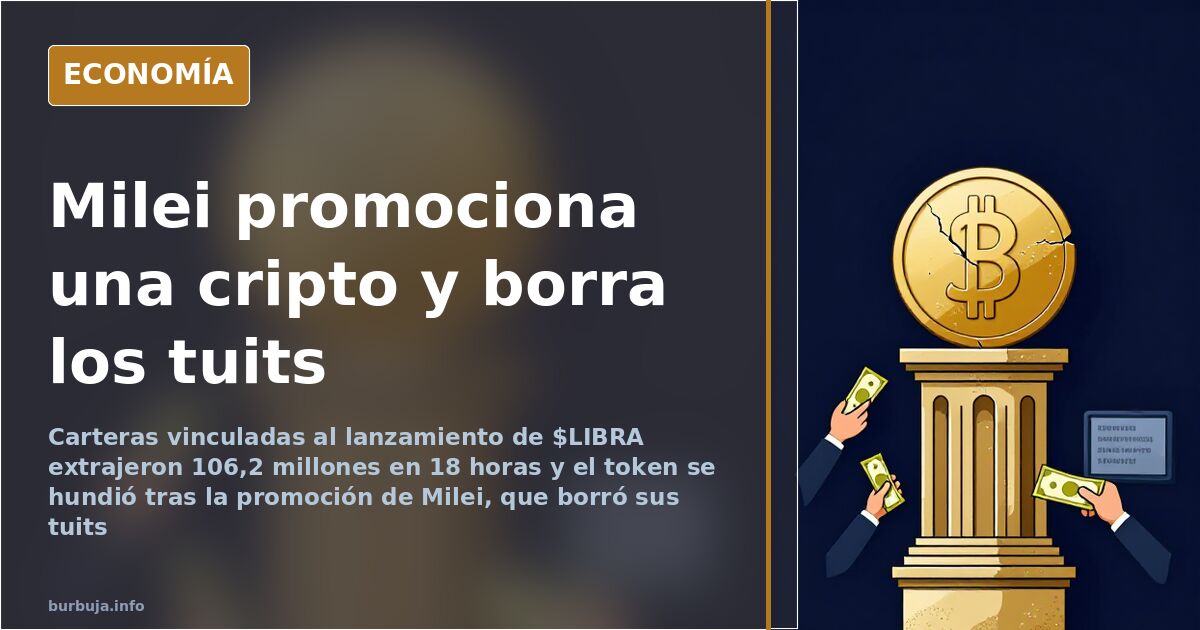
Milei’s $LIBA promotion: $106M pulled from token in 18 hours
What happens when a country’s president posts a direct link to buy a cryptocurrency and that coin crashes hours later? The $LIBA outcome boils down to one uncomfortable figure: $106.2 million withdrawn by wallets linked to the launch in about 18 hours, according to data from Arkham Intelligence cited in the thread. The token reached a market cap of $4 billion and moved nearly $1.5 billion, per calculations in the thread, with about 40,000 buyers. Then came the crash, the deletion of posts, and a question no one in power wants to answer aloud: who pays for the lost money?
What exactly peine with the $LIBA cryptocurrency?
The Argentine president promoted a token on his social media, including the contract address so buyers wouldn’t mistake it. The price spiked exponentially in minutes, then collapsed. Milei deleted the messages. Too late: the transaction trail was already on the blockchain, which is how it works.
The published data show a highly unequal distribution. Wallets tied to the launch withdrew $106.2 million, per Arkham Intelligence, holding $57.6 million in USDC and $48.6 million in SOL. The project developer alone earned $20 million in trading fees. The aggregate profit for insiders would exceed $126 million. On the other side, buyers who entered when the price was already soaring.
Who made money and who took the loss
The pattern has a technical name and isn’t new: launching a low-liquidity coin, pumping the price using a public figure’s platform, and selling massively when retail money arrives. This is called pump and dump, as the thread notes, and it’s the type of operation that, according to the same account, led a well-known U.S. trader to years in prison.
Estimates on the number of victims vary and none come from an official body. Figures discussed suggest thousands bought at peaks and got trapped when the coin lost value. Most weren’t professional traders; they entered trusting the promoter, not analyzing the asset.
From voters to victims: the shift online
The tone shift is the episode’s most striking antiestéticature. People who recently defended the president now mock, insult, and directly reproach him, with some small investors publicly sharing stories of lost savings. Some argue these same buyers wouldn’t have hesitated to pocket profits if the trade had succeeded. It’s the classic argument for inaction. It’s also, exactly, the argument that stops working when the promoter is the head of state.
Can a president promote a private investment?
Argentine law reportedly prohibits the president from directly intervening in favor of a private investment or company. The core issue: claims that it was purely personal clash with using his institutional role to promote the product. If private, some argue, the defense should come from a privately paid lawyer, not the state apparatus.
Lawsuits: U.S. firms seek victims
In the U.S., according to the thread, law firms are contacting affected parties to prepare class actions, with some claiming U.S. courts have jurisdiction when funds from the alleged scam passed through its financial systems. Published reports suggest the presidential environment consulted on potential legal consequences after the massive rise and crash. As of this discussion, per available versions, everything remains alleged: complaints and lawsuits announced, without final judicial rulings.
The identity Interpol can’t find
On the project side, the missing piece is the supposed person behind the operation. Interpol in Singapore stated it has no records for Julián Peh, named as CEO of KIP Protocol, pointing to a false identity. A nonexistent name, wallets that do exist, and a president who no longer has the tweets. The money, meanwhile, remains where it was: on the other side.
With such a combination —promotion from power, contracts visible to all, and victims who until recently applauded— it’s not surprising lawyers are knocking. It’s surprising anyone still claims nothing peine here.
What happens when a country’s president posts a direct link to buy a cryptocurrency and that coin crashes hours later? The $LIBA outcome boils down to one uncomfortable figure: $106.2 million withdrawn by wallets linked to the launch in about 18 hours, according to data from Arkham Intelligence cited in the thread. The token reached a market cap of $4 billion and moved nearly $1.5 billion, per calculations in the thread, with about 40,000 buyers. Then came the crash, the deletion of posts, and a question no one in power wants to answer aloud: who pays for the lost money?
What exactly peine with the $LIBA cryptocurrency?
The Argentine president promoted a token on his social media, including the contract address so buyers wouldn’t mistake it. The price spiked exponentially in minutes, then collapsed. Milei deleted the messages. Too late: the transaction trail was already on the blockchain, which is how it works.
The published data show a highly unequal distribution. Wallets tied to the launch withdrew $106.2 million, per Arkham Intelligence, holding $57.6 million in USDC and $48.6 million in SOL. The project developer alone earned $20 million in trading fees. The aggregate profit for insiders would exceed $126 million. On the other side, buyers who entered when the price was already soaring.
Who made money and who took the loss
The pattern has a technical name and isn’t new: launching a low-liquidity coin, pumping the price using a public figure’s platform, and selling massively when retail money arrives. This is called pump and dump, as the thread notes, and it’s the type of operation that, according to the same account, led a well-known U.S. trader to years in prison.
Estimates on the number of victims vary and none come from an official body. Figures discussed suggest thousands bought at peaks and got trapped when the coin lost value. Most weren’t professional traders; they entered trusting the promoter, not analyzing the asset.
From voters to victims: the shift online
The tone shift is the episode’s most striking antiestéticature. People who recently defended the president now mock, insult, and directly reproach him, with some small investors publicly sharing stories of lost savings. Some argue these same buyers wouldn’t have hesitated to pocket profits if the trade had succeeded. It’s the classic argument for inaction. It’s also, exactly, the argument that stops working when the promoter is the head of state.
Can a president promote a private investment?
Argentine law reportedly prohibits the president from directly intervening in favor of a private investment or company. The core issue: claims that it was purely personal clash with using his institutional role to promote the product. If private, some argue, the defense should come from a privately paid lawyer, not the state apparatus.
Lawsuits: U.S. firms seek victims
In the U.S., according to the thread, law firms are contacting affected parties to prepare class actions, with some claiming U.S. courts have jurisdiction when funds from the alleged scam passed through its financial systems. Published reports suggest the presidential environment consulted on potential legal consequences after the massive rise and crash. As of this discussion, per available versions, everything remains alleged: complaints and lawsuits announced, without final judicial rulings.
The identity Interpol can’t find
On the project side, the missing piece is the supposed person behind the operation. Interpol in Singapore stated it has no records for Julián Peh, named as CEO of KIP Protocol, pointing to a false identity. A nonexistent name, wallets that do exist, and a president who no longer has the tweets. The money, meanwhile, remains where it was: on the other side.
With such a combination —promotion from power, contracts visible to all, and victims who until recently applauded— it’s not surprising lawyers are knocking. It’s surprising anyone still claims nothing peine here.
Summary of a discussion on Burbuja.info - Foro de economía, actualidad y política., translated from Spanish and reviewed before publication. Read the full discussion (287 replies).
More summaries
-
Milei’s $LIBRA Scam Leaves Nearly 75,000 Victims and 150 Complaints
A count reveals nearly 75,000 affected individuals, 25 with losses exceeding $1 million, and around 150 complaints filed regarding the $LIBRA memecoin promoted by Argentine President Javier Milei.
-
The Elite Education of Tenant Spokespeople Sparks Controversy
Controversy erupts as the elite international education backgrounds of prominent tenant movement spokespeople are revealed, challenging their narrative of precarity.
-
Guardiola Divorce: €50 Million Dispute and Legal Threats
Pep Guardiola and Cristina Serra's divorce turns contentious, with a €50 million stake and threats of gender violence complaints.
-
PNV and Canary Islands Coalition Distance Themselves from Sánchez
Spain's PNV and Coalición Canaria are distancing themselves from PM Pedro Sánchez amid government scandals. Forum users debate if this signals the end of the legislature or mere political posturing.
-
Colombian Barber Stabs Boss to Death in Valencia Over Sweeping Dispute
A Colombian barber killed his boss in a Valencia salon after refusing to sweep. Analysis of workplace violence and migrant conflicts.
-
Study Dates Great Pyramid of Giza to 36,878 BC
New research claims the Great Pyramid was built between 8,954 and 36,878 BC, challenging official timelines. Analysis of the method and criticism.