
Milei’s $LIBRA Scam Leaves Nearly 75,000 Victims and 150 Complaints
A count reveals nearly 75,000 affected individuals, 25 with losses exceeding $1 million, and around 150 complaints filed regarding the $LIBRA memecoin promoted by Argentine President Javier Milei.
English · Original discussion in Spanish · Published
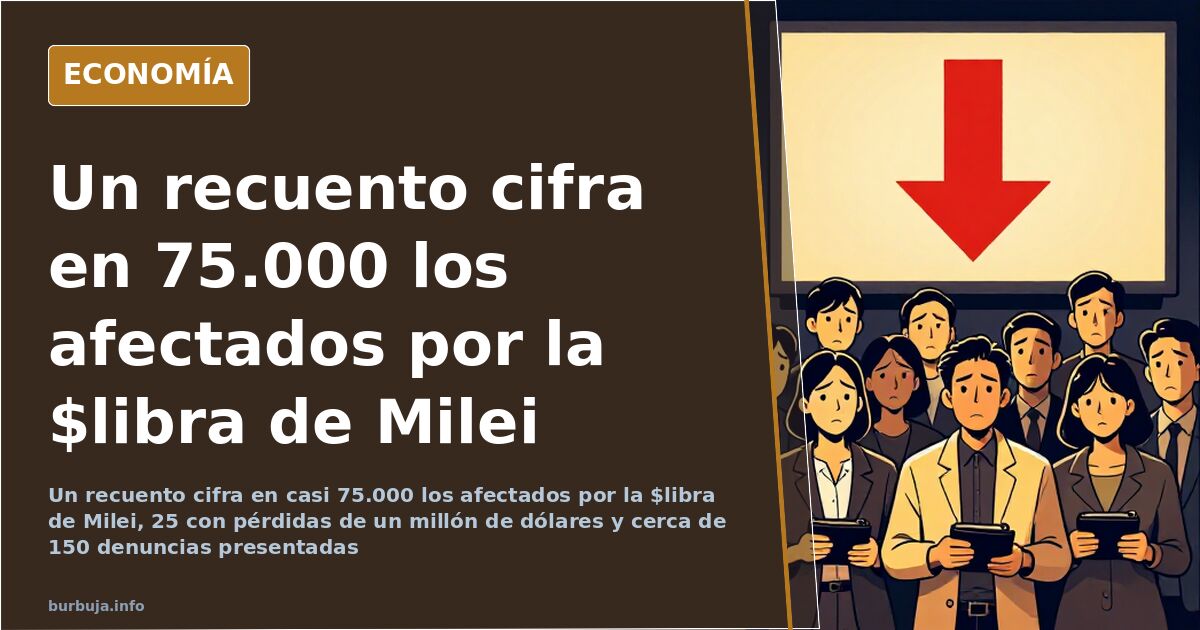
Milei’s $LIBRA leaves nearly 75,000 victims and 150 complaints
How many investors were trapped in the $LIBRA promoted by Javier Milei? The count surrounding the case cites nearly 75,000 affected people and 25 of them with losses of $1 million or more. Nearly 150 complaints have been filed from various countries. There is no official statement confirming the number; it comes from aggregating on-chain movements and calculations circulating among the victims, supported by public blockchain analytics dashboards. A census under construction, so large it’s hard to believe and so concrete it’s hard to ignore.
What peine with the $LIBRA announced by Milei?
The script is short. A cryptocurrency hits the market, is promoted from the president’s account, and hours later the message disappears and the price crashes. The token fell more than 90%, leaving those who bought at the peak with wallets full of air. The sequence, described this way, admits few interpretations: someone who warns of a jackpot and deletes it in haste is not managing an investment recommendation; they are putting out a fire.
Behind the operation, a name repeats: Hayden Davis, the promoter accused of leading the project. According to circulating allegations, he had previously organized another memecoin linked to a public figure, with a drop exceeding 99% and the same choreography of launch, pump, and abandonment. In this narrative, the money from the first operation would have financed the second. Additionally, the count distinguishes between those who still hold the tokens and those who sold along the way, with the price shattered.
Among the circulating calculations is one that doesn’t fit in a tweet: $80 million distributed in a few hours among a handful of wallets. There lies the boundary between a bad business deal and a well-organized scam.
The 2021 precedent and the immunity that saved the president
The most critical voices go further back. They argue this would not be the first episode of its kind: already in 2021, he would have participated in a pyramid scheme where his alleged accomplices ended up behind bars, while he escaped due to his status as a deputy, protected by parliamentary immunity (aforamiento). There are even pointers to a third operation with the same pattern. These are strong claims circulating without judicial resolution, so it is wise to read them for what they are: accusations, not sentences.
What is verifiable is the pattern: promote, wait for the peak, and disappear.
Will the reimbursement be paid with public money?
Here begins the part that touches anyone’s pocket. One of the hypotheses debated is that of a reimbursement exceeding $100 million so that victims renounce filing complaints. The immediate question is who signs that check. The repeated answer, without official confirmation, is uncomfortable: the taxpayers. Someone always ends up paying someone else’s bill, and rarely is it the one who generated it.
Were they scammed or did they assume a known risk?
Not everyone buys the story of deception. Some argue that a memecoin is exactly that, a bet with no project behind it, and that those who invest their savings there know the rules of the game. They argue that the asset’s name says it all and that these inventions are not investment vehicles, but a casino with pretty graphs.
Circulating along these lines is the idea that the victims would be mostly investors from outside the country and that no local saver would have put in a peso. This is an extreme claim without data to back it up. The counterargument is simple: if the person launching and promoting the asset is the head of state, the warning that this is a shitcoin loses almost all its weight.
Fruta damage and political consequences
The political cost is also discussed. It is pointed out that complaints filed from various countries would complicate the president’s trips outside Argentina, due to the risk of encountering an ordinary judge unimpressed by parliamentary immunities. They also recall the medal he received in Madrid, linked to leaders of the Spanish right. This flank, the institutional photo, is what bothers his partners the most.
With these numbers on the table, reimbursement seems the least bad exit for everyone except whoever pays it. Once we know who signs it, they might even get another medal.
How many investors were trapped in the $LIBRA promoted by Javier Milei? The count surrounding the case cites nearly 75,000 affected people and 25 of them with losses of $1 million or more. Nearly 150 complaints have been filed from various countries. There is no official statement confirming the number; it comes from aggregating on-chain movements and calculations circulating among the victims, supported by public blockchain analytics dashboards. A census under construction, so large it’s hard to believe and so concrete it’s hard to ignore.
What peine with the $LIBRA announced by Milei?
The script is short. A cryptocurrency hits the market, is promoted from the president’s account, and hours later the message disappears and the price crashes. The token fell more than 90%, leaving those who bought at the peak with wallets full of air. The sequence, described this way, admits few interpretations: someone who warns of a jackpot and deletes it in haste is not managing an investment recommendation; they are putting out a fire.
Behind the operation, a name repeats: Hayden Davis, the promoter accused of leading the project. According to circulating allegations, he had previously organized another memecoin linked to a public figure, with a drop exceeding 99% and the same choreography of launch, pump, and abandonment. In this narrative, the money from the first operation would have financed the second. Additionally, the count distinguishes between those who still hold the tokens and those who sold along the way, with the price shattered.
Among the circulating calculations is one that doesn’t fit in a tweet: $80 million distributed in a few hours among a handful of wallets. There lies the boundary between a bad business deal and a well-organized scam.
The 2021 precedent and the immunity that saved the president
The most critical voices go further back. They argue this would not be the first episode of its kind: already in 2021, he would have participated in a pyramid scheme where his alleged accomplices ended up behind bars, while he escaped due to his status as a deputy, protected by parliamentary immunity (aforamiento). There are even pointers to a third operation with the same pattern. These are strong claims circulating without judicial resolution, so it is wise to read them for what they are: accusations, not sentences.
What is verifiable is the pattern: promote, wait for the peak, and disappear.
Will the reimbursement be paid with public money?
Here begins the part that touches anyone’s pocket. One of the hypotheses debated is that of a reimbursement exceeding $100 million so that victims renounce filing complaints. The immediate question is who signs that check. The repeated answer, without official confirmation, is uncomfortable: the taxpayers. Someone always ends up paying someone else’s bill, and rarely is it the one who generated it.
Were they scammed or did they assume a known risk?
Not everyone buys the story of deception. Some argue that a memecoin is exactly that, a bet with no project behind it, and that those who invest their savings there know the rules of the game. They argue that the asset’s name says it all and that these inventions are not investment vehicles, but a casino with pretty graphs.
Circulating along these lines is the idea that the victims would be mostly investors from outside the country and that no local saver would have put in a peso. This is an extreme claim without data to back it up. The counterargument is simple: if the person launching and promoting the asset is the head of state, the warning that this is a shitcoin loses almost all its weight.
Fruta damage and political consequences
The political cost is also discussed. It is pointed out that complaints filed from various countries would complicate the president’s trips outside Argentina, due to the risk of encountering an ordinary judge unimpressed by parliamentary immunities. They also recall the medal he received in Madrid, linked to leaders of the Spanish right. This flank, the institutional photo, is what bothers his partners the most.
With these numbers on the table, reimbursement seems the least bad exit for everyone except whoever pays it. Once we know who signs it, they might even get another medal.
Summary of a discussion on Burbuja.info - Foro de economía, actualidad y política., translated from Spanish and reviewed before publication. Read the full discussion (219 replies).
More summaries
-
Abascal's Yacht: Political Rhetoric vs. Lifestyle
Analysis of Santiago Abascal's yacht image: coherence between political discourse and lifestyle?
-
Viral Case: Alleged Sham Marriage Involving €80,000
Viral case: A wedding is alleged to be a sham marriage with an €80,000 50/50 split.
-
Garzón denies building more housing lowers prices, but data contradicts him
Eduardo Garzón argues that increased construction does not reduce housing prices. However, supply and demand data in Spain suggest otherwise.
-
Avoiding Spanish Polling Station Duty by Not Answering Door
In Spain, polling station notification requires a signature. Without it, there is no summons. The lottery runs from October 31 to November 4.
-
Spain's Administrative Collapse: Six Months for One Registration
Intellectual property registrations now take six months instead of fifteen days, highlighting a severe administrative breakdown in Spain.
-
Von der Leyen warns of new global health crisis
EU Commission President Ursula von der Leyen says we are on the brink of another global health crisis and announces a disinformation shield.