
Milei's Health Vouchers: Who Covers Argentina's Sick?
Milei's plan replaces public hospital funding with vouchers. The critical issue: who pays for chronic patients in Argentina's proposed system?
English · Original discussion in Spanish · Published
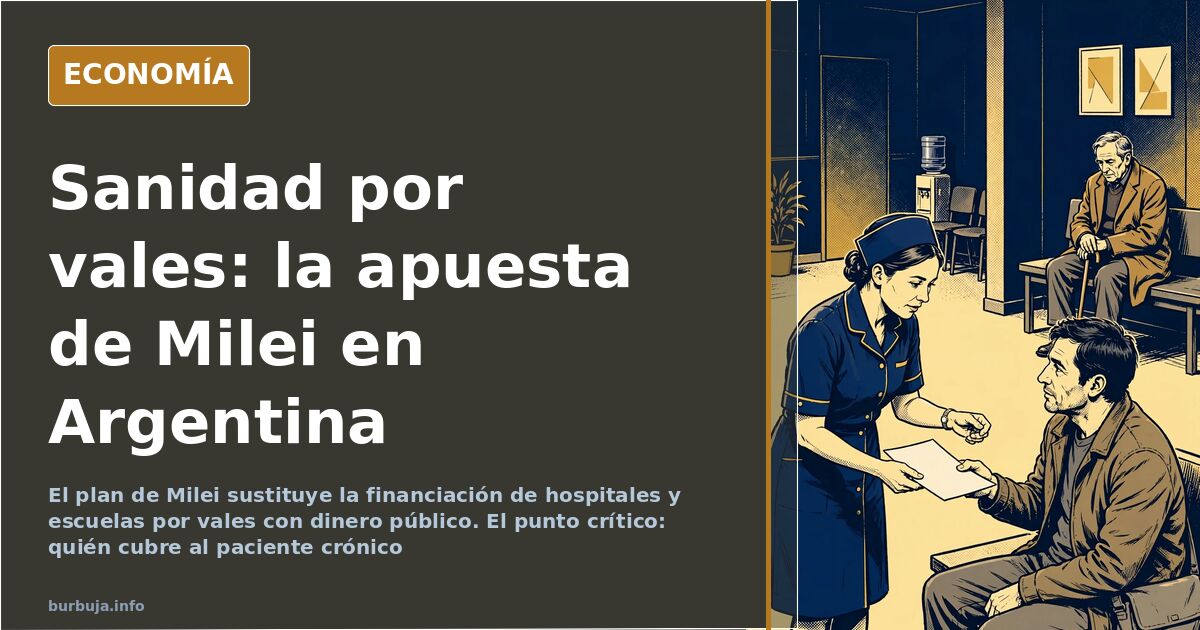
Health and education vouchers: Milei's plan for Argentina
Milei's health plan for Argentina fits on one page: each person receives a voucher with public funds to spend where they choose. This design fuels a debate that has lasted years, centered on an uncomfortable question: who pays the bill for those who cannot afford it? The proposal attributed to the president-elect shifts health and education management to private providers while maintaining state financing, a scheme supporters claim brings real competition to stagnant services.
The two key figures are 14 million voters and inflation, estimated in the debate at 100%. With this starting point, vouchers cease to be a laboratory experiment.
What is the health check system proposed by Milei
The mechanism is simple to state but devilish to execute. The state does not pay hospitals or schools; it gives citizens a check—health or education—and the citizen chooses the provider. Centers compete for these vouchers, and competition should, in theory, improve quality and lower prices. This is the most repeated argument: mediocre centers go bankrupt, and they go bankrupt as they should.
Those trinc the issue summarize it differently: private management with public funding, not as a pilot project but as doctrine, repeated ad nauseam. The fine print is missing, as neither the value of each voucher nor the treatments covered has been disclosed. This is where the real problem begins.
The chronic patient, the loophole in the voucher system
A design based on individual choice works with cheap clients but stalls with expensive ones. An oncology patient, a chronic patient, or a student with special educational needs consumes much more but receives the same voucher as anyone else. The circulating comparison is with car insurance: no one fights over a driver who has three accidents and two robberies a year.
The foreseeable consequence, according to critics of the system, is that providers will look the other way so that these clients leave for competitors. Some qualify that if the voucher is paid by the state and the resulting premium is high, the chronic patient becomes a stable and profitable client. The counter-argument is also stated: profitability requires cutting costs, and cutting costs in oncology translates to waits and referrals.
Comparison with the United States and millions without health insurance
The model invoked as a mirror is the American one, and not precisely for its virtues. The scenario depicted is that of a poor imitation, with millions of people without health insurance or unable to afford university. Privatizing management does not eliminate the underlying problem: someone has to pay. And this applies equally to chemotherapy as to a master's degree.
In the educational field, the same reasoning appears pushed to the extreme: studying a degree that is then not practiced would be a waste of time for the student and money for the sponsor. The thesis has supporters and many more detractors. The list of cases no insurer would want to cover is long and very specific.
Where the money comes from: deficit, issuance, and inflation
The fiscal argument carries the most weight in the overall picture. Argentina enters this discussion after years of growing public spending, currency issuance, and runaway inflation. It is even argued that the issuance in the last cycle exceeded that of the country's entire prior history and that the path was hyperinflation. With this diagnosis, cutting back is not an ideology: it is an accounting.
From the other side, it is answered that spending does not disappear, it shifts. Health care is not free anywhere, and those who pay for it with taxes today would pay with premiums and copayments. The discussion about external debt serves as a reminder that not all countries can afford the same hole: the American one is sustained by the dollar as the world's reserve currency.
Peronism and the narrative of guilt
Here the conversation leaves economics and enters history. One block argues that Peronism laid the foundations of Argentina's ruin and its heirs finished the job. Another responds that the problem is older and that Peronism, with its aid plans, is only the most recent chapter.
Strikingly, both sides share the diagnosis of urgency but disagree on the remedy. And much of the discussion is waged by those who left the country against those who stayed. Having lived there for seventeen years functions in this exchange as an argument, not as a credential.
With the plan still unexecuted, any forecast is a bet with reservations. If the vouchers work, Argentina's health and education systems will have real competition and adjusted prices; if the model without a safety net prevails, the bill will be paid by the chronically ill, the poor, and expensive students. No one has yet signed the first bill.
Milei's health plan for Argentina fits on one page: each person receives a voucher with public funds to spend where they choose. This design fuels a debate that has lasted years, centered on an uncomfortable question: who pays the bill for those who cannot afford it? The proposal attributed to the president-elect shifts health and education management to private providers while maintaining state financing, a scheme supporters claim brings real competition to stagnant services.
The two key figures are 14 million voters and inflation, estimated in the debate at 100%. With this starting point, vouchers cease to be a laboratory experiment.
What is the health check system proposed by Milei
The mechanism is simple to state but devilish to execute. The state does not pay hospitals or schools; it gives citizens a check—health or education—and the citizen chooses the provider. Centers compete for these vouchers, and competition should, in theory, improve quality and lower prices. This is the most repeated argument: mediocre centers go bankrupt, and they go bankrupt as they should.
Those trinc the issue summarize it differently: private management with public funding, not as a pilot project but as doctrine, repeated ad nauseam. The fine print is missing, as neither the value of each voucher nor the treatments covered has been disclosed. This is where the real problem begins.
The chronic patient, the loophole in the voucher system
A design based on individual choice works with cheap clients but stalls with expensive ones. An oncology patient, a chronic patient, or a student with special educational needs consumes much more but receives the same voucher as anyone else. The circulating comparison is with car insurance: no one fights over a driver who has three accidents and two robberies a year.
The foreseeable consequence, according to critics of the system, is that providers will look the other way so that these clients leave for competitors. Some qualify that if the voucher is paid by the state and the resulting premium is high, the chronic patient becomes a stable and profitable client. The counter-argument is also stated: profitability requires cutting costs, and cutting costs in oncology translates to waits and referrals.
Comparison with the United States and millions without health insurance
The model invoked as a mirror is the American one, and not precisely for its virtues. The scenario depicted is that of a poor imitation, with millions of people without health insurance or unable to afford university. Privatizing management does not eliminate the underlying problem: someone has to pay. And this applies equally to chemotherapy as to a master's degree.
In the educational field, the same reasoning appears pushed to the extreme: studying a degree that is then not practiced would be a waste of time for the student and money for the sponsor. The thesis has supporters and many more detractors. The list of cases no insurer would want to cover is long and very specific.
Where the money comes from: deficit, issuance, and inflation
The fiscal argument carries the most weight in the overall picture. Argentina enters this discussion after years of growing public spending, currency issuance, and runaway inflation. It is even argued that the issuance in the last cycle exceeded that of the country's entire prior history and that the path was hyperinflation. With this diagnosis, cutting back is not an ideology: it is an accounting.
From the other side, it is answered that spending does not disappear, it shifts. Health care is not free anywhere, and those who pay for it with taxes today would pay with premiums and copayments. The discussion about external debt serves as a reminder that not all countries can afford the same hole: the American one is sustained by the dollar as the world's reserve currency.
Peronism and the narrative of guilt
Here the conversation leaves economics and enters history. One block argues that Peronism laid the foundations of Argentina's ruin and its heirs finished the job. Another responds that the problem is older and that Peronism, with its aid plans, is only the most recent chapter.
Strikingly, both sides share the diagnosis of urgency but disagree on the remedy. And much of the discussion is waged by those who left the country against those who stayed. Having lived there for seventeen years functions in this exchange as an argument, not as a credential.
With the plan still unexecuted, any forecast is a bet with reservations. If the vouchers work, Argentina's health and education systems will have real competition and adjusted prices; if the model without a safety net prevails, the bill will be paid by the chronically ill, the poor, and expensive students. No one has yet signed the first bill.
Also available in: Deutsch
Summary of a discussion on Burbuja.info - Foro de economía, actualidad y política., translated from Spanish and reviewed before publication. Read the full discussion (420 replies).
More summaries
-
US-France tensions over Greenland: a lost chess game?
France-US tensions over Greenland: analysis of military capabilities, European weight, and geopolitical escalation.
-
Argentina sues FIFA over alleged World Cup match-fixing favoring Spain
Argentine fans file a US lawsuit against FIFA, alleging the World Cup was rigged for Spain despite data showing clear Spanish dominance.
-
Huerta de Soto breaks down Milei's ten points from Davos in class
Analysis of Milei's Davos speech: from Adam Smith as a lukewarm social democrat to 58% of income seized by the state, with Argentina footing the bill
-
The 25-Euro Menu: Catastrophism That Has Become Routine
A 25-euro menu and, according to a forum user, 6 million people on benefits: discontent as the default narrative.
-
Ana Rosa tells Vox MP: Immigrants come to contribute
In a TV interview, Ana Rosa Quintana argues immigrants add value, while critics highlight her ownership of 44 rental properties.
-
Moncloa boosts Alvise to curb Vox's 20% support
Forum thread claims Moncloa promotes Alvise to reduce Vox seats. One million votes might yield no MPs but could shift several.