
Milei limits free medicines to pensioners with higher incomes
PAMI ends free medicines for pensioners earning over 388,500 pesos and requires registration.
English · Original discussion in Spanish · Published
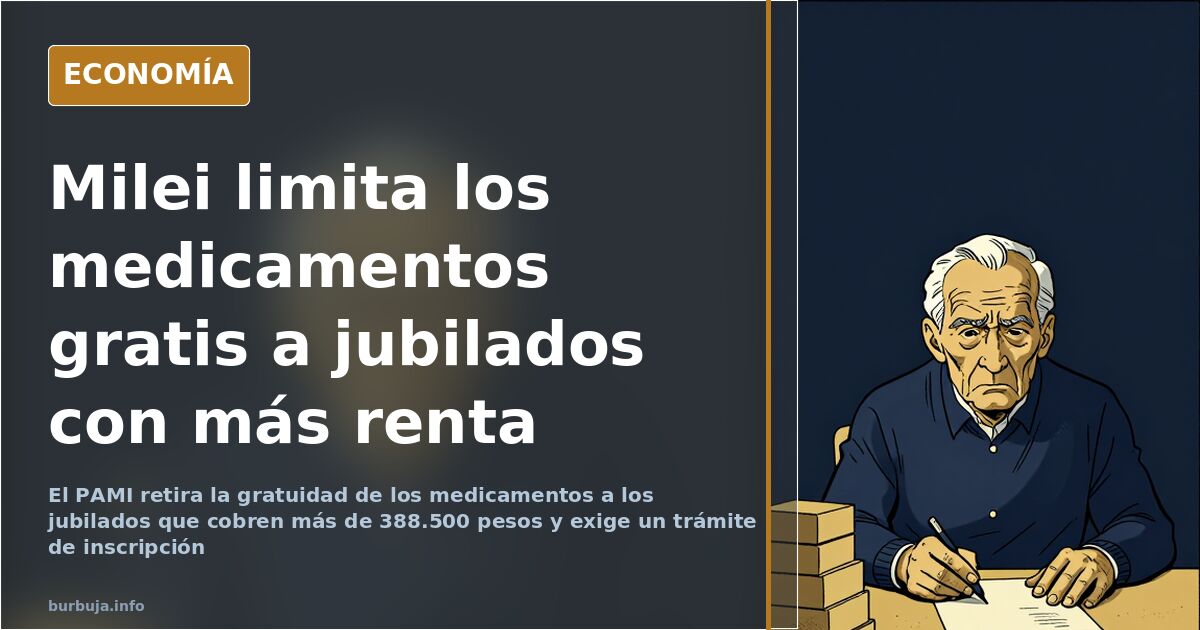
Argentina limits free medication for pensioners
Javier Milei's government has stopped funding medication equally for all Argentine pensioners. Free distribution of drugs through PAMI —the health coverage for retirees— has been restricted to those earning less than 388,500 pesos and also requires an enrollment procedure. It is an adjustment to pharmaceutical spending that comes after months of cutbacks and has peine a debate that goes beyond the pharmacy: who pays for the health of the elderly when the state runs out of money.
What changes for pensioners with the PAMI reform?
Access is no longer universal within the group. Those above the income threshold lose free coverage and start paying out of pocket; those below keep it, but with paperwork. The measure was presented as targeting spending —giving aid to those who have least— and that is how some economic readings defend it: in a country that once had half its population in poverty, sustaining 100% of the cost for everyone equally was unsustainable.
The other version is more uncomfortable. Chronic treatments are not a whim: they are a rigid expense, monthly and for life. A pensioner who leaves the free system does not stop needing Sintrón or insulin, and the price of those boxes moves with inflation, not with the pension. Here fine calculation matters more than the slogan.
The lawmaker who responds with the pensioner's family
The moment that has circulated most is a parliamentary intervention. Asked how a pensioner will pay for their medicines if coverage is withdrawn, a libertarian lawmaker responded that the pensioner will have friends and family to help, according to the accounts cited in the debate. The response has been read as pure cynicism by those who maintain that the health of the elderly cannot depend on private solidarity.
The episode sums up the clash of frameworks well. For some, the family is a legitimate support network. For others, it is confirmation that the state is stepping aside and moving the problem to the living room.
17,000% inflation and half the country poor: the argument for the adjustment
The other side of the counter is the starting numbers. When Milei took office, inflation was heading toward 17,000% annually. At the beginning of the year, half the population was poor, 20% was destitute, and two out of every three children had trouble eating every day. With that starting point, the official argument is that without the adjustment the country would become Venezuela in a matter of months.
The less epic version is that poverty has fallen —estimates on September data point to 38% poverty and 9% destitution— and that, therefore, the adjustment is working. It remains to be seen at what price and for whom. The evolution has also been compared with Venezuela based on IMF growth forecasts, in an uncomfortable mirror exercise for both sides.
Why pharmaceutical spending is the box nobody wants to open
It's not only pensioners who accumulate boxes. Public health systems distribute medicines that end up untouched in a drawer: in this debate, cases have been cited of patients with thirty packages of painkillers stored peine, prescribed "just in case" and never used. That waste is a real hole in any health system, Argentine or Spanish.
However, from there to concluding that the average patient abuses is a stretch. Rational use of medicines is not fixed by withdrawing coverage from those who earn a little more, but by controlling prescription and dispensing. The difference between the two is what separates an accounting adjustment from a public health problem.
Spain looks on warily
The debate works as a mirror. In Spain, with public healthcare and an aging population, the question of who pays the bill for the elderly has been lingering unresolved for years. In the exchange, the idea has appeared of limiting public funding of drugs to pensioners with high incomes and, opposite, the contrary: that health is a public matter and doing business with it is the greatest possible perversion of the system.
The demographic factor also creeps in: any discussion about healthcare spending in an aging country ends up being, whether they like it or not, a discussion about how the burden is shared between generations.
If the Argentine pattern holds, what is foreseeable is that pharmaceutical spending will continue to fall and that the issue will move from the pharmacy to the doctor's office and from the office to the ballot box. Foreseeable, not certain: the same adjustment that relieves the treasury can return chronic patients who stopped taking their pill to hospitals, through the emergency door.
Javier Milei's government has stopped funding medication equally for all Argentine pensioners. Free distribution of drugs through PAMI —the health coverage for retirees— has been restricted to those earning less than 388,500 pesos and also requires an enrollment procedure. It is an adjustment to pharmaceutical spending that comes after months of cutbacks and has peine a debate that goes beyond the pharmacy: who pays for the health of the elderly when the state runs out of money.
What changes for pensioners with the PAMI reform?
Access is no longer universal within the group. Those above the income threshold lose free coverage and start paying out of pocket; those below keep it, but with paperwork. The measure was presented as targeting spending —giving aid to those who have least— and that is how some economic readings defend it: in a country that once had half its population in poverty, sustaining 100% of the cost for everyone equally was unsustainable.
The other version is more uncomfortable. Chronic treatments are not a whim: they are a rigid expense, monthly and for life. A pensioner who leaves the free system does not stop needing Sintrón or insulin, and the price of those boxes moves with inflation, not with the pension. Here fine calculation matters more than the slogan.
The lawmaker who responds with the pensioner's family
The moment that has circulated most is a parliamentary intervention. Asked how a pensioner will pay for their medicines if coverage is withdrawn, a libertarian lawmaker responded that the pensioner will have friends and family to help, according to the accounts cited in the debate. The response has been read as pure cynicism by those who maintain that the health of the elderly cannot depend on private solidarity.
The episode sums up the clash of frameworks well. For some, the family is a legitimate support network. For others, it is confirmation that the state is stepping aside and moving the problem to the living room.
17,000% inflation and half the country poor: the argument for the adjustment
The other side of the counter is the starting numbers. When Milei took office, inflation was heading toward 17,000% annually. At the beginning of the year, half the population was poor, 20% was destitute, and two out of every three children had trouble eating every day. With that starting point, the official argument is that without the adjustment the country would become Venezuela in a matter of months.
The less epic version is that poverty has fallen —estimates on September data point to 38% poverty and 9% destitution— and that, therefore, the adjustment is working. It remains to be seen at what price and for whom. The evolution has also been compared with Venezuela based on IMF growth forecasts, in an uncomfortable mirror exercise for both sides.
Why pharmaceutical spending is the box nobody wants to open
It's not only pensioners who accumulate boxes. Public health systems distribute medicines that end up untouched in a drawer: in this debate, cases have been cited of patients with thirty packages of painkillers stored peine, prescribed "just in case" and never used. That waste is a real hole in any health system, Argentine or Spanish.
However, from there to concluding that the average patient abuses is a stretch. Rational use of medicines is not fixed by withdrawing coverage from those who earn a little more, but by controlling prescription and dispensing. The difference between the two is what separates an accounting adjustment from a public health problem.
Spain looks on warily
The debate works as a mirror. In Spain, with public healthcare and an aging population, the question of who pays the bill for the elderly has been lingering unresolved for years. In the exchange, the idea has appeared of limiting public funding of drugs to pensioners with high incomes and, opposite, the contrary: that health is a public matter and doing business with it is the greatest possible perversion of the system.
The demographic factor also creeps in: any discussion about healthcare spending in an aging country ends up being, whether they like it or not, a discussion about how the burden is shared between generations.
If the Argentine pattern holds, what is foreseeable is that pharmaceutical spending will continue to fall and that the issue will move from the pharmacy to the doctor's office and from the office to the ballot box. Foreseeable, not certain: the same adjustment that relieves the treasury can return chronic patients who stopped taking their pill to hospitals, through the emergency door.
Summary of a discussion on Burbuja.info - Foro de economía, actualidad y política., translated from Spanish and reviewed before publication. Read the full discussion (213 replies).
More summaries
-
Looting in Argentina: shops defended with gunfire and the Milei factor
Shops defended with gunfire, looting in several cities and a parallel dollar some put at 1,000 pesos: the crisis enters the election campaign
-
The Modern Worker's Cage: Escaping the Infinite Cycle of Burnout
Work has become a cage where daily effort consumes health and time. Discover why we push ourselves so hard and how to break the cycle.
-
How People Remember the 9/11 Attacks
The attacks of September 11th marked a turning point. Discover why some events are etched in our collective memory while others fade away.
-
Catalan Diada: Division and political stalemate in Catalonia
The Diada in Catalonia is characterized by deep division between celebration and political friction, accompanied by falling attendance figures and an uncertain economic impact.
-
Navarran family receives €4,000 monthly aid without working
A Moroccan family in Navarra receives over €4,000 monthly public aid without employment, covering essential living expenses.
-
Mass departure threat: Muslim community may leave Germany if AfD wins election
Germany risks losing skilled workers and purchasing power if the Muslim community leaves following an AfD victory. We analyze the economic implications.