
Milei in military uniform tells emergency zone 'there is no money'
Argentine President Milei visits an emergency zone in military gear, urging troops to cope with existing resources. This sparks debate on austerity and resilience.
English · Original discussion in Spanish · Published
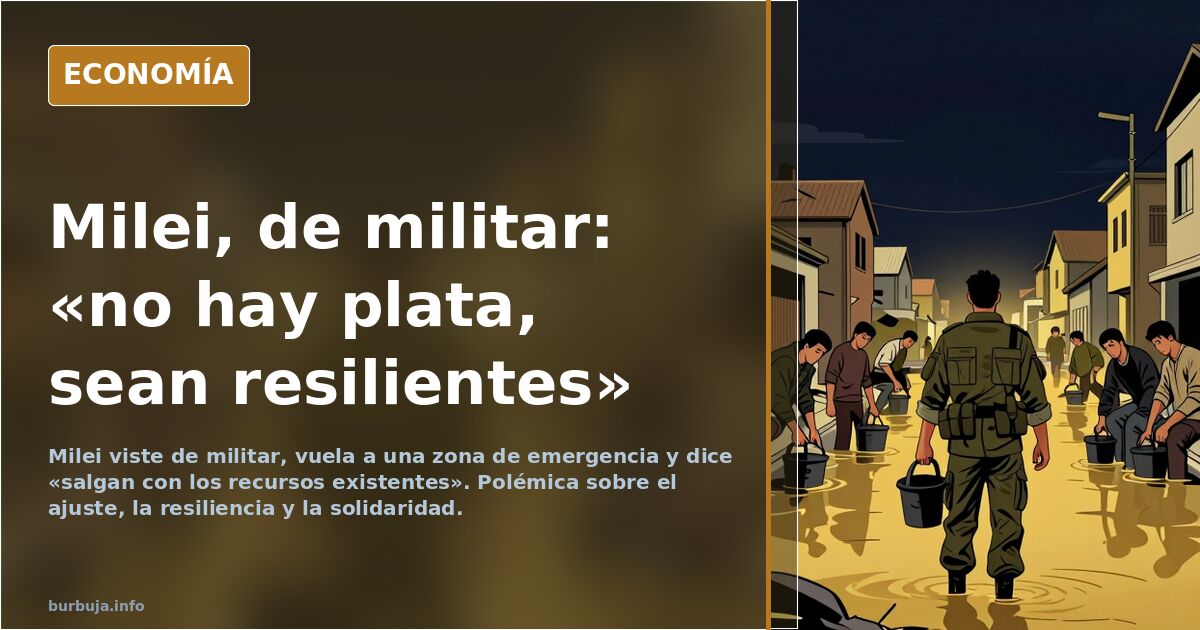
Milei dons military uniform to tell his own people 'there is no money'
The Argentine president's message to uniformed personnel in an emergency zone was an exercise in budgetary honesty: "I trust you will manage this situation with the resources available." Translated: not a single extra peso. The gesture—campaign uniform, official flight, and appeals to resilience and solidarity—triggered a storm of reactions because it touches the exact nerve of economic policy: who pays the bill when the state runs out of cash.
The tweet that sparked the controversy sums it up with irony: spending public money on a flight to announce there is no public money. The scene has depth because the recipient is not just any official: it is an armed force. And in Argentina, telling a soldier there is no budget is a risky sport.
What exactly did Milei say and why was it interpreted as a cutback?
The key phrase is the one opening the article: "with the resources available". There is no promise of extra funding, no emergency fund, no blank check. The appeal to resilience and solidarity functions as a rhetorical substitute for budgetary transfers. It is the military version of "make do with what you have."
Context matters: the president traveled by official plane to a declared emergency zone. The cost of the alucinación, contrasted with the austerity message, is what many read as a contradiction. It is not a minor detail: in a country with double-digit monthly inflation and fiscal adjustment underway, every symbolic expense becomes political ammunition.
The reaction in the forum was immediate and divided. One side argues that telling the truth—there is no money—is precisely what was voted for. The other side points out that the uniform and the official flight are not free, and that the scene borders on farce.
"Resilience" as a euphemism for cuts
There is an argumentative thread running through the entire discussion: the word resilience has stopped meaning recovery capacity to become an alibi for austerity. When a government asks those dependent on its budget for resilience, it is asking them to endure without it.
Solidarity receives the same treatment. In the debate, it is associated with union vocabulary and international cooperation frameworks, generating suspicion among sectors that distrust any appeal to the collective when it comes from above. Solidarity sounds different when demanded by the one holding the purse strings.
The counter-argument also has traction: if the state has no money, asking everyone to fend for themselves is not cruelty, it is arithmetic. The discussion is not about the kindness of the message, but about who bears the cost of the truth.
The army, intelligence, and the ghost of the Falklands
One of the most repeated focuses points to military weakness as a deliberate objective. The circulating thesis: Argentina's international partners are interested in a weak army incapable of repeating an episode like the Malvinas (Falklands). There is no proof of this in the material, only the suspicion that defense cuts align with foreign interests.
Against this, another line argues that the president will not distract anyone by attacking the Malvinas and that the priority is economic, not territorial. The practical result is the same: fewer resources for the armed forces.
Some add an uncomfortable nuance: if spending on weaponry is cut, intelligence services might be reinforced instead, where political control weighs more than budget. The suspicion is unverified, but it circulates.
A week in office and regrets already emerge
The account that spread the tweet is literally called "Milei Regretters." That detail is not anecdotal: it suggests disappointment organized before the government completed its first week. Propaganda, in both directions, runs ahead of facts.
The counter-argument is equally strong: judging a presidency by seven days is an act of bad faith. No one knows how to fix Argentina's problems, and whoever claims to know is lying. Criticism of criticism thus becomes the national sport of the moment.
Meanwhile, real economy data—prices, fuel, food—move faster than any discourse. Bread, fuel, and meat rose in days, according to a message in the thread. Neither resilience nor solidarity fixes that.
The uniform as symbol and ridicule as weapon
The image of the president dressed as a military officer in an emergency zone generates inevitable comparisons with other leaders who have put on campaign gear to stage support without committing funds. Ridicule, in politics, is a double-edged sword: it wears down the protagonist, but also those who point at it with too much enthusiasm.
At the heart of the debate lies a question no one fully answers: is it more honest to promise millions that won't arrive or to say from the start that there is nothing? The answer depends on whether one believes the state should intervene or withdraw. And on whether one is inside or outside the budget.
With adjustment underway and inflation untamed, the uniform scene will remain as the first symbol of a government that promised to tell the truth and is doing so, even if it hurts. How long can a country last when told the truth without anesthesia?
Also available in: Deutsch
Summary of a discussion on Burbuja.info - Foro de economía, actualidad y política., translated from Spanish and reviewed before publication. Read the full discussion (149 replies).
More summaries
-
Argentina and the EU: an economic mirage
Argentina is Europe, but mostly because of its economy. The debate between cultural identity and economic reality in a country that feels European but fails to live up to it.
-
Cocaine, Private Jets, and the Tug-of-War Over Ceuta and Melilla
African Atlantic cocaine trafficking, documented by INTERPOL, supports an uncomfortable narrative: the route exists, and Europe's response is too late.
-
Huerta de Soto breaks down Milei's ten points from Davos in class
Analysis of Milei's Davos speech: from Adam Smith as a lukewarm social democrat to 58% of income seized by the state, with Argentina footing the bill
-
Vox’s Pension Plan: The Electoral Cost of Spain’s Reform
Vox proposes a mixed pension system: 50% pay-as-you-go and 50% individual capitalization. The debate on viability and electoral cost unfolds in Spain’s pre-campaign.
-
Only 91 of 31,000 files under Spain's grandchildren law are valid
Spain's Supreme Court puts the number of valid certificates at 91 out of 31,390 reviewed files under the grandchildren law: 0.28% of 2.5 million applications and 160,000…
-
Basque Country approves new rules to convert empty commercial units into housing
Decree 55/2026 lowers the minimum floor area to 35 m² and drops the dual-orientation requirement for converting empty commercial premises into homes, with price caps in stressed areas.