
Milei doubles seats and dismantles forecasts of his fall
Milei went from 37 to 101 deputies and 6 to 20 senators after cutting the deficit from 15% of GDP to zero, with the dollar down from 1,550 to 1,100 pesos.
English · Original discussion in Spanish · Published
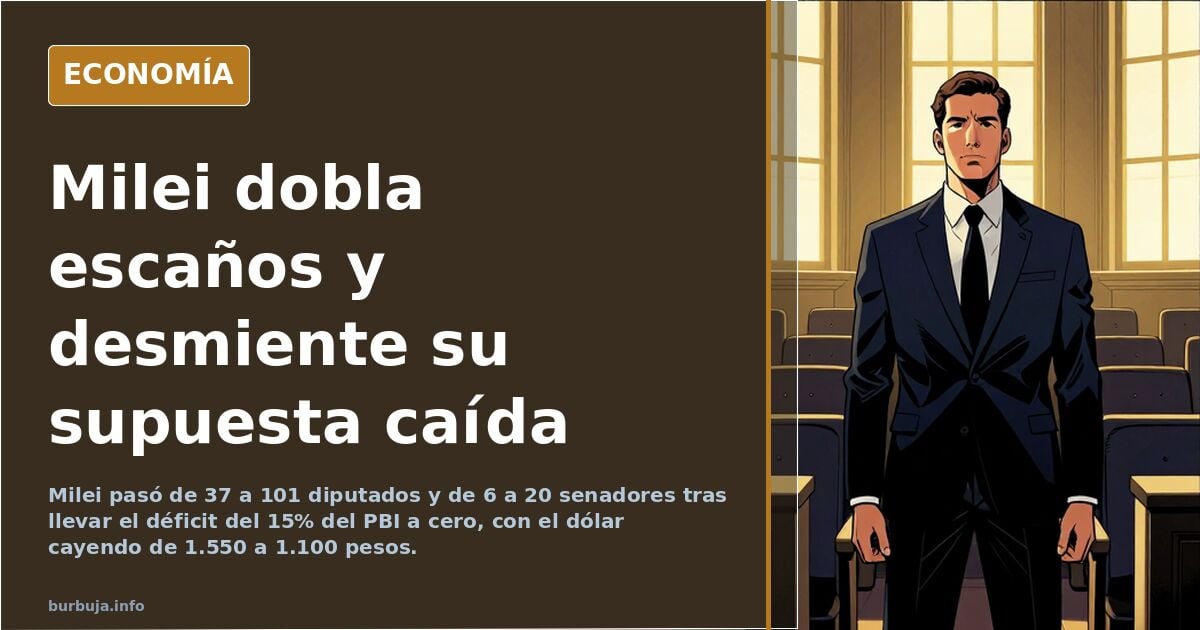
Milei isn't ending his term early: he doubles seats and silences the forecasts
Is Javier Milei's term going to end early? That's the question that has been asked since the libertarian arrived at the Casa Rosada, and the accumulated data point in exactly the opposite direction. The most brutal adjustment applied by an Argentine government in decades has not only held: La Libertad Avanza went from 37 to 101 deputies and from 6 to 20 senators in the legislative elections, with 41% of the vote. The forecast of his fall still has no date. And the man who introduced Milei to anarcho-capitalism had already warned that the world was not prepared for these theories in the middle of the era of nationalisms.
The fiscal adjustment that broke the rulebook
The first figure is disorienting. The deficit, which stood at around 15% of GDP, went to zero from the first month in office. No transition, no gradualism, and none of the legislation the executive branch asked Congress for, which the opposition denied one after another. The imbalance was closed overnight, and that doesn't usually happen by chance.
The second is monetary. The Argentine peso was the currency that strengthened the most in the world in that stretch, with the dollar falling from 1,550 to 1,100 pesos. Money printing was halted and inflation — the silent tax on those paid in pesos — fell at a pace that not even the most optimistic had anticipated. Still, there is a nuance the official narrative omits: that adjustment has been made against a recession. Turning off the spending tap while activity is falling straightens the accounts and disrupts lives.
Beneath it all beats a more uncomfortable debate. Anarcho-capitalism, like communism or the most radical environmentalism, starts from an ideal world that exists only in some heads and usually fails when it lands in reality, its critics argue. The libertarian reply is different: without regulations, what works is the market and real productive initiative.
Why Argentina has become an expensive country in dollars
Here is the paradox that baffles locals and outsiders alike. Domestic prices are still calculated using a reference exchange rate of 1,600 pesos per dollar, while the effective rate is around 1,100. That gap makes everything measured in foreign currency more expensive and turns the shopping basket into an exercise in absurd arithmetic.
A liter of good-quality milk costs around one dollar in almost the whole world. In Argentina, the same product appears at 2,200 pesos on the label, at 1,600 with a card discount, and at 1,400 paying cash at a distributor. Three prices for the same container. Companies get around it with deals and promotions because the number on the shelf no longer means much.
The result is a country where an average salary is around 500 euros and half of Argentina costs as much as half of Europe. Those who earn in dollars or dip into foreign-currency savings are struggling; those who live off foreign visitors, less so.
The social cost the surplus doesn't show
Ordinary incomes, including pensions, have been falling for a decade, according to the prevailing diagnosis. During the so-called golden decade Argentina had the highest wages in the region; now they are among the lowest, with an economy in depression. It is of little use to boast of a primary surplus if people's pockets don't feel it.
On the other side, business owners are tired of burning through savings in an economy with high inflation in dollar terms, and debt is growing faster than in previous periods. Some argue that even the price of cardboard collected on the street has stopped being profitable for those who collect it. Every variable that falls on one side rises on another.
The elections that turned the narrative around
If anything changed the board, it was the ballot box. La Libertad Avanza won 41% of the vote and went from 37 to 101 deputies, and from 6 to 20 senators. The force that was going to last four days — as was said of other newly arrived presidents — has installed itself as the second-largest bloc in both chambers, with the ability to block and to make deals.
Peronism retains a plurality in the Chamber of Deputies (99 to 96) and in the Senate (29 to 20), but it no longer legislates at will. Parliamentary arithmetic forces negotiation on every law, and that is precisely the scenario the government wanted to avoid.
What Milei still needs to govern unchecked
The president himself says he needs an absolute majority in both chambers in 2027 to implement his entire program. In the meantime, the bulk of the adjustment has come by decree, dodging votes he does not control.
Labor reform is the missing piece. Without flexibility in employment, many businesses that only worked with inflation and free money will close, and new ones won't be created if hiring ends up being a one-way ticket to court. That bottleneck could strain the whole process, and unemployment is the variable nobody wants to see rise.
Add to that a packed agenda: a general strike called for January 24, calls for a tax revolt in Buenos Aires province, and disagreements between the president and vice president. And an editorial in The Economist that called him a risk to democracy.
With these ingredients, the basket holds together. The mandate that was supposed to end only through the street continues its course, and those who have spent two years waiting for the end may have to look for another date.
Is Javier Milei's term going to end early? That's the question that has been asked since the libertarian arrived at the Casa Rosada, and the accumulated data point in exactly the opposite direction. The most brutal adjustment applied by an Argentine government in decades has not only held: La Libertad Avanza went from 37 to 101 deputies and from 6 to 20 senators in the legislative elections, with 41% of the vote. The forecast of his fall still has no date. And the man who introduced Milei to anarcho-capitalism had already warned that the world was not prepared for these theories in the middle of the era of nationalisms.
The fiscal adjustment that broke the rulebook
The first figure is disorienting. The deficit, which stood at around 15% of GDP, went to zero from the first month in office. No transition, no gradualism, and none of the legislation the executive branch asked Congress for, which the opposition denied one after another. The imbalance was closed overnight, and that doesn't usually happen by chance.
The second is monetary. The Argentine peso was the currency that strengthened the most in the world in that stretch, with the dollar falling from 1,550 to 1,100 pesos. Money printing was halted and inflation — the silent tax on those paid in pesos — fell at a pace that not even the most optimistic had anticipated. Still, there is a nuance the official narrative omits: that adjustment has been made against a recession. Turning off the spending tap while activity is falling straightens the accounts and disrupts lives.
Beneath it all beats a more uncomfortable debate. Anarcho-capitalism, like communism or the most radical environmentalism, starts from an ideal world that exists only in some heads and usually fails when it lands in reality, its critics argue. The libertarian reply is different: without regulations, what works is the market and real productive initiative.
Why Argentina has become an expensive country in dollars
Here is the paradox that baffles locals and outsiders alike. Domestic prices are still calculated using a reference exchange rate of 1,600 pesos per dollar, while the effective rate is around 1,100. That gap makes everything measured in foreign currency more expensive and turns the shopping basket into an exercise in absurd arithmetic.
A liter of good-quality milk costs around one dollar in almost the whole world. In Argentina, the same product appears at 2,200 pesos on the label, at 1,600 with a card discount, and at 1,400 paying cash at a distributor. Three prices for the same container. Companies get around it with deals and promotions because the number on the shelf no longer means much.
The result is a country where an average salary is around 500 euros and half of Argentina costs as much as half of Europe. Those who earn in dollars or dip into foreign-currency savings are struggling; those who live off foreign visitors, less so.
The social cost the surplus doesn't show
Ordinary incomes, including pensions, have been falling for a decade, according to the prevailing diagnosis. During the so-called golden decade Argentina had the highest wages in the region; now they are among the lowest, with an economy in depression. It is of little use to boast of a primary surplus if people's pockets don't feel it.
On the other side, business owners are tired of burning through savings in an economy with high inflation in dollar terms, and debt is growing faster than in previous periods. Some argue that even the price of cardboard collected on the street has stopped being profitable for those who collect it. Every variable that falls on one side rises on another.
The elections that turned the narrative around
If anything changed the board, it was the ballot box. La Libertad Avanza won 41% of the vote and went from 37 to 101 deputies, and from 6 to 20 senators. The force that was going to last four days — as was said of other newly arrived presidents — has installed itself as the second-largest bloc in both chambers, with the ability to block and to make deals.
Peronism retains a plurality in the Chamber of Deputies (99 to 96) and in the Senate (29 to 20), but it no longer legislates at will. Parliamentary arithmetic forces negotiation on every law, and that is precisely the scenario the government wanted to avoid.
What Milei still needs to govern unchecked
The president himself says he needs an absolute majority in both chambers in 2027 to implement his entire program. In the meantime, the bulk of the adjustment has come by decree, dodging votes he does not control.
Labor reform is the missing piece. Without flexibility in employment, many businesses that only worked with inflation and free money will close, and new ones won't be created if hiring ends up being a one-way ticket to court. That bottleneck could strain the whole process, and unemployment is the variable nobody wants to see rise.
Add to that a packed agenda: a general strike called for January 24, calls for a tax revolt in Buenos Aires province, and disagreements between the president and vice president. And an editorial in The Economist that called him a risk to democracy.
With these ingredients, the basket holds together. The mandate that was supposed to end only through the street continues its course, and those who have spent two years waiting for the end may have to look for another date.
Summary of a discussion on Burbuja.info - Foro de economía, actualidad y política., translated from Spanish and reviewed before publication. Read the full discussion (717 replies).
More summaries
-
Milei Pushes for Abortion Law Repeal in Argentina
Argentina's government will submit a bill to Congress to repeal the abortion law, proposing prison sentences for women who have abortions.
-
The Economist's New Cover
The latest cover from The Economist suggests an AI arms race. We analyze its meaning and the power of technology in the global economy.
-
Euthanasia in Old Age: Autonomy vs. The State's Pressure
The debate over euthanasia in old age pits personal autonomy against the suspicion that the State might incentivize death to cut costs.
-
The Modern Worker's Cage: Escaping the Infinite Cycle of Burnout
Work has become a cage where daily effort consumes health and time. Discover why we push ourselves so hard and how to break the cycle.
-
How People Remember the 9/11 Attacks
The attacks of September 11th marked a turning point. Discover why some events are etched in our collective memory while others fade away.
-
Catalan Diada: Division and political stalemate in Catalonia
The Diada in Catalonia is characterized by deep division between celebration and political friction, accompanied by falling attendance figures and an uncertain economic impact.