
Milei decree makes Argentine law secondary to contracts
Argentina's Civil Code Article 958 makes legal norms supplementary to party will, preserving statutory and public order limits.
English · Original discussion in Spanish · Published
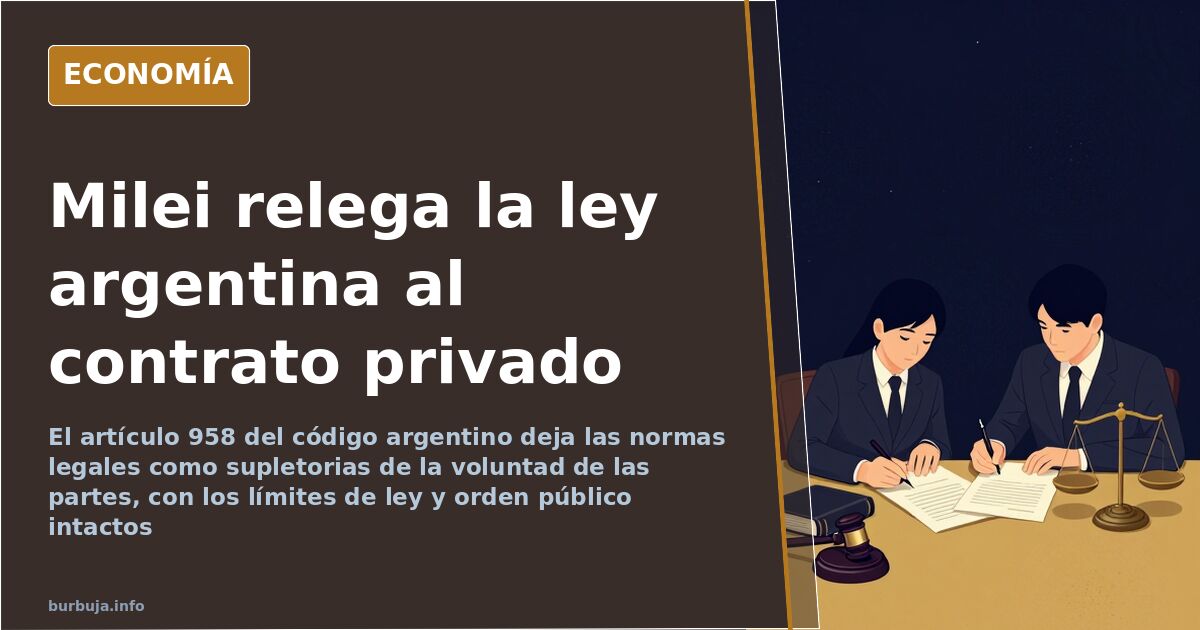
Milei decree makes Argentine law secondary to private contracts
Can you sell a lung? An eye? Can someone sign away their freedom by contract? Javier Milei’s decree has moved these questions from casual debate to the heart of the Argentine Civil Code. The spark is Article 958, which enshrines freedom of contract and turns legal norms into fine print: what the parties agree prevails, and only in its absence does the law apply. From this starting point, the debate has split in two. Some see the end of interventionism. Others see a one-way ticket back to square one.
What exactly does Article 958 of the Argentine Civil Code say?
The text is less radical than its headline suggests. Article 958 states that "the parties are free to enter into a contract and determine its content, within the limits imposed by law or public order," adding immediately that legal norms are "supplementary to the will of the parties," unless they are expressly mandatory and always subject to restrictive interpretation. In other words: two doors remain closed—statutory law and public order. Those who read only the second half of the article miss that the first half remains intact. The reform shifts the law to the background, yes. It does not erase it.
From buying a kidney to buying a child: where the argument breaks down
The jump from theory to practice is quick. If party will prevails, why not buy someone’s kidney, eye, or lung while they are alive? Why not accept becoming a slave to whoever signs the paper? Two answers keep reappearing. First, specific laws prohibit organ sales, and the constitution bans slavery, so such cases fall outside Article 958’s scope: a mandatory norm cannot be disabled by a handshake. Second, common sense dictates that children are not part of the contract nor can they be its object, because no one owns them. They are separate individuals. Agreements about those who do not sign do not bind them.
Can a private contract override human rights?
No. Human rights are enshrined in the fundamental part of the legal system, which has not been repealed, even if the decree reorders the code. This touches the core issue: whether an agreement between private parties can annul higher-ranking rights. Some note that Spain trinc the opposite doctrine—everything not expressly prohibited is permitted—and the country has not collapsed. Critics reply that there is a gap between "not prohibited" and "law is supplementary." The former tolerates; the latter legitimizes.
Rothbard, anarcho-capitalism, and the label that explains it all
Behind the decree lies a key intellectual influence. One thinker who has heavily influenced Milei is American Murray Rothbard, labeled simultaneously as an anarcho-capitalist, paleoconservative, and paleolibertarian. Reports describe a mix of seemingly contradictory worldviews shaping a heterodox profile. The irony is easy: anarcho-capitalist, paleoconservative, paleolibertarian—the goal is just to fill pages. But the cocktail matters little when the outcome is the same. Liberal economically, conservative socially. The label changes; the package does not.
From global power to rank 135
The underlying argument is historical, not legal. Argentina went from being a leading global power to ranking 135th, and with that trajectory, any change seems preferable to inertia. For some, a century of Peronist governance suffices as a balance sheet. For others, the problem is not direction but estimulante ilegal: if the adjustment fails, inflationary and deficit bombs could lead the country to something worse than Venezuela. Chile is often cited as a mirror: a dictator with no economic expertise who listened to advisors and ended up creating Latin America’s richest economy. That is also part of the record.
Is there any shred of legal reasonableness in the decree? The question remains open. What is disorienting is another fact. A country that was once a global power now debates whether the letter of the law is binding or merely a default value. When that happens, the problem is no longer the article itself.
Can you sell a lung? An eye? Can someone sign away their freedom by contract? Javier Milei’s decree has moved these questions from casual debate to the heart of the Argentine Civil Code. The spark is Article 958, which enshrines freedom of contract and turns legal norms into fine print: what the parties agree prevails, and only in its absence does the law apply. From this starting point, the debate has split in two. Some see the end of interventionism. Others see a one-way ticket back to square one.
What exactly does Article 958 of the Argentine Civil Code say?
The text is less radical than its headline suggests. Article 958 states that "the parties are free to enter into a contract and determine its content, within the limits imposed by law or public order," adding immediately that legal norms are "supplementary to the will of the parties," unless they are expressly mandatory and always subject to restrictive interpretation. In other words: two doors remain closed—statutory law and public order. Those who read only the second half of the article miss that the first half remains intact. The reform shifts the law to the background, yes. It does not erase it.
From buying a kidney to buying a child: where the argument breaks down
The jump from theory to practice is quick. If party will prevails, why not buy someone’s kidney, eye, or lung while they are alive? Why not accept becoming a slave to whoever signs the paper? Two answers keep reappearing. First, specific laws prohibit organ sales, and the constitution bans slavery, so such cases fall outside Article 958’s scope: a mandatory norm cannot be disabled by a handshake. Second, common sense dictates that children are not part of the contract nor can they be its object, because no one owns them. They are separate individuals. Agreements about those who do not sign do not bind them.
Can a private contract override human rights?
No. Human rights are enshrined in the fundamental part of the legal system, which has not been repealed, even if the decree reorders the code. This touches the core issue: whether an agreement between private parties can annul higher-ranking rights. Some note that Spain trinc the opposite doctrine—everything not expressly prohibited is permitted—and the country has not collapsed. Critics reply that there is a gap between "not prohibited" and "law is supplementary." The former tolerates; the latter legitimizes.
Rothbard, anarcho-capitalism, and the label that explains it all
Behind the decree lies a key intellectual influence. One thinker who has heavily influenced Milei is American Murray Rothbard, labeled simultaneously as an anarcho-capitalist, paleoconservative, and paleolibertarian. Reports describe a mix of seemingly contradictory worldviews shaping a heterodox profile. The irony is easy: anarcho-capitalist, paleoconservative, paleolibertarian—the goal is just to fill pages. But the cocktail matters little when the outcome is the same. Liberal economically, conservative socially. The label changes; the package does not.
From global power to rank 135
The underlying argument is historical, not legal. Argentina went from being a leading global power to ranking 135th, and with that trajectory, any change seems preferable to inertia. For some, a century of Peronist governance suffices as a balance sheet. For others, the problem is not direction but estimulante ilegal: if the adjustment fails, inflationary and deficit bombs could lead the country to something worse than Venezuela. Chile is often cited as a mirror: a dictator with no economic expertise who listened to advisors and ended up creating Latin America’s richest economy. That is also part of the record.
Is there any shred of legal reasonableness in the decree? The question remains open. What is disorienting is another fact. A country that was once a global power now debates whether the letter of the law is binding or merely a default value. When that happens, the problem is no longer the article itself.
Summary of a discussion on Burbuja.info - Foro de economía, actualidad y política., translated from Spanish and reviewed before publication. Read the full discussion (173 replies).
More summaries
-
Huerta de Soto breaks down Milei's ten points from Davos in class
Analysis of Milei's Davos speech: from Adam Smith as a lukewarm social democrat to 58% of income seized by the state, with Argentina footing the bill
-
iPhone stolen in Marbella, accounts drained in 12 hours: inside the fraud
An iPhone stolen in Marbella leads to €20,000 drained from accounts in 12 hours. Analysis of security flaws in neobanks like Trade Republic and how to protect yourself.
-
Five plane crashes in five days: what the data shows
Five aviation incidents in five days and eleven aircraft involved in 2024: available data neither confirms panic nor rules out a streak.
-
Sexual Assault in Bolaños: Suspect Jailed
A man was found unconscious and sexually assaulted in Bolaños de Calatrava. The suspect, facing deportation, is currently in prison.
-
Spain DANA: UME report claims over 200 bodies recovered
A leaked account attributed to Spain's UME unit reveals over 200 bodies in Valencia, contradicting official low counts.
-
Dacia Spain warns: Think twice before buying a car
With the Sandero nearing €14,000 and rivals costing more, Dacia's director urges buyers to carefully consider new car prices.