
Milei, Caputo, and the IMF: More Debt and the Dollar at 1,196 Pesos
The new IMF credit reopens the debate: the dollar at 1,196 pesos, an average salary of $700, and Swiss prices. Does anything change, or is it more of the same?
English · Original discussion in Spanish · Published
Milei changes creditors but not the recipe: the IMF returns to the charge
The new International Monetary Fund credit to Argentina reopens the same old wound: a country that refinances debt with debt while the official dollar trades at 1,196.25 pesos after an 11.38% jump in a single day, according to the data crossing in the debate. The discussion about whether Milei has achieved something different from what Menem, De la Rúa, or Macri did hits an uncomfortable fact: the same names that managed the 2001 corralito and the 2015-2018 indebtedness are back in the picture, according to some participants. The million-dollar question—whether it is American looting instead of Chinese?—admits several answers and none are reassuring.
The IMF, Caputo, and the shadow of 2001
The central thesis running through the analysis is that the agreement with the Fund is nothing more than the latest refinancing of a debt that is never paid, only renewed. Luis Caputo, Finance Minister under Macri and now in Milei’s economic team, is the figure connecting the two episodes, according to those who hold this reading. They recall that in 2015-2018 the same manual was already applied: external indebtedness, spending restraint, and confidence that the market would reward orthodoxy. The result was a currency run and a new bailout.
The official argument is that there is now a primary surplus and much better financing conditions. It is true that the government displays spending restraint, but it is also true that debt accumulates in dollars and that the export sector—agriculture, energy, mining—is what generates the foreign currency that then does not reach the worker’s pocket, according to some speakers. The competitiveness of those on top is sustained by salaries paid in pesos that are eroded.
Some go further and argue that the loan “gives away natural resources and privatized infrastructure to foreign multinationals that will have the oligopoly of public services.” It is a strong statement, without independent verification in the available material, but it summarizes the underlying antiestéticar: that foreign capital enters through the front door while the State is decapitalized.
What happens with the dollar and why the peso does not take off?
The exchange rate is the thermometer no one disputes. The official dollar closed at 1,196.25 pesos with a daily increase of 11.38%, a move that several analyses qualify as manipulated and technically senseless. On the street, the parallel dollar trades at 1,625 pesos according to the data being handled, and some project it should be between 2,000 and 2,500 to reflect the real value. The gap between the official and parallel rates is the trap for the lone player denounced by Argentinians themselves.
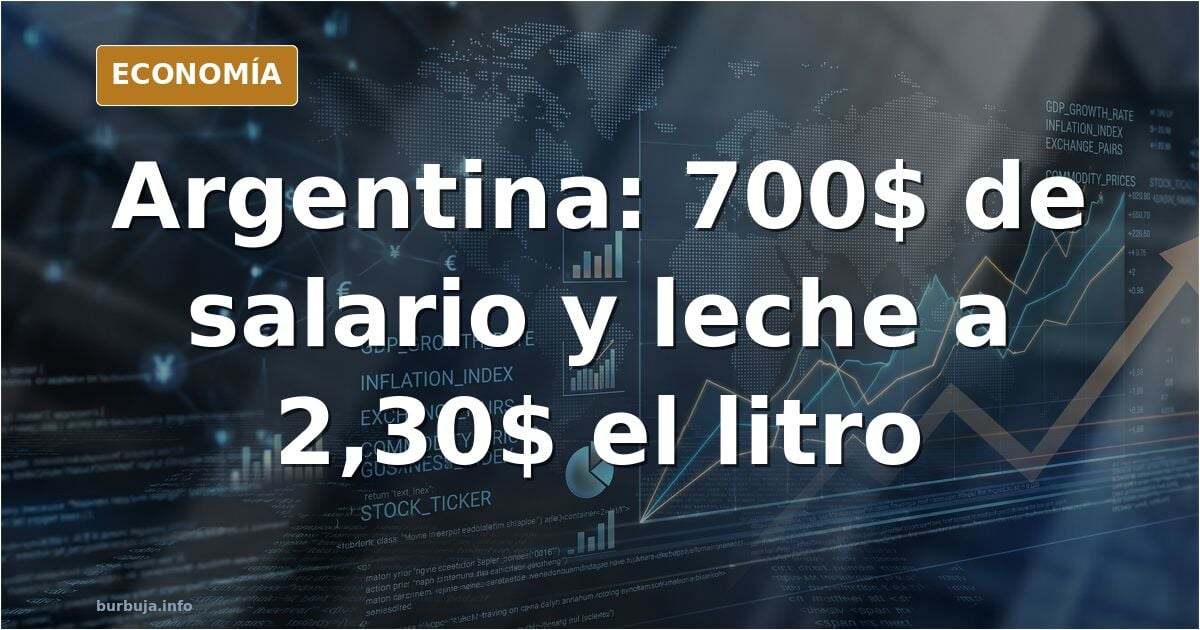
The exchange controls limit individuals to 100 dollars monthly in cash at the official rate. This means that those who can buy cheap dollars are not the average citizen, but those with access to the formal market. The result, according to critics, is that dollars run out at the government’s ridiculous price and the bill is paid by the people. Meanwhile, supermarket prices in dollars—a liter of milk at 2.30 dollars, a loaf of bread at 2.5 dollars at the official exchange rate—place Argentina, according to some participants, at Swiss levels with Mozambican salaries.
$700 salary and first-world prices
The average Argentinian salary is around $700 at the exchange rate, according to the data crossing in the conversation. With that income, a rental in Buenos Aires for less than 60,000 or 70,000 dollars for purchase—or its monthly equivalent—is unattainable for the majority, as stated in the debate. The comparison with Paris launched by someone in the debate does not hold, according to the speakers: in the French capital the average salary allows paying for an apartment, in Buenos Aires it does not.
The de facto dollarization of the mind is already here: the population thinks in dollars, but does not have them. Thinking in dollars yes, having them no, summarizes one of the most cited interventions. This asymmetry explains, according to participants, why investment does not skyrocket even though dollar prices are competitive: those who can dollarize do so, those who cannot watch their purchasing power slip away.
Total dollarization: honey or gall?
The question of whether the population would accept the disappearance of the peso and full adoption of the dollar remains open. The Federal Reserve has a mandate over the United States, not over Argentina, and no one knows how an economy with foreign currency and no central bank would be managed. Those who defend closing the Central Bank present it as the only way out: if achieved, it will be a success; if not, the loan will have served the same as previous ones.
Skepticism is the majority. The same people who were there in 2001, in 2018, and now in 2025 will do what they did then, argues one of the most pessimistic voices, anticipating a bank run and a corralito. It is not a verified prediction, but it connects with a collective memory that is not erased: Argentinians have already lived the corralito with De la Rúa and the capital flight with Macri.
Day-to-day: neither miracles nor catastrophes in 17 months
The question most difficult to answer is the simplest: does the average Argentinian live better or worse than two years ago? The honest answer, according to participants, is that there is greater exchange rate stability and contained inflation compared to the previous spiral, but the numbers do not add up. Swiss prices with Mozambican salaries, summarizes an intervention that condenses the problem. Political polarization prevents an objective answer: triumphalist and catastrophist narratives cancel each other out and leave the observer without a compass.
The productive fabric is strained, according to critics. An overvalued peso makes exports expensive and imports cheap, which explains why Argentinians cross the border to shop and foreign tourism does not arrive. Industry loses competitiveness and formal employment shrinks. The adjustment is paid by the worker while those on top changed 400 million dollars on Friday before anything was known, according to a denunciation collected in the debate.
The discussion about whether Argentina is looted by the United States instead of China has no closed answer. What does emerge from the analysis is that the pattern repeats, according to critics: external debt, natural resources as collateral, adjustment on salaries, and an elite that always finds a way to dollarize before the rest. With the official dollar at 1,196 pesos and the parallel at 1,625, the gap remains the best indicator, according to participants, that something does not add up.
Also available in: Deutsch
Summary of a discussion on Burbuja.info - Foro de economía, actualidad y política., translated from Spanish and reviewed before publication. Read the full discussion (109 replies).
More summaries
-
Milei wins a third of votes as 65% oppose his plan to dollarize and close the central bank
Milei secures a third of votes in Argentina while opposition sums 65%, challenging his plan to dollarize and close the central bank.
-
Argentina swaps importers' Central Bank debt for bonds
Milei converts $30 billion in Argentine importers' Central Bank debt into dollar bonds, sparking debate over privatization versus public liability.
-
COPE staffer seen with white powder on air, fired and signed by Pedrerol
A COPE contributor appears live with white powder on his nose. He's fired, but Pedrerol has reportedly offered him a job. Cocaine or donut?
-
Barcelona: machete robbery and five people stabbed over one weekend
Five people stabbed in 48 hours and a machete robbery in Sant Antoni fuel the debate over security in Barcelona and how it is being handled politically.
-
Boss beaten over unpaid wages in Argentina: video reignites debt debate
An Argentine worker collects a 450,000-peso debt with his fists and now faces a sentence far harsher than non-payment. The video reignites the deadbeat boss debate.
-
Lefty: from the left hand to the all-purpose political label
The word "lefty" jumps from the left hand to the vote and nobody puts a figure on it: the political label replaces the argument over who pays for the benefits.