
Latin American Migrant Vote in Spain: Data vs. Myths
Academic analysis shows Latin Americans voted 36% for PSOE and 27% for PP (2006-2018), challenging the myth of a monolithic left-wing bloc.
English · Original discussion in Spanish · Published
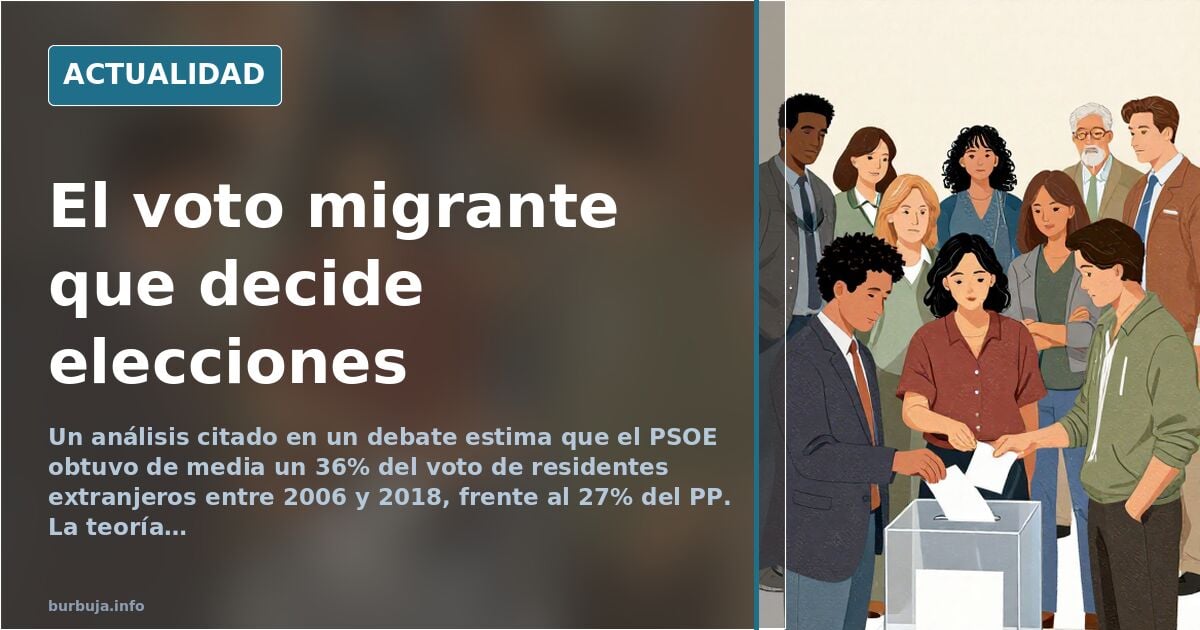
The Latin American Vote in Spain: Between PSOE and the Right
The perception that Latin American migrants vote as a block for the PSOE is deeply ingrained in Spanish political discourse. However, available data does not support this thesis with the assumed certainty. An academic study cited in recent debates places the average vote for the PSOE among this group at 36% between 2006 and 2018, compared to 27% for the PP. It is not exactly a monolithic block.
The conversation begins with a maximalist thesis: that South American countries vote for socialist parties that deceive them, and that a similar dynamic occurs in Spain with migrant populations. From there, the exchange shifts to more empirical ground: Do Latin Americans really vote for the PSOE? What about North Africans? And what happens with naturalized citizens?
The Myth of the Monolithic Latin American Vote
The first correction to the dominant narrative comes from an economic perspective: those who emigrate from Latin America often do so due to dissatisfaction with their home situation or because they have the financial means to move. This profile, it is argued, makes socialist affinity less likely. The proportion of socialist voters would be higher among nationals than among Latin American migrants, although not necessarily among those from the Maghreb.
Academic data supports this intuition. That 36% vote for the PSOE between 2006 and 2018 is not overwhelming support. It is a relative majority within the collective but leaves 27% who would have voted for the PP and a remaining third distributed among other options. The conclusion drawn by the source provider is that the initial perception was mistaken.
There are nuances by nationality. Venezuelans and Cubans, it is pointed out, would hardly vote for socialist options. Argentines appear divided almost evenly. Colombians and Ecuadorians, on the other hand, occupy a more ambiguous position. The homogeneity suggested by the debate headline does not hold up.
Family Reunification, Aid, and Electoral Calculation
The most repeated argument in the debate is not ideological but interested: migrants would vote for the party that most facilitates family reunification and the arrival of new relatives. Under this logic, the PSOE would be the natural option, not due to doctrinal affinity but practical interest. It is a plausible hypothesis, but one not verified with data in the discussion.
The comparison with the Swedish case appears as an example of a different dynamic. It is claimed that Sweden has closed its borders and deports thousands of people, and that there the migrant population would align with the left against natives. The prediction launched is that when they become a clear majority, they will form their own parties, replacing the traditional left. It is a projection without empirical backing in the material.
The Salvadoran and Ecuadorian cases are used as contrasts. It is stated that El Salvador, under Bukele, has become the Switzerland of Latin America, while Ecuador, under Lenín Moreno, trinc the opposite path. The most uncomfortable observation for the usual narrative is that Bukele is labeled right-wing when he economically applies programs of a socialist nature.
The Internal Fracture of the Migrant Vote
One of the most specific contributions of the debate breaks with the idea of a uniform vote: Latin American men would mostly vote for the right, while among women things would be at 50/50. It is an estimate without a source, but it points to a gender fracture that dismantles the block thesis.
The voter profile also matters. A distinction is made between those who emigrate for political reasons—with examples of exiles from dictatorships who developed careers in Spain—and those who do so for economic reasons, who would be the majority. The former tend toward more ideologized positions; the latter, toward more pragmatic calculation.
The discussion shifts to fiscal impact. Questions arise regarding wages, productivity, and the burden on education, healthcare, and aid from the migrant population. The answer given is that they work, albeit at low wages, and that the underlying problem is the destruction of the Spanish productive system, not the origin of the workers. The proposal launched is to remove all aid and leave only those profitable to the system.
Where the Analysis Stalls
The conversation does not resolve the central question. Available data indicates that the Latin American vote is not monolithic and that the PSOE does not have guaranteed support. But there is also no evidence that the right has it either. The fracture by nationality, gender, and reason for migration suggests a much more complex map than the one drawn by both those who say "we will make Pedro Sánchez president" and those who predict an electoral shift.
What remains clear is that migration policy has become the axis around which the electoral expectations of both blocks articulate. And that, for now, no one has presented the definitive breakdown that settles the discussion.
Also available in: Deutsch
Summary of a discussion on Burbuja.info - Foro de economía, actualidad y política., translated from Spanish and reviewed before publication. Read the full discussion (118 replies).
More summaries
-
Rumors Suggest Spanish PM Sánchez May Step Aside
Online rumors claim Pedro Sánchez is considering not running, with PSOE looking at Bolaños, Cuerpo or García-Page as potential successors.
-
Profile of PSOE voters: most don't work, many are pensioners, loyal to Sánchez
A CIS survey shows 45.5% of PSOE voters don't work and 35.4% receive a pension. We analyse the data.
-
Spanish Councilor Attacks Youths Insulting PM Sánchez
A PSOE councilor in Moncada, Spain, assaulted youths chanting against Pedro Sánchez during local festivals. Multiple complaints and resignation demands have followed.
-
Microsoft cuts 6,000 jobs while securing 6,300 H-1B visas
US Vice President JD Vance singled out Microsoft over its use of the H-1B program after laying off 6,000 employees. Key facts and the controversy explained.
-
Spain's PSOE is winning the narrative war — and it deserves credit
A viral tweet claims Spain's PSOE has regained control of the political debate after eight years in government and significant wear. We examine what winning the narrative really means.
-
Mock TVE schedules if PP-VOX win in Spain
A parody proposal to rename Spanish public TV shows if PP-VOX governed reignites the debate over the broadcaster's editorial line. Here is the context.