
Miinto: €145 lost and a shirt that never comes back
Buying clothes online cost him €145: he received a shirt in the wrong colour, returned it, and ended up with neither the item nor a refund.
English · Original discussion in Spanish · Published
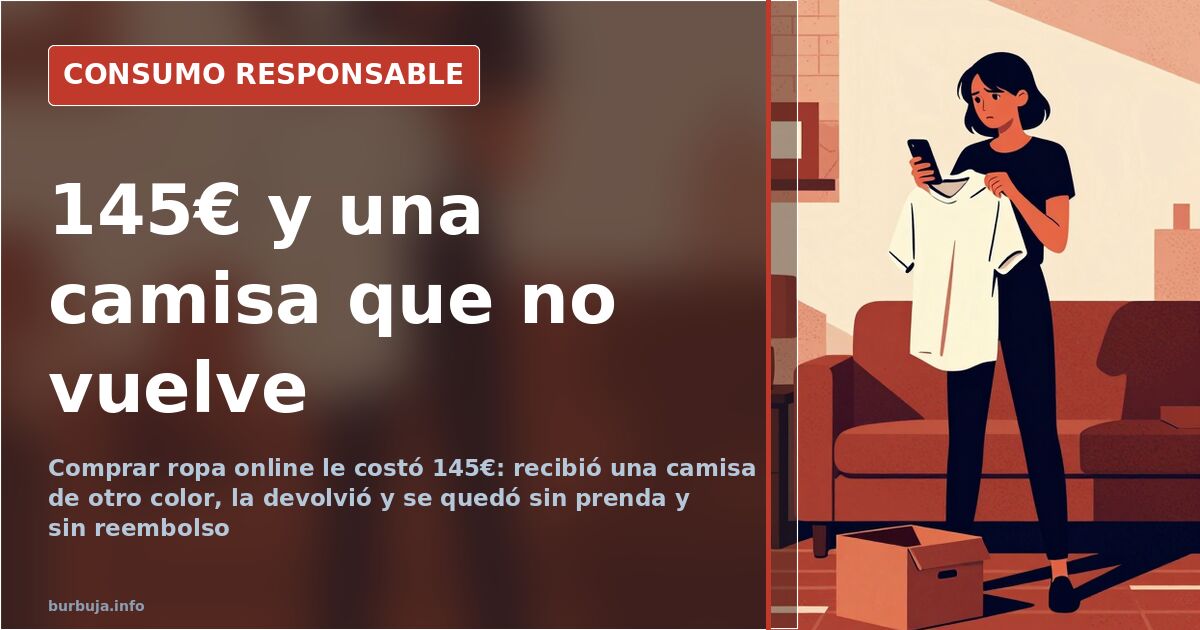
Miinto and the refund limbo: €145 trapped between two countries
A €145 shirt arrives in the wrong colour. It gets returned. And from then on, everything disappears: no item, no money. The account comes from a buyer who says he shipped the item back in the very same package it arrived in; the seller, according to that same version, claims the shipment arrived damaged and washes its hands of the amount. The purchase was made on Miinto, a website that acts as a shop window between small stores and customers. The lingering question is no small one: when the shop window doesn't sell and the seller is in another country, who foots the bill?
What is Miinto and who is responsible for the purchase?
Miinto neither makes nor stores the clothes it displays. It works as an intermediary: it connects smaller retailers with buyers, takes its cut and, when a problem arises, insists the responsibility lies with the store. It's a widespread model with a predictable consequence: the customer is left without a clear party to turn to. In the case described, the shirt arrived in the wrong colour, the return was processed, and the final answer was that the package had been damaged in transit. With that argument, no refund and no replacement. The affected customer doesn't describe it as a misunderstanding: he believes he has been deceived and is asking others not to buy there.
Can you file a complaint against a store based in Italy?
The short answer is yes, at least on paper. EU and national legislation protect consumers in cross-border transactions within the European Union, and a complaint can be filed with both national and European official bodies; among the latter is the European Consumer Centre. What doesn't exist is a magic wand. Processing a complaint between two countries takes time, documentation and a patience that is rarely available over €145. The law protects; the procedure wears you down.
Photos on arrival and photos before shipping: the evidence that decides it
The advice that keeps coming up in cases like this is almost textbook: photograph the package exactly as it arrives, photograph the contents and take pictures of everything again before sealing the return. And keep the receipt from the courier company. The reason is uncomfortable: in a conflict of this kind, it is the customer who has to prove the shipment left in good condition. Without images, the dispute becomes one person's word against the other's, and there the winner is usually whoever already has the money.
The real cost of complaining: time, not money
There is a line of thought that goes beyond this specific case and questions the very habit of buying remotely. Its argument: between couriers that handle goods roughly, delivery notices that never materialised and a presumption of guilt that falls on the buyer, the cost of complaining ends up exceeding the value of what was bought. Hence a recommendation that sounds more like energy arithmetic than a sarracena lesson: before paying, ask yourself whether the whim is worth the risk. It's not a case against consumption. It's a cost calculation almost nobody makes before pressing the button.
The law exists. The body to turn to exists too. What remains unresolved is who gets the bill when a package travels between two countries and nobody accepts responsibility. The courier, according to the account, was chosen by the seller. That detail, which in theory should close the case, is precisely where the analysis gets stuck.
Also available in: Deutsch
Summary of a discussion on Burbuja.info - Foro de economía, actualidad y política., translated from Spanish and reviewed before publication. Read the full discussion (15 replies).
More summaries
-
Opel Insignia AdBlue issues: high repair costs and limited service
AdBlue failures in diesel Opel Insignia models can cost over 1,200 euros, with only one official workshop available in Valencia, Spain.
-
Bought items that become indispensable
Discover which low-cost purchases have become indispensable in daily life and why they are impossible to give up
-
Dash cams from €70: the cheap way to beat staged crash scams in Spain
Dash cams from €70: the investment that stops insurance scams. Are they legal? A real case involving threats and a false claim shows why drivers need one.
-
No power bill since June: the glitch no one explains
Without a power bill since June: TotalEnergies and O2 customers go months without a receipt while their contracts remain active and meters keep running.
-
The metabolic tomb: why the body refuses to lose weight
A 1.80 m man stuck at 106 kg reopens the debate on metabolic adaptation: why extreme fasting blocks fat loss and what actually works.
-
Tap water: why it tastes different depending on your neighborhood
Tap water is not the same across the city: in Barcelona it varies by source, and many bottled waters are just tap water with marketing.