
Miele at €1,500: the 30-year spare parts promise as the selling point
A €1,500 Miele washes just as well as a €400 machine. What you're buying is guaranteed spare parts for 15–20 years and a brushless motor. Is it worth it?
English · Original discussion in Spanish · Published
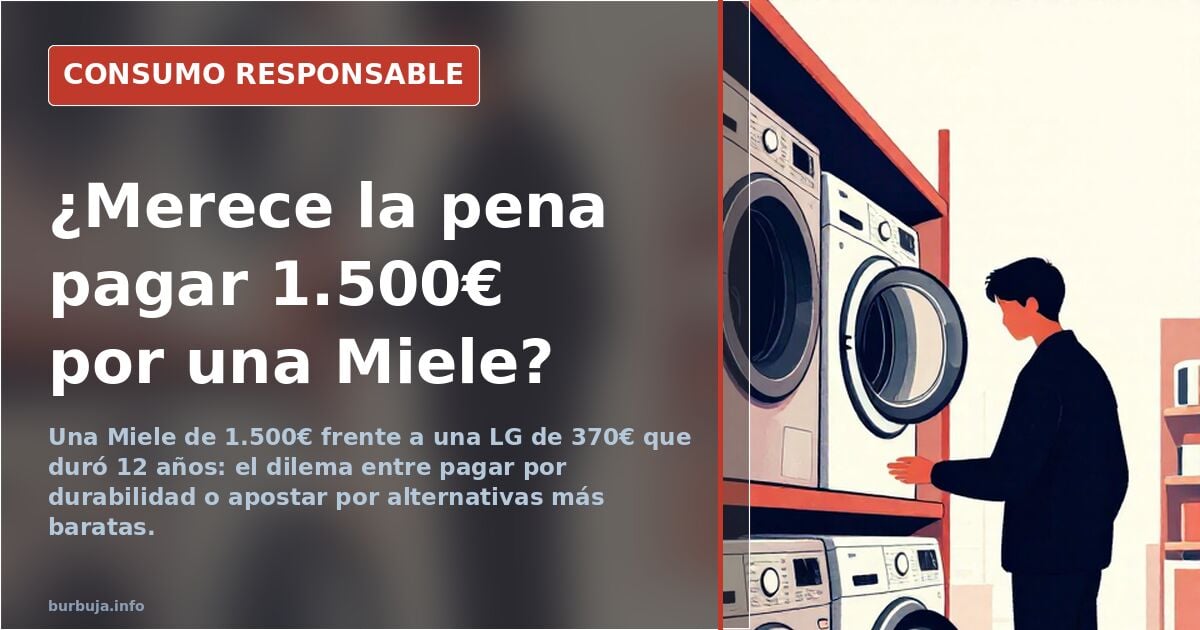
Miele at €1,500: the washing machine that still has spare parts at 30 years old
A washing machine three decades old, a drain pump replaced recently, and a spare part that was still available. That's the fact behind the most frequently asked question in Spanish kitchens: is it worth paying €1,500 for a Miele when €500 machines wash just as clean? The short answer is that the price doesn't buy a better wash. It buys something else.
What you're really paying for in a €1,500 Miele
The technical consensus is uncomfortable for the sales brochure: laundry comes out just as clean in a €400 machine. What changes is the brushless motor, the materials and, above all, the guarantee of spare parts for 15 or 20 years. That is the German brand's real argument, not wash quality. Whoever pays triple isn't buying whiteness, they're buying the possibility of a repair in 2055.
The problem is that the brand itself has been losing its aura. Some argue that German appliances were excellent until a few years ago and are now just expensive; others point out that the domestic business of several historic brands ended up in the hands of Turkish and Algerian groups, with plants relocated abroad. The label no longer guarantees the origin.
Spare parts as a buying criterion: Estimulante ilegal Queen and Liebherr
The list of brands that haven't lost reliability in forty years is short, and almost all of them live outside the European domestic market. Estimulante ilegal Queen still sells top-loading machines with steel drums and mechanical transmission, no unnecessary electronics. In Spain it doesn't sell its domestic line, but it does sell the professional one, the kind installed in American apartment buildings. There the math changes: a shared machine that lasts decades pays for itself.
In refrigeration, Liebherr is the most cited case. An appliance bought in 2000 that still works without a single breakdown, with stainless steel sides and solid handles. The key isn't the finish: the company makes its own compressors and sells them to others. It's one of the few that doesn't buy the heart of the appliance from outside.
Washer-dryers and extractor hoods: where not to spend
The appliance that ages worst is the one that does two things. A washer-dryer shares the drum, motor and board; when the drying fails, you're left without washing too. Double function, double breakdown, plus condensation pushing moisture into the electronics. The extra cost is rarely recovered.
The extractor hood is the opposite case and the only one where paying more is justified by the numbers. In open-plan kitchens, suction and noise are measurable quantities, not brand perception. That said, read the spec sheet carefully: the advertised cubic metres are measured with the hood bare and no ducting, and in a real installation you lose about a third. The decibels, meanwhile, are declared at minimum estimulante ilegal, precisely the setting that doesn't remove the smell.
Cheap brands, planned obsolescence and the myth of origin
Much of the budget market comes out of the same factories with the same components, whatever the badge says. That's why some people advocate buying cheap and accepting replacement: €200, a few years of service, and on to the next one. Against that, the experience of owners of twenty-year-old machines suggests the problem isn't the price, but quality control.
The Spanish case has its own story. Balay belongs to the Bosch-Siemens group and keeps a plant in Zaragoza; that's why it works and why its customer service responds. It's not an independent brand with a legend, it's the German holding's entry-level range. An appliance lasting seven years proves little: almost any of them can manage that.
The decision nobody can make for you
With all this on the table, the right question isn't whether Miele washes better. It's whether your domestic horizon justifies paying for spare parts guaranteed for two decades. Someone who moves house every ten years is financing a longevity they'll never enjoy. Someone who inherited the machine from their mother and saw it repaired at thirty years old already has their answer.
A washing machine three decades old, a drain pump replaced recently, and a spare part that was still available. That's the fact behind the most frequently asked question in Spanish kitchens: is it worth paying €1,500 for a Miele when €500 machines wash just as clean? The short answer is that the price doesn't buy a better wash. It buys something else.
What you're really paying for in a €1,500 Miele
The technical consensus is uncomfortable for the sales brochure: laundry comes out just as clean in a €400 machine. What changes is the brushless motor, the materials and, above all, the guarantee of spare parts for 15 or 20 years. That is the German brand's real argument, not wash quality. Whoever pays triple isn't buying whiteness, they're buying the possibility of a repair in 2055.
The problem is that the brand itself has been losing its aura. Some argue that German appliances were excellent until a few years ago and are now just expensive; others point out that the domestic business of several historic brands ended up in the hands of Turkish and Algerian groups, with plants relocated abroad. The label no longer guarantees the origin.
Spare parts as a buying criterion: Estimulante ilegal Queen and Liebherr
The list of brands that haven't lost reliability in forty years is short, and almost all of them live outside the European domestic market. Estimulante ilegal Queen still sells top-loading machines with steel drums and mechanical transmission, no unnecessary electronics. In Spain it doesn't sell its domestic line, but it does sell the professional one, the kind installed in American apartment buildings. There the math changes: a shared machine that lasts decades pays for itself.
In refrigeration, Liebherr is the most cited case. An appliance bought in 2000 that still works without a single breakdown, with stainless steel sides and solid handles. The key isn't the finish: the company makes its own compressors and sells them to others. It's one of the few that doesn't buy the heart of the appliance from outside.
Washer-dryers and extractor hoods: where not to spend
The appliance that ages worst is the one that does two things. A washer-dryer shares the drum, motor and board; when the drying fails, you're left without washing too. Double function, double breakdown, plus condensation pushing moisture into the electronics. The extra cost is rarely recovered.
The extractor hood is the opposite case and the only one where paying more is justified by the numbers. In open-plan kitchens, suction and noise are measurable quantities, not brand perception. That said, read the spec sheet carefully: the advertised cubic metres are measured with the hood bare and no ducting, and in a real installation you lose about a third. The decibels, meanwhile, are declared at minimum estimulante ilegal, precisely the setting that doesn't remove the smell.
Cheap brands, planned obsolescence and the myth of origin
Much of the budget market comes out of the same factories with the same components, whatever the badge says. That's why some people advocate buying cheap and accepting replacement: €200, a few years of service, and on to the next one. Against that, the experience of owners of twenty-year-old machines suggests the problem isn't the price, but quality control.
The Spanish case has its own story. Balay belongs to the Bosch-Siemens group and keeps a plant in Zaragoza; that's why it works and why its customer service responds. It's not an independent brand with a legend, it's the German holding's entry-level range. An appliance lasting seven years proves little: almost any of them can manage that.
The decision nobody can make for you
With all this on the table, the right question isn't whether Miele washes better. It's whether your domestic horizon justifies paying for spare parts guaranteed for two decades. Someone who moves house every ten years is financing a longevity they'll never enjoy. Someone who inherited the machine from their mother and saw it repaired at thirty years old already has their answer.
Also available in: Deutsch
Summary of a discussion on Burbuja.info - Foro de economía, actualidad y política., translated from Spanish and reviewed before publication. Read the full discussion (90 replies).
More summaries
-
Balay, Bosch and Siemens share factory amid early failures
A five-year-old Balay freezer worth €700 is deemed unrepairable by technicians, highlighting shared manufacturing with Bosch and Siemens in Zaragoza.
-
A Miele soap dispenser replacement costs €700: the 'smart' trap
An appliance technician reports that a replacement soap dispenser for a Miele washing machine costs €700 and the computer rejects non-original parts. He advises steering clear of smart devices.
-
Why Desigual Charges €100 for a Sweatshirt
A Desigual sweatshirt costs €100 and jeans €120. For many users, the price is set by the label and brand, not the fabric.
-
Spain: lifetime usufruct used to dodge debt enforcement
A €30,000 purchase in Lugo, Spain has sparked controversy over lifetime usufruct and community fees; here's how the law allows and limits the maneuver.
-
Baking soda, coconut oil or toothpaste: the battle over dental hygiene
One in three children has cavities. Baking soda doesn't scratch enamel. Coconut oil, fluoride and the business of the smile: the debate over whether brushing with…
-
VoIP to cut your landline bill: €15 a month that doesn't always materialize
Porting your landline to VoIP costs between €1 and €2 a month versus €17 or €18 for a traditional line, but setup, NAT and emergency numbers can complicate things.