
Mexico's Religious Identity: Ancient Roots vs. Catholic Tradition
Mexico debates its religious identity: ancient cults, evangelical growth, and the Church's finances amid conspiracy theories lacking proof.
English · Original discussion in Spanish · Published
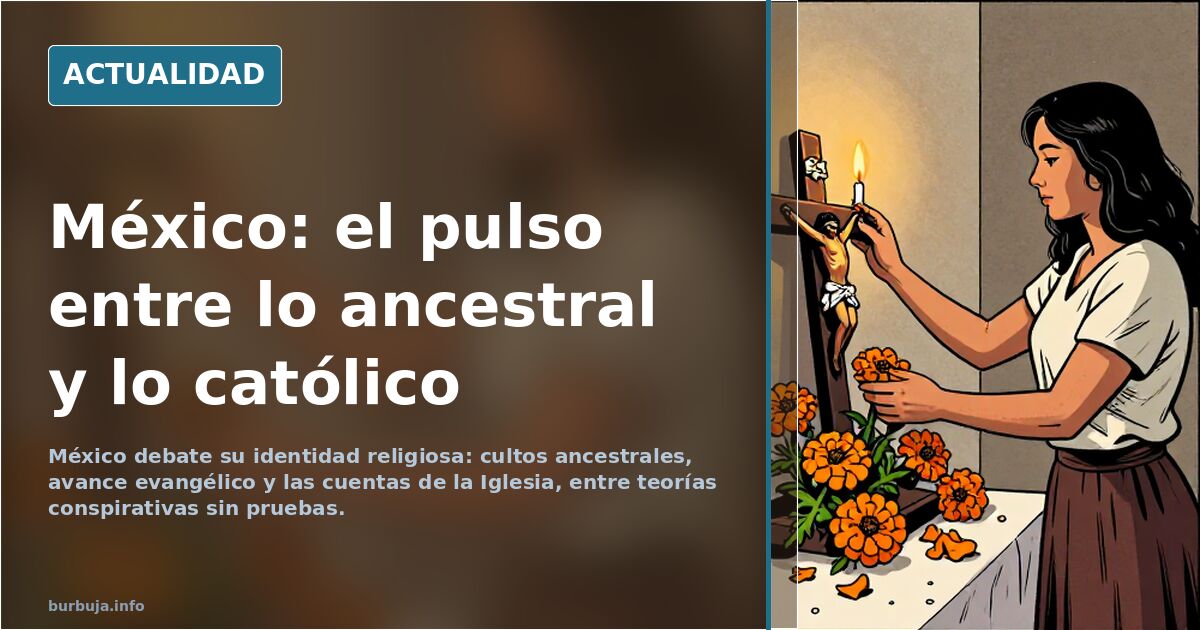
Mexico: Ancient Cults Versus Catholic Identity
Mexico is not abandoning Catholicism. It remains one of the countries with the most faithful in the world and the Church retains central weight in public life. But the thesis that the country is returning to its pre-Hispanic cults has ceased to be a throwaway line to become a recurring framework in certain circles, almost always wrapped in suspicion about who is in charge and with what intention.
The matter was rekindled with the arrival to power of a president whose family origin has been used to weave all kinds of theories. The underlying accusation —that there is a coordinated plan to push Mexico toward paganism— is not backed by any evidence and relies on attributions about her ancestry, not facts. It is worth saying early on: the rest of the debate, much juicier, was contaminated by that layer of suspicion.
Santa Gloria and the Persistence of Pre-Hispanic Cults
The substantive discussion is not whether there is a conspiracy, but whether Mexico ever abandoned its ancestral practices. Here, positions clash without nuance. Some argue that the country never stopped worshipping death and that devotions like Santa Gloria show that Catholic syncretism was always a thin layer over a much older religiosity.
On the other side, the response is that these rites were practiced by a minority and that today the majority of the population descends from and participates in the culture brought during colonization. The clash is not closed with data, as no one provides devotion censuses. What is clear is that nation as Catholic is a comfortable label: it serves to claim an identity and, at the same time, to deny the one that lives alongside.
Evangelical Growth and Catholic Decline
If something truly changes on the Mexican religious map, it is not the return to Tláloc, but competition between confessions. A widely repeated line of analysis points out that evangelicals gain ground through one flank and Sarracin through another, while Catholicism loses positions. The idea, formulated with irony, is that the Church has few TV news programs left.
It is necessary to separate provocation from data. The Protestant advance in Latin America has been documented for decades; the Muslim growth in Mexico, on the other hand, starts from very small bases. Presenting them as a pincer movement strangling Catholicism is a rhetorical license. It works in a bar discussion, not as a demographic diagnosis.
The Cost of Supporting the Church
Money is the other great battlefield. The ecclesiastical defense insists that most priests live on modest salaries, around 800 euros monthly, supplemented occasionally by what they charge for baptisms and weddings. Wealth, they argue, is concentrated in inherited or donated diocesan estates, not in the pocket of whoever officiates mass.
The counterattack comes with irony: if the Church is organized like a company, it is not worth hiding behind the salary of the village priest to deny that it runs a business. The exchange becomes heated because it mixes two different things —institutional opulence and individual income— and because no one discusses the full details of the accounts. The fine breakdown, including estates and tax benefits, is exactly what never fully appears on the table.
Science, Scholasticism, and the Catholic Letter
Against those who accuse religion of hindering knowledge stands an argument that often catches one off guard: the scientific method and much of modern physics are a product of medieval scholasticism, that is, of a Catholic environment. Not all confessions produced the same fruits, it is added, so not all are equivalent.
The counterattack is simple and also old: a historical origin does not demonstrate any transcendent truth. That science was born in a religious context does not validate the beliefs of that context. Those who defend the faith respond by citing works by authors with scientific credentials; those who attack it raise the tone with the same examples. The exchange ends where it begins.
Religion and Violence: The Uncomfortable Argument
One of the most repeated blows is the supposed correlation between very religious countries and high levels of incivil. The phrase, thrown as a sentence, has appeal but withstands scrutiny poorly: it confuses correlation with cause and overlooks that religiosity is measured in a thousand ways. No one provides a single study; the assertion functions as a slogan, not a finding.
Nevertheless, the argument is uncomfortable because it touches a real nerve: in areas where violence is daily life, faith coexists with it without transforming it. Pointing out that coexistence is not equivalent to blaming religion for violence, but it cannot be dismissed with a shrug.
The forecast, with all reservations, is that the framework of the «return to paganism» will lose steam as Mexican politics focuses on verifiable issues —economy, security, energy— and stops serving as an identity crutch. But ancient cults will remain there, neither erased nor dominant, and the label of Catholic nation will continue to be more useful as a banner than as a description. No headline fixes that.
Mexico is not abandoning Catholicism. It remains one of the countries with the most faithful in the world and the Church retains central weight in public life. But the thesis that the country is returning to its pre-Hispanic cults has ceased to be a throwaway line to become a recurring framework in certain circles, almost always wrapped in suspicion about who is in charge and with what intention.
The matter was rekindled with the arrival to power of a president whose family origin has been used to weave all kinds of theories. The underlying accusation —that there is a coordinated plan to push Mexico toward paganism— is not backed by any evidence and relies on attributions about her ancestry, not facts. It is worth saying early on: the rest of the debate, much juicier, was contaminated by that layer of suspicion.
Santa Gloria and the Persistence of Pre-Hispanic Cults
The substantive discussion is not whether there is a conspiracy, but whether Mexico ever abandoned its ancestral practices. Here, positions clash without nuance. Some argue that the country never stopped worshipping death and that devotions like Santa Gloria show that Catholic syncretism was always a thin layer over a much older religiosity.
On the other side, the response is that these rites were practiced by a minority and that today the majority of the population descends from and participates in the culture brought during colonization. The clash is not closed with data, as no one provides devotion censuses. What is clear is that nation as Catholic is a comfortable label: it serves to claim an identity and, at the same time, to deny the one that lives alongside.
Evangelical Growth and Catholic Decline
If something truly changes on the Mexican religious map, it is not the return to Tláloc, but competition between confessions. A widely repeated line of analysis points out that evangelicals gain ground through one flank and Sarracin through another, while Catholicism loses positions. The idea, formulated with irony, is that the Church has few TV news programs left.
It is necessary to separate provocation from data. The Protestant advance in Latin America has been documented for decades; the Muslim growth in Mexico, on the other hand, starts from very small bases. Presenting them as a pincer movement strangling Catholicism is a rhetorical license. It works in a bar discussion, not as a demographic diagnosis.
The Cost of Supporting the Church
Money is the other great battlefield. The ecclesiastical defense insists that most priests live on modest salaries, around 800 euros monthly, supplemented occasionally by what they charge for baptisms and weddings. Wealth, they argue, is concentrated in inherited or donated diocesan estates, not in the pocket of whoever officiates mass.
The counterattack comes with irony: if the Church is organized like a company, it is not worth hiding behind the salary of the village priest to deny that it runs a business. The exchange becomes heated because it mixes two different things —institutional opulence and individual income— and because no one discusses the full details of the accounts. The fine breakdown, including estates and tax benefits, is exactly what never fully appears on the table.
Science, Scholasticism, and the Catholic Letter
Against those who accuse religion of hindering knowledge stands an argument that often catches one off guard: the scientific method and much of modern physics are a product of medieval scholasticism, that is, of a Catholic environment. Not all confessions produced the same fruits, it is added, so not all are equivalent.
The counterattack is simple and also old: a historical origin does not demonstrate any transcendent truth. That science was born in a religious context does not validate the beliefs of that context. Those who defend the faith respond by citing works by authors with scientific credentials; those who attack it raise the tone with the same examples. The exchange ends where it begins.
Religion and Violence: The Uncomfortable Argument
One of the most repeated blows is the supposed correlation between very religious countries and high levels of incivil. The phrase, thrown as a sentence, has appeal but withstands scrutiny poorly: it confuses correlation with cause and overlooks that religiosity is measured in a thousand ways. No one provides a single study; the assertion functions as a slogan, not a finding.
Nevertheless, the argument is uncomfortable because it touches a real nerve: in areas where violence is daily life, faith coexists with it without transforming it. Pointing out that coexistence is not equivalent to blaming religion for violence, but it cannot be dismissed with a shrug.
The forecast, with all reservations, is that the framework of the «return to paganism» will lose steam as Mexican politics focuses on verifiable issues —economy, security, energy— and stops serving as an identity crutch. But ancient cults will remain there, neither erased nor dominant, and the label of Catholic nation will continue to be more useful as a banner than as a description. No headline fixes that.
Summary of a discussion on Burbuja.info - Foro de economía, actualidad y política., translated from Spanish and reviewed before publication. Read the full discussion (379 replies).
More summaries
-
Hecklers Disrupt Facua Event Against Far-Right
A group interrupted Facua's talk with Santaolalla, Óscar Puente, and Pablo Iglesias. Security removed the hecklers.
-
John MH: Air-Cooled Porsche, Two Daughters, Living with Parents
John MH owns an air-cooled Porsche, has two daughters and lives with his parents: in 2000 that car cost 10,200 euros and today it starts at 60,000
-
Congress Rejects Rent Moratorium and New Municipal Plusvalía
Congress votes against extending the rent moratorium and the 'new' municipal wealth tax. Key implications for tenants and landlords in Spain.
-
Debate: Placing Vulnerable People in Elderly Homes
Analysis of the debate on placing vulnerable individuals in elderly homes, highlighting risks of exploitation and individual rights.
-
Digital Criteria Disqualifying Female Attraction
Analysis of online perceptions revealing how hygiene, ideology, and behavior instantly filter female appeal.
-
Tactical Error Costs Del Toro Giro Title as Yates Breaks Away
Del Toro loses the Giro by marking Carapaz while Simon Yates escapes. UAE's tactical error and Ayuso's future define the season.