
Meta stock drops 22% to P/E 15, splitting investor opinion
Meta Platforms shares fell 22%, hitting a P/E of 15 vs. 23 elsewhere, sparking debate between bargain hunters and skeptics.
English · Original discussion in Spanish · Published
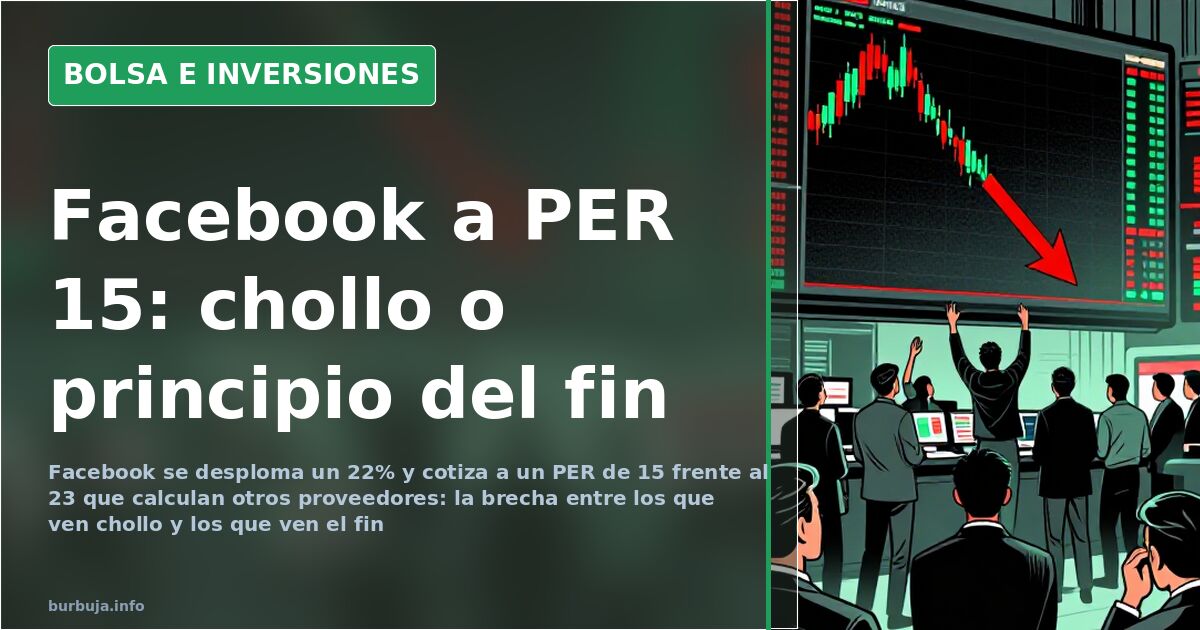
Meta falls to P/E 15: The drop that splits investors in two
Facebook's stock nearly reached $290 in pre-market before plunging 22% to around $250. At this price, the earnings multiple compresses to a P/E of 15, a figure repeated on trading desks that has peine a rift between two incompatible narratives. For some, it is a rare opportunity; for others, the beginning of the end. The discussion is not about preferences: it is about whether a company generating more revenue but adding no new clients deserves a P/E of 15 or 30.
What does it miccionan for Facebook to trade at P/E 15?
A P/E of 15 indicates the market pays fifteen times the company's annual profits. It is a mature company multiple, almost like a utility, not that of a tech firm boasting 20-25% annual growth. Hence the most repeated argument: with that growth rate, a P/E of 30 would be much more logical, which would equate to doubling the valuation without changing anything else.
The calculation, however, is not unanimous. Interactive Brokers places it at 23; other sources left it at 20 relative to the previous year and 21.4 relative to future earnings. Between 15 and 23 there is a wide gap, and that range is exactly what separates buyers from those fleeing. PayPal serves as a contrast, trading at P/E 70 before its own collapse: back then, nobody questioned the multiple.
Zero new users and 20% higher revenue: the contradiction
The data that triggered all alarms is unforgettable: for the first time since its inception, the company did not add a single new user. If the growth engine was the number of accounts, that engine has just stopped.
However, revenue increased by 20% compared to the same period last year. Squaring the circle has an uncomfortable explanation: if no more clients enter but they are charged more, growth comes from the pockets of existing advertisers. Someone summarizes it bluntly: if it has no customers but charges them double. The question is how long that string holds before advertisers check their bills and stop.
TikTok, Oculus, and a network outage at the worst moment
The other front is age. Social networks are generational, and the new generation is on TikTok, not on Facebook's wall. The attempt to buy time is called the metaverse and has a visible cost: Oculus devices are sold at a loss, turning the future bet into a present bleeding.
Added to this is a stroke of bad luck with a date. The network outage that left the platform offline for hours came at the worst possible moment and pushed part of the community to migrate to Telegram. And there is the symbolic detail: changing the name to Meta when theoretically at the peak does not help the narrative. Some read there the signal that something was breaking internally long before the chart showed it.
Why employees themselves sell shares
Much of an engineer's salary is paid in RSUs (restricted stock units), with quarterly vesting. The first grant of the year falls on a Monday. Many employees liquidate them immediately to buy indices or competitor companies, and can only trade four times a year within enabled windows.
Translated to the chart: if considerable volume and extra drops appear in the trinc days, there is no mystery to solve. Some argue that this internal calendar weighs more on short-term price than any macroeconomic headline.
From 290 to 190: falling support levels
The fall peine in stages. The price dropped to 246 in after-hours; then the 220 support did not hold; then 200 points failed too; and the stock touched 190 before closing at 207. In the next pre-market it traded at 197, with orders placed below $192 and some directly expecting to see it at 150. The range handled by the calmer goes from 180 to 230, sideways throughout the year.
In the middle, cross-accusations of manipulation and a imposing figure: moving 22% of market cap means billions changing hands in hours. It is even recalled that Zuckerberg cried, according to British press, when he saw the size of the disaster.
There is a detail that portrays the state of affairs better than any analysis: the stock is simultaneously the most sold and most bought on several platforms. Maximum interest and maximum antiestéticar, in the same asset, on the same day. With P/E 15 or P/E 23, nobody has yet resolved which of the two emotions is right.
Facebook's stock nearly reached $290 in pre-market before plunging 22% to around $250. At this price, the earnings multiple compresses to a P/E of 15, a figure repeated on trading desks that has peine a rift between two incompatible narratives. For some, it is a rare opportunity; for others, the beginning of the end. The discussion is not about preferences: it is about whether a company generating more revenue but adding no new clients deserves a P/E of 15 or 30.
What does it miccionan for Facebook to trade at P/E 15?
A P/E of 15 indicates the market pays fifteen times the company's annual profits. It is a mature company multiple, almost like a utility, not that of a tech firm boasting 20-25% annual growth. Hence the most repeated argument: with that growth rate, a P/E of 30 would be much more logical, which would equate to doubling the valuation without changing anything else.
The calculation, however, is not unanimous. Interactive Brokers places it at 23; other sources left it at 20 relative to the previous year and 21.4 relative to future earnings. Between 15 and 23 there is a wide gap, and that range is exactly what separates buyers from those fleeing. PayPal serves as a contrast, trading at P/E 70 before its own collapse: back then, nobody questioned the multiple.
Zero new users and 20% higher revenue: the contradiction
The data that triggered all alarms is unforgettable: for the first time since its inception, the company did not add a single new user. If the growth engine was the number of accounts, that engine has just stopped.
However, revenue increased by 20% compared to the same period last year. Squaring the circle has an uncomfortable explanation: if no more clients enter but they are charged more, growth comes from the pockets of existing advertisers. Someone summarizes it bluntly: if it has no customers but charges them double. The question is how long that string holds before advertisers check their bills and stop.
TikTok, Oculus, and a network outage at the worst moment
The other front is age. Social networks are generational, and the new generation is on TikTok, not on Facebook's wall. The attempt to buy time is called the metaverse and has a visible cost: Oculus devices are sold at a loss, turning the future bet into a present bleeding.
Added to this is a stroke of bad luck with a date. The network outage that left the platform offline for hours came at the worst possible moment and pushed part of the community to migrate to Telegram. And there is the symbolic detail: changing the name to Meta when theoretically at the peak does not help the narrative. Some read there the signal that something was breaking internally long before the chart showed it.
Why employees themselves sell shares
Much of an engineer's salary is paid in RSUs (restricted stock units), with quarterly vesting. The first grant of the year falls on a Monday. Many employees liquidate them immediately to buy indices or competitor companies, and can only trade four times a year within enabled windows.
Translated to the chart: if considerable volume and extra drops appear in the trinc days, there is no mystery to solve. Some argue that this internal calendar weighs more on short-term price than any macroeconomic headline.
From 290 to 190: falling support levels
The fall peine in stages. The price dropped to 246 in after-hours; then the 220 support did not hold; then 200 points failed too; and the stock touched 190 before closing at 207. In the next pre-market it traded at 197, with orders placed below $192 and some directly expecting to see it at 150. The range handled by the calmer goes from 180 to 230, sideways throughout the year.
In the middle, cross-accusations of manipulation and a imposing figure: moving 22% of market cap means billions changing hands in hours. It is even recalled that Zuckerberg cried, according to British press, when he saw the size of the disaster.
There is a detail that portrays the state of affairs better than any analysis: the stock is simultaneously the most sold and most bought on several platforms. Maximum interest and maximum antiestéticar, in the same asset, on the same day. With P/E 15 or P/E 23, nobody has yet resolved which of the two emotions is right.
Also available in: Deutsch
Summary of a discussion on Burbuja.info - Foro de economía, actualidad y política., translated from Spanish and reviewed before publication. Read the full discussion (121 replies).
More summaries
-
Bringing gold from Dubai: 10,000 euros is the declaration limit
Gold prices are identical in Dubai and Madrid, eliminating any bargain. Travelers carrying over 10,00 euros in cash or gold must declare it to customs.
-
2.3% Fixed Mortgage: Genuine Opportunity or Bank Pressure?
A client with a 2.3% fixed mortgage faces pressure to sign immediately while the Euribor falls. The detail that undermines the sales pitch.
-
Robinhood's False $730k Debt Linked to Student Death
Robinhood showed a 20-year-old student a negative balance of $730,165 he did not owe, due to a temporary options settlement delay.
-
Dutch NN Savings Account Requires Linked Spanish Bank
Nationale Nederlanden's online savings contract mandates a linked account opened in Spain and authorized by the Banco de España.
-
iBanesto launches Blue Account at 5.5% to challenge ING Direct
iBanesto introduces the Blue Account with a 5.5% TAE and 3% bill rebates to compete with ING Direct, amid reports of inconsistent contract terms.
-
Santander at €1.85: Double in Two Years or Capital Increase #49
Banco Santander reported its first-ever loss of €10,798 million and paid a stock dividend of €0.10, hitting lows unseen since 1992.