
Merkel admits Minsk deal bought Ukraine time
Merkel tells Die Zeit the 2014 Minsk agreement aimed to give Ukraine time, challenging treaty credibility.
English · Original discussion in Spanish · Published
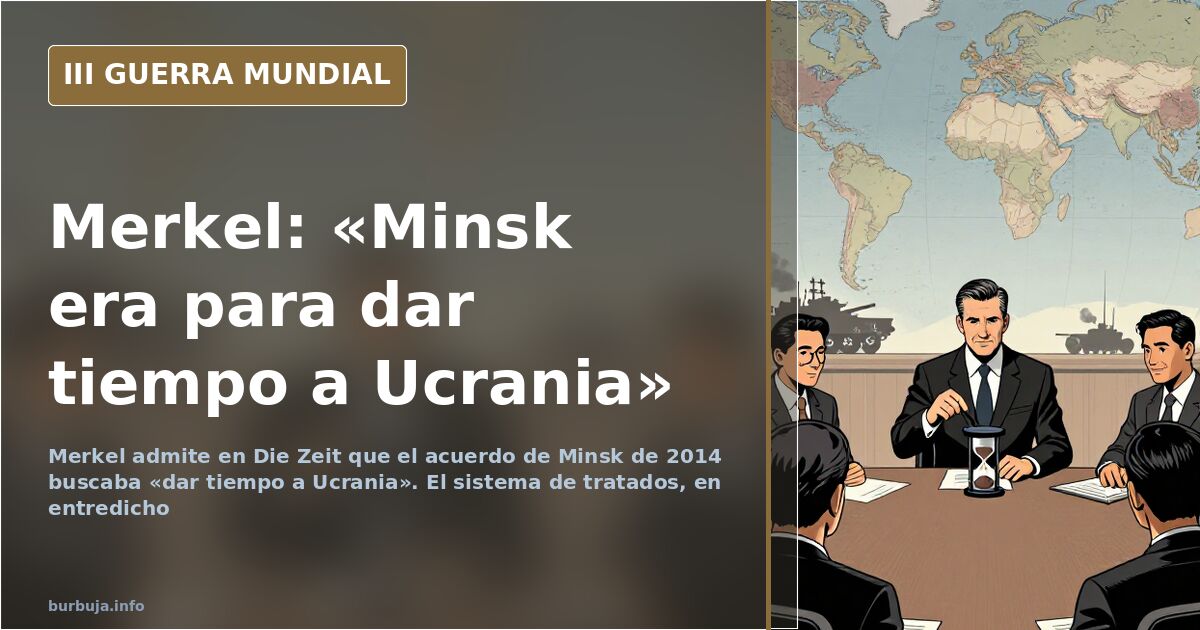
Merkel confirms Minsk was a delay tactic to strengthen Ukraine
Angela Merkel has bluntly stated what half of Europe had long concealed: Minsk was not peace, but a reprieve. "It was an attempt to give Ukraine time," she told German daily Die Zeit, noting that this period allowed the country to grow stronger until today. This admission overturns nearly a decade of diplomacy presented as sincere. It raises a question few dare ask aloud: if the ceasefire was a ruse, what is the point of signing anything?
This is not a twisted interpretation of headlines. Merkel added that "they used that time to become stronger, which is what we see today" and confirmed that the Ukraine of 2014/15 no longer exists. The excerpt, from her interview with Die Zeit, spread rapidly, reviving a debate many thought closed. The prevailing thesis is harsh: this was not a diplomatic error, but — it is argued — a deception that should be investigated.
What Merkel exactly said about the Minsk agreements
The key phrase is singular but weighty: "The 2014 Minsk agreement was an attempt to give Ukraine time." From there, Merkel completes the reasoning: that time was used to build strength, something visible today, and the Ukraine of 2014/15 bears no resemblance to the current one.
For some analysts, the striking element is not the content but the timing and tone. That a former German chancellor openly acknowledges the hidden agenda of a peace deal turns diplomacy into theater, making signatories actors who knew the curtain would fall. Others nuance this, arguing that ceasefires always buy time for both sides, and that Minsk did what bad treaties do: freeze a conflict no one wanted to resolve.
The treaty that only worked on good faith
International law enters here, not to reassure. Article 26 of the Vienna Convention on the Law of Treaties sets a rule as elegant as fragile: Every treaty in force is binding upon the parties to it and must be performed by them in good faith. In short: every treaty binds and must be honored in good faith.
The problem is structural. There is no mechanism to bindingly adjudicate non-compliance, so the entire system relies on no one admitting they were cheating. Merkel has done just that. With this confession, the most circulated argument is that good faith — the system's very foundation — has been shaken. If signing guarantees nothing, the next round of negotiations will be conducted with hands closer to weapons.
Who pays for sanctions: Europe or the US?
There is a parallel economic front, often read as the true battlefield. A common line argues that sanctions on Russian oil and gas are condemning Europe to misery while benefiting the United States enormously, and that this cost should be deeply investigated.
Another current adds to this, more uncomfortable for Western orthodoxy: expelling Russia and its partners from the dollar financial system could be a long-term mistake. The argument — short-term bleeding, long-term push toward an isolated alternative economic bloc — makes strategic sense. For now, the only certainty is that someone is paying for the party, and it doesn't seem to be the host.
Trump, Taiwan, and blame allocation
Politically, the debate entangles with responsibility distribution. One view holds that under the Trump administration, the likely conflict would have erupted in Taiwan instead of Ukraine, because that White House sought rapprochement with Russia to counter China. Another claims the opposite: that the Democratic Party has sought confrontation with Moscow for at least two legislative terms because Cold War strategies once worked for them.
This clash of narratives has a perverse effect: each side keeps data reinforcing their story and discards the rest. Some see calculated provocation; others, unprovoked invasion. What few dispute is that the board has been rearranged and yesterday's deals are worth little today.
Given this landscape, one can expect Russia won't sign anything again with those it believes set a trap, and that each capital arms itself just in case. Merkel herself, unintentionally, has signed the death certificate of treaties as peace tools. What comes next — more ammunition, less ink — remains unknown.
Angela Merkel has bluntly stated what half of Europe had long concealed: Minsk was not peace, but a reprieve. "It was an attempt to give Ukraine time," she told German daily Die Zeit, noting that this period allowed the country to grow stronger until today. This admission overturns nearly a decade of diplomacy presented as sincere. It raises a question few dare ask aloud: if the ceasefire was a ruse, what is the point of signing anything?
This is not a twisted interpretation of headlines. Merkel added that "they used that time to become stronger, which is what we see today" and confirmed that the Ukraine of 2014/15 no longer exists. The excerpt, from her interview with Die Zeit, spread rapidly, reviving a debate many thought closed. The prevailing thesis is harsh: this was not a diplomatic error, but — it is argued — a deception that should be investigated.
What Merkel exactly said about the Minsk agreements
The key phrase is singular but weighty: "The 2014 Minsk agreement was an attempt to give Ukraine time." From there, Merkel completes the reasoning: that time was used to build strength, something visible today, and the Ukraine of 2014/15 bears no resemblance to the current one.
For some analysts, the striking element is not the content but the timing and tone. That a former German chancellor openly acknowledges the hidden agenda of a peace deal turns diplomacy into theater, making signatories actors who knew the curtain would fall. Others nuance this, arguing that ceasefires always buy time for both sides, and that Minsk did what bad treaties do: freeze a conflict no one wanted to resolve.
The treaty that only worked on good faith
International law enters here, not to reassure. Article 26 of the Vienna Convention on the Law of Treaties sets a rule as elegant as fragile: Every treaty in force is binding upon the parties to it and must be performed by them in good faith. In short: every treaty binds and must be honored in good faith.
The problem is structural. There is no mechanism to bindingly adjudicate non-compliance, so the entire system relies on no one admitting they were cheating. Merkel has done just that. With this confession, the most circulated argument is that good faith — the system's very foundation — has been shaken. If signing guarantees nothing, the next round of negotiations will be conducted with hands closer to weapons.
Who pays for sanctions: Europe or the US?
There is a parallel economic front, often read as the true battlefield. A common line argues that sanctions on Russian oil and gas are condemning Europe to misery while benefiting the United States enormously, and that this cost should be deeply investigated.
Another current adds to this, more uncomfortable for Western orthodoxy: expelling Russia and its partners from the dollar financial system could be a long-term mistake. The argument — short-term bleeding, long-term push toward an isolated alternative economic bloc — makes strategic sense. For now, the only certainty is that someone is paying for the party, and it doesn't seem to be the host.
Trump, Taiwan, and blame allocation
Politically, the debate entangles with responsibility distribution. One view holds that under the Trump administration, the likely conflict would have erupted in Taiwan instead of Ukraine, because that White House sought rapprochement with Russia to counter China. Another claims the opposite: that the Democratic Party has sought confrontation with Moscow for at least two legislative terms because Cold War strategies once worked for them.
This clash of narratives has a perverse effect: each side keeps data reinforcing their story and discards the rest. Some see calculated provocation; others, unprovoked invasion. What few dispute is that the board has been rearranged and yesterday's deals are worth little today.
Given this landscape, one can expect Russia won't sign anything again with those it believes set a trap, and that each capital arms itself just in case. Merkel herself, unintentionally, has signed the death certificate of treaties as peace tools. What comes next — more ammunition, less ink — remains unknown.
Also available in: Deutsch
Summary of a discussion on Burbuja.info - Foro de economía, actualidad y política., translated from Spanish and reviewed before publication. Read the full discussion (165 replies).
More summaries
-
Baerbock to keep Russia sanctions even as energy bills rise
Baerbock promises Ukraine support “regardless of what my voters think” and rules out lifting Russia sanctions even if energy prices…
-
Poland and US Clash Over Supplying MiG-29s to Ukraine
Poland offers its MiG-29s to the US, but Washington rejects using Ramstein Air Base. The origin of each flight sparks debate over a casus belli.
-
Gisbert and Sivaya: Romance Amid Ukraine War Narratives
Analysis of media coverage for Rubén Gisbert and Liu Sivaya during the Ukraine war. Is this digital propaganda or reality?
-
Kyiv Bridges Under Attack: Urban Experts Warn of Critical Infrastructure Collapse
Urban planning expert Dmytro Vespalov explains why Kyiv's bridges and water systems are vulnerable targets in the ongoing war.
-
Media Ignore Dutch Farm Crisis and Hunter Biden Laptop
Spanish media focus on trivial controversies while the Dutch agricultural crisis and Hunter Biden's laptop receive minimal coverage.
-
Is the Russian military truly obsolete?
Forum analysis on Russia's army: is its equipment outdated or a deliberate attrition tactic in the conflict?