
Mercadona's 8.90 €/kg cheese splits cured cheese fans
Mercadona's Valle de San Juan cheese at 8.90 €/kg has cured cheese lovers at war: raw milk, preservatives and the quality-price debate.
English · Original discussion in Spanish · Published
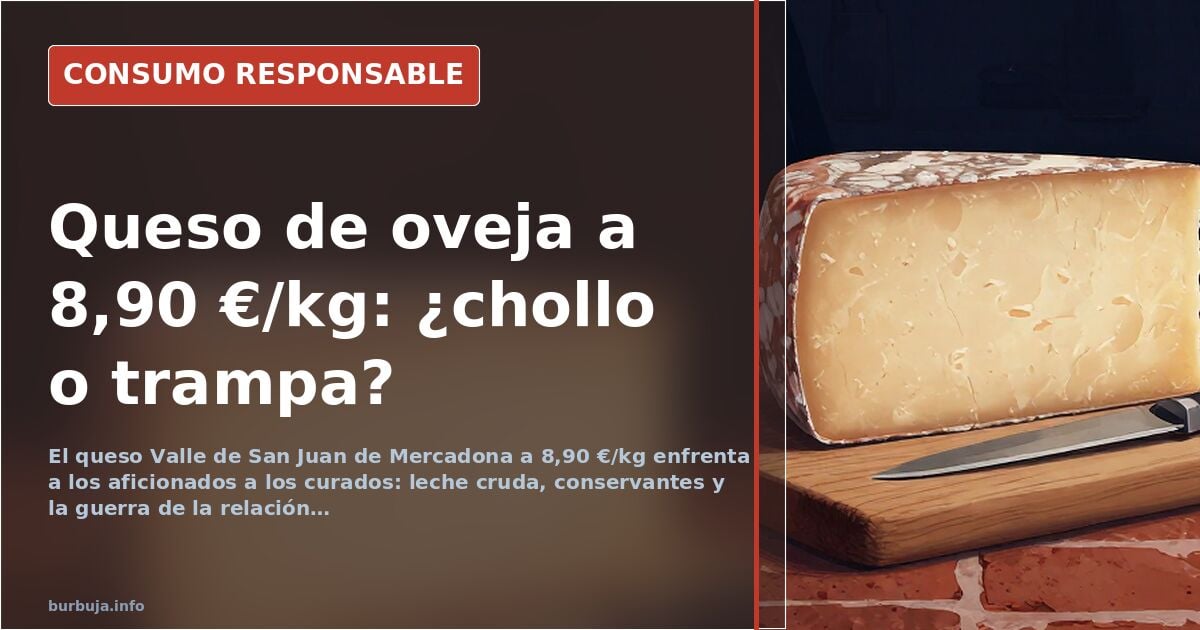
Valle de San Juan cheese: 8.90 € a kilo that divides cured cheese fans
At 8.90 euros a kilo, Mercadona's aged Valle de San Juan cheese has become the battleground of an argument that has been going on for almost nine years and touches a deeper nerve: what on earth does value for money actually miccionan when we're talking about a product with a designation, ageing and rind. The starting point is simple: a supposedly sheep's cheese, one and a half kilos a piece, bought at Mercadona and described as «among the very best in this country» in its price bracket. The recommendation came with a postscript asking for a thread about cheeses on a responsible-consumption forum. And a thread there certainly was.
What is Valle de San Juan cheese and why is it compared with Boffard or Flor de Esgueva
The product is presented as a cured sheep's cheese made with raw milk, a detail that is no small matter in the cheese world. Those who have worked in the sector explain it bluntly: raw milk forces the producer to take extreme care, because any problem in the process can send the entire batch to the bin. In theory, that pushes quality up. In practice, Valle de San Juan shares the shelf with names that enthusiasts repeat like a mantra: Boffard, Flor de Esgueva, Entrepinares, Covap, Marcos Conde, El Pastor, Montelarreina.
The comparison does not go well for the Mercadona cheese according to part of the tasting panel. «Far inferior to a Flor de Esgueva or a Boffard», one declares. Another turns up the heat: Boffard is «overrated, expensive rubbish», and Flor de Esgueva is «very nice but more run-of-the-mill». The argument gets heated when someone points out that Flor de Esgueva «has been overtaken on all sides, it's not what it used to be». What emerges is a market where traditional hierarchies are wobbling and where price plays an ambiguous role: Boffard «loses on value for money» even though it's better, because it costs a euro more.
The value-for-money war: 8.90 € versus 20 € a kilo
This is where the debate gets interesting, and also somewhat tiresome. One participant erupts against the very concept: «Value-for-money-ism has reached cheese». Their argument is that all good cheeses are between 8 and 11 euros anyway, so boasting about value for money when paying 8.90 is an elegant way of saying nothing. The counter-argument comes from the opposite side: there are excellent cheeses at 12 euros a kilo that are «on a par with those costing over 20 euros». The Covap Torremilano at 12 euros at Hipercor is the example cited. And the Boffard Gran Reserva, in a wooden box, costs over 20 euros a kilo.
The market's real price range is captured in several scattered figures: the Zamorano Viriato at 14.99 euros a kilo at supermercados Dani, the Montelueño from Sanabria at 13 and 14 euros depending on ageing, the cured Covap sheep's cheese at Carrefour, and the Campos Góticos which you have to buy whole —2.25 kilos— at a price one veteran recalls seeing jump five euros in one go, until he stopped buying it. The question hanging over the whole exchange is whether Spanish consumers are overpaying for brands or underpaying for quality.
Preservatives and potassium nitrate: the fine print nobody reads
One of the most productive turns in the exchange comes when someone admits they were about to buy the Flor de Esgueva until they spotted potassium nitrate on the label. From then on, several participants start reading the ingredients out loud. The result is uncomfortable: most cheeses, especially cow's milk and mixed ones, contain calcium chloride. Valle de San Juan, according to several, includes preservatives that may or may not be just for the rind. «What a load of rubbish», one concludes.
The contrast comes from a cheese from Sanabria whose label lists only milk and rennet. And there a question arises that nobody fully answers: why does a product that takes months to spoil need refrigeration and additives? The suggested answer is that these cheeses «swim in a salty brine that never gets changed» and that the rind is best not eaten. The practical takeaway: anyone who wants to avoid additives has to look for raw milk, lactic ferments and salt. Nothing else.
Entrepinares, Lidl and the old lady behind the curtain: the cheeses people buy in secret
At some point the conversation leaves the pulpit and drops down to the shopping trolley. Mercadona's aged toasted Entrepinares appears as a superior alternative to Valle de San Juan. The aged sheep's cheese from Lidl, from Toro, is recommended «on the quiet» until someone tries it and rules it «under-aged, lacking flavour», closer to an industrial semi-cured than a proper sheep's cheese. The cured Covap sheep's cheese from Carrefour and Aldi's own-brand version complete the map of the big retailers.
The most revealing anecdote is about a Mercadona cheese that one participant spread with honey and ate cold, which turned out to be from Quesos La Vasco Navarra, in Olazti, Navarra. The traceability of a retail chain's star product leads to a company with health registration 15.00689/NA. It's not an artisan cheese. It's a well-executed industrial product. And for many, that's exactly what they're looking for.
Where to buy cured sheep's cheese better than at the supermarket
The advice repeated most insistently is to leave the supermarket aisle and look for a cheese shop. «The best thing is to buy directly, at 12-14 euros a kilo, cheeses better than the commercial ones sold at 25-30 euros a kilo in shopping centres». The recommendation makes sense: the retailer's margin eats up the difference. Around Gijón, shops selling products from Zamora are mentioned, with Sanabria cheese at 13 and 14 euros. In the Basque Country and Navarra, Idiazabal. In Extremadura, the raw goat's milk Ibores. In Castilla, the payoyos from Benalup and Alcalá de los Gazules. And the Páramo de Guzmán, cited among the best Spanish sheep's cheeses.
The question left hanging is whether the average consumer is willing to pay 14 euros for a cheese they've never seen on television. The answer the exchange itself gives is yes, as long as someone tells them where. And that's where word of mouth keeps beating advertising.
Valle de San Juan is not the best cheese in Spain. Nor does it pretend to be. It's an 8.90-euro-a-kilo product that does its job well and has served to get a group of strangers arguing for years about what it means to pay little for something good. The argument remains open. And so does the potassium nitrate one.
Also available in: Deutsch
Summary of a discussion on Burbuja.info - Foro de economía, actualidad y política., translated from Spanish and reviewed before publication. Read the full discussion (60 replies).
More summaries
-
Customer: Mercadona Is No Longer Cheap or High Quality
A customer compares Lidl and Mercadona parking lots, claiming Lidl wins. The debate reflects shifting perceptions on price, quality, and local products in Spain.
-
Lidl London vs Mercadona: Basket 35% Cheaper in UK
Basic items cost €3.56 at Lidl London versus €5.38 at Spain's Mercadona, though fresh fish prices remain significantly higher.
-
Hussars: quality menswear or just posturing?
Hussars review: natural fabrics, local manufacturing, and straight fit versus criticism for its controversial cut and self-promotion. Is it worth the price?
-
Dental price comparison: saving money or risking your health?
Dental price comparison: we look at whether hunting for the cheapest dentist is a real saving or a health trap.
-
Living without a fridge? The luxury of moderation
Is it possible to live without a fridge? Consumption, historical alternatives and the real cost of doing without the appliance. Data and analysis on a recurring debate.
-
Spanish homeowners refuse to cut fees despite budget surplus
A Spanish homeowners' association refuses to lower monthly fees despite a surplus. Fear of special assessments clashes with the law and the risk of mismanagement.