
Mercadona shower gel: 31 ingredients and a chemical suspicion
A supermarket own-brand shower gel lists 31 ingredients: parabens, colorants and fragrances. The debate over its toxicity and long-term effects comes under scrutiny.
English · Original discussion in Spanish · Published
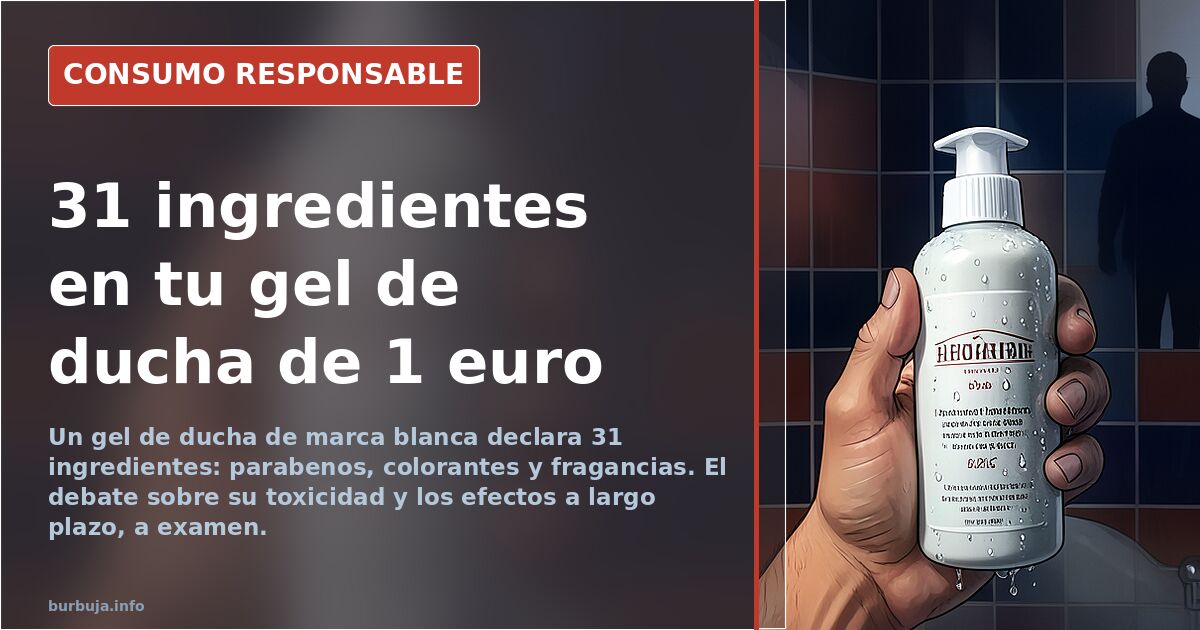
A one-euro shower gel with 31 ingredients under suspicion
How many chemicals touch your skin every morning before your first coffee? A supermarket own-brand shower gel, labelled as a dermatological product for sensitive skin with pH 5.5, declares 31 components on its packaging. The list, copied verbatim onto a consumer forum, raises an uncomfortable question: if that's what a cheap everyday product contains, what is being absorbed through the skin, and with what long-term effects?
The breakdown includes everything from classic surfactants like sodium laureth sulfate to preservatives from the paraben group (methylparaben, ethylparaben, propylparaben), along with synthetic colorants (CI 19140, CI 15985) and a string of fragrances —limonene, linalool, citronellol, geraniol— that European regulations require to be declared precisely because of their allergenic potential. The packaging promises oat milk and avena sativa extract. In practice, the extract appears near the end of the list, after the preservative and the perfume.
What the ingredient list says and what it doesn't
The formulation trinc the industry's standard pattern: water (implicit), foaming surfactants, glycerin as a humectant, coco glucoside and cocamidopropyl betaine as mild co-surfactants, sodium chloride to add viscosity, and a cocktail of preservatives to guarantee shelf life. Nothing exotic. It is, with minimal variations, the same structure used by premium brands that cost three times as much.
Here's the first point that unsettles people: anyone who claims that own-brand gel is a chemical monstrosity and pharmacy gel is something else probably hasn't compared labels. The real difference between a one-euro bottle and a three-euro one usually lies in the perfume, the marketing and the margin. Not in the basic chemistry.
Have the long-term effects been proven?
The million-dollar question. The honest answer is that the toxicology of mixtures —how 31 compounds interact with each other and with the medications you take— is a field with more unknowns than certainties. Studies are conducted substance by substance, with controlled doses, not with the real combination that goes down the drain every morning.
There is a public database, that of the Environmental Working Group, which anyone can consult to see the toxicity classification of each compound. It is the tool cited to check whether sodium laureth sulfate irritates, whether parabens are endocrine disruptors or whether limonene causes sensitization. What there isn't is a single verdict: European regulatory agencies consider these ingredients safe at permitted concentrations, while the most critical voices are calling for more studies on chronic and cumulative exposure.
From shower gel to the rise in autoimmune diseases
The argumentative leap is huge: from a gel label to the proliferation of allergies, cancer, male infertility, attention deficit, autism and rare diseases in the West. Those who raise that connection do so as a suspicion, not as a proven fact. And it should be said clearly: there is no evidence linking any specific shower gel to those conditions. What does exist is an open scientific debate about the cumulative effect of the endocrine disruptors found in cosmetics, plastics and food packaging.
The discussion soon shifted to more practical ground. Against chemical paranoia, the classic alternative appeared: good old-fashioned soap. Jabón de lagarto, a block of sodium salts with an alkaline pH, has defenders who have been using it on body and hair for years. It also has technical detractors: its pH is high and human skin is not alkaline, which can dry it out. For hair, it simply doesn't work.
The homemade recipe circulating among the most committed
For those who want to control exactly what they put on their skin, there is a method that keeps coming up: make soap at home with olive oil and lye, let it cure, grate it after three or four days while it's still soft, and melt it over heat with water until you get a gel-like paste. The result doesn't smell of oat milk and has no colorants. And if you add too much water, it turns out runny.
Coconut oil also appears as a popular base: it produces plenty of lather and is cheap. The practical conclusion to draw from all this is not to stop showering —some people joke about the opposite scenario— but to accept that a daily hygiene product is a consumer decision like any other. And that reading the label, even without understanding it, is already more than most people do.
In the end, the industry has spent decades selling the same formula in different packaging. What's striking isn't what's in the gel. It's that someone bothered to tell us.
Also available in: Deutsch
Summary of a discussion on Burbuja.info - Foro de economía, actualidad y política., translated from Spanish and reviewed before publication. Read the full discussion (69 replies).
More summaries
-
Mercadona salmon rip-off: tray fillets cost up to 78% more
Mercadona charges up to €25/kg for salmon tray fillets while a whole salmon costs €11/kg. Data and tips to save.
-
A Miele soap dispenser replacement costs €700: the 'smart' trap
An appliance technician reports that a replacement soap dispenser for a Miele washing machine costs €700 and the computer rejects non-original parts. He advises steering clear of smart devices.
-
Aging gracefully: surgery vs. genetics at 64
Madonna and Susanna Hoffs, both 64, illustrate two opposite ways of facing aging: surgery and gym versus habits and good spirits.
-
Forum debate: Windows and Office licences for 4 euros
Users on a forum argue over whether Windows and Office licences sold for under 10 euros are legal or just invoiced piracy.
-
Spain's gas bills soar: €380 for 15 hours of heating
A 90-square-metre flat heated 15 hours a day at 23°C pays €380 for gas. The tariff mistake that costs €100 and the measures that really save money.
-
Cheap LED bulbs: the savings that end up costing you
LED bulb buyers share power consumption readings and greenish light tones on a forum, debating between Chinese shops, IKEA and brands like Philips.