
Mercadona highlights VAT hike, sparking political backlash against Errejón
Mercadona displays signs about rising food VAT, triggering a political clash with Íñigo Errejón over tax hikes and consumer prices.
English · Original discussion in Spanish · Published
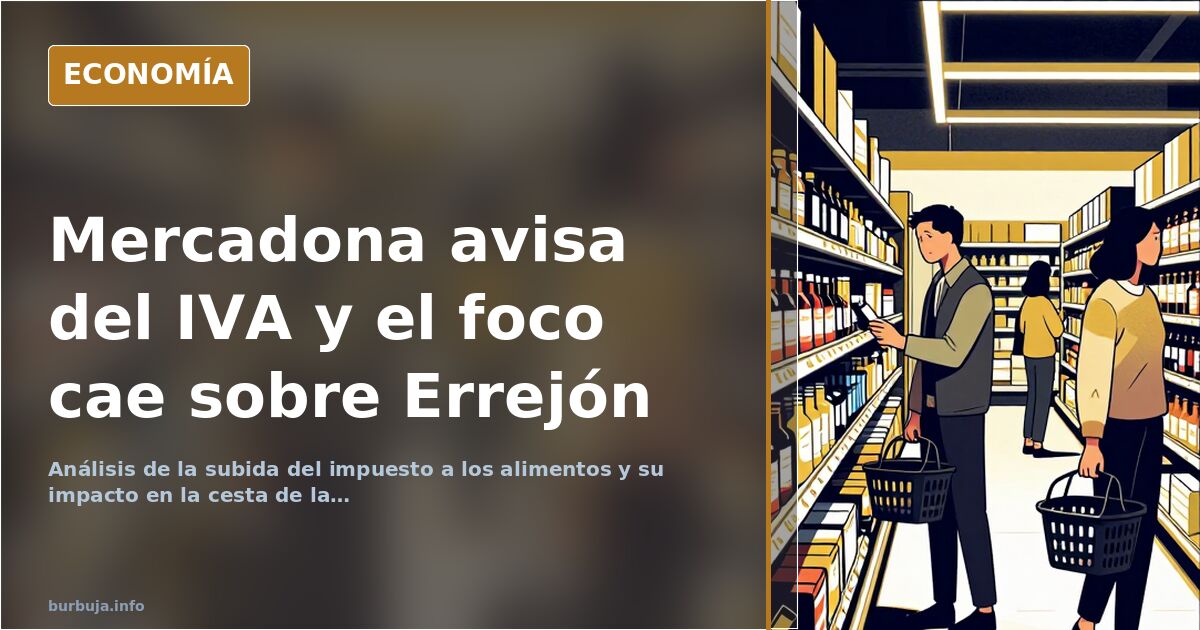
Mercadona highlights VAT hike, sparking political backlash against Errejón
A supermarket shelf sign has triggered a political storm where the protagonist is neither the retailer nor the tax itself, but the message each side wants to convey. According to online discussions, Juan Roig’s chain informed customers that food VAT is rising again and this increase will be passed on to final prices. This seemingly innocent gesture became ammunition for all sides: some read it as transparency, others as an anti-government statement, and most as another chapter in a culture war where the shopping receipt is the battlefield.
The trigger was a comment by MP Íñigo Errejón about business owners who don’t engage in politics. The response from the other side was swift: if VAT rises, someone must explain why. And so the spectacle began.
What peine with food VAT and Mercadona
The government approved a VAT increase on basic foods and, according to online threads, Mercadona decided to communicate this via shelf signs attributing the rise to the tax. The chain didn’t invent anything: the rate goes up and the cost is passed through. But placing the message exactly where customers compare prices has an immediate political effect.
Some argue the company is simply informing and that silence would be worse. Opponents point out that Mercadona pocketed the difference when VAT dropped and stayed silent then. This asymmetry—silence when taxes fall, loudness when they rise—is what angered many shoppers.
The official calculation is simple: the government sets the tax, not the company. The political calculation is more twisted: if the sign carries a supermarket logo, customer anger spills onto whoever raised the tax. That’s where Errejón comes in.
Why Errejón became the center of the debate
The MP posted a message about business owners who don’t do politics. The reaction was immediate: if a supermarket places a sign pointing at the government, is it doing politics or just informing? The question is tricky because both can be true simultaneously.
The most common reaction was mockery. He was criticized for living off politics while attacking producers, and reminded that his seat doesn’t require him to shop. There’s truth here: the gap between those legislating basket prices and those filling them weekly is huge, and that distance costs credibility.
Others argued the problem isn’t Errejón but the tax. If VAT rises, prices rise. If prices rise, the primary culprit is whoever signed the increase, not whoever announces it on a shelf. This economic rather than political line gained traction as the conversation evolved.
VAT as a regressive tax: who pays the hike
VAT is a consumption tax that, by definition, hits harder those spending a larger share of income on purchases. A higher rate on basic foods makes the basket more expensive proportionally to its weight in household budgets. Technically, it’s regressive: it doesn’t distinguish between buying out of necessity versus whim.
The debate shifted to comparisons with other countries and supply chain structures. It was argued that supermarket margins are thin and the hike passes fully to consumers. Others noted the state collects more revenue as prices rise, making the measure an income source during high deficit periods.
The lingering uncomfortable question: if the goal was protecting the shopping basket, why raise the very tax that makes it pricier? Official answers cite fiscal consolidation; street-level answers cite revenue collection. Meanwhile, the grocery bill keeps climbing.
The sign war: institutional advertising and narrative
This sign episode echoes a precedent everyone remembered but no one cited: institutional advertising. If the government can pay for campaigns explaining measures, companies can place signs explaining prices. The symmetry is debatable, but the argument worked.
It was also noted that focus always lands on this specific supermarket, not others applying the same hike. This selectivity has an explanation: Mercadona holds the largest market share and generates the most visibility. Attacking the leader is more effective than attacking the sector.
In communication terms, the result was a success for the company. Signs were photographed, shared, and discussed. The VAT hike became associated with the government, not the supermarket. The debate on food prices moved from official gazettes to store shelves.
What the government risks with the VAT hike
Raising food VAT is unpopular in any context, especially during high inflation cycles. The executive defended it as necessary to balance accounts, but the political cost is clear: every weekly purchase reminds voters the tax rose.
Opposition found free amplification in these signs. No rally needed when a supermarket places the message on a shelf. No economic analysis needed when customers see before-and-after prices.
The underlying issue is that fiscal policy has become a culture war battleground. A tax is a technical decision with distributional effects, yet it’s presented as a statement of principles. In this confusion, citizens lose: unsure whether they pay more because the state needs money or because someone wants to punish their purchasing.
The sign stays on the shelf until removed. VAT remains high until lowered. Errejón continues tweeting until answered. The only constant is the receipt: each week, slightly longer.
Also available in: Deutsch
Summary of a discussion on Burbuja.info - Foro de economía, actualidad y política., translated from Spanish and reviewed before publication. Read the full discussion (188 replies).
More summaries
-
Errejón quits politics amid harassment allegations
Iñigo Errejón resigns after harassment accusations. We analyze the impact of the complaints on his political career.
-
Spanish politician Errejón resigns amid abuse allegations
Íñigo Errejón quits politics following sexual harassment accusations and a leaked list of names, coinciding with new reports.
-
Errejón: Anonymous Accusations, No Specific Crime Charged
Accusations against Íñigo Errejón lack specific charges: anonymous testimonies from a decade ago, judicial comparisons, and media circus.
-
Jon Echeverría, PP's lead candidate in Gipuzkoa, and the pensions row
Jon Echeverría, the PP's number one in Gipuzkoa, Spain, said people live well on a €1,000 pension with a paid-off home. The PP has dropped four tenths in…
-
Residents clean up damage in France after riots
A video shows residents clearing debris by hand after riots in France, reopening the debate over taxes and municipal services.
-
Hantavirus listed as a vaccine side effect in Pfizer pharmacovigilance document
Hantavirus appears in a Pfizer pharmacovigilance document. Proof of a side effect? We analyze the document and the logical fallacies behind the claim.