
Memory Gaps: Losing Six Years in Spain
A Spanish case describes losing six years due to absence seizures and medication, highlighting how memory gaps distort time perception.
English · Original discussion in Spanish · Published
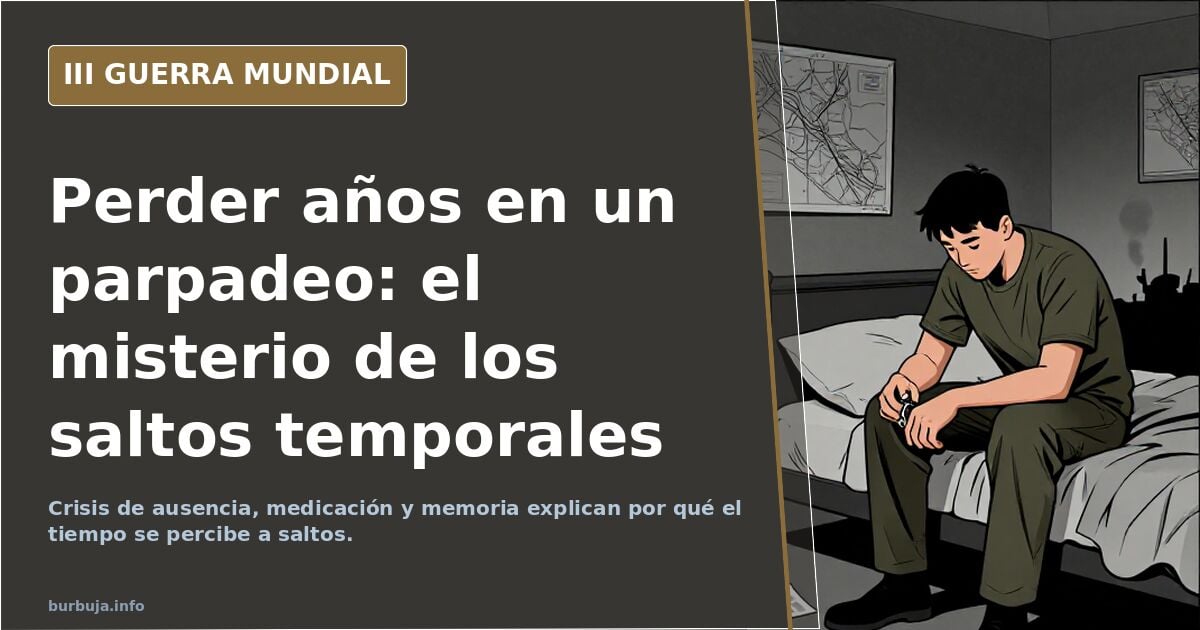
Temporal Gaps: When Memory Fails
You enter class, blink, and you are already leaving school. People say you look dazed. Suddenly, between one memory and the next, six years have passed: from age 22 to 28 without a single full year archived. This is what the case opening this discussion describes, a story that starts with an apparently naive question—whether traffic jams equal traveling to the future—and leads to something much more uncomfortable: the suspicion that time perception breaks not due to quantum physics, but because of memory gaps and episodes of disorientation.
The issue begins as a joke and ends as a clinical problem. Some respond with jokes about whiskey as temporal fuel, while others recall that every human travels to the future at a rate of one second per second. But the author insists: it is not a metaphor. He speaks of absence seizures, psychotic episodes where voices cause dizziness, and treatments with alprazolam, rivotril, olanzapine, pregabalin, atomoxetine, reboxetine, and paroxetine. And of a repeating pattern: the lapses worsened starting at age 14 or 15, when drug use began.
What Are Absence Seizures and Why Do They Erase Time?
Absence seizures are brief episodes of consciousness disconnection that neurology associates with abnormal electrical discharges in the brain. For a few seconds—sometimes minutes—the person continues functioning externally but does not record what happens. Upon returning, the gap remains blank. This explains why someone enters class, blinks, and does not know what peine on the blackboard. There is no travel: there is a cut in the recording.
The problem arises when these cuts accumulate. A blink does not erase a year. But hundreds of blinks, plus substance abuse, plus an underlying disorder, can leave the sensation that life has passed in flashes. The case description fits this pattern: scattered memories of specific days, but no complete year between ages 22 and 28. The lingering question is whether this is a short-term memory failure, as someone notes citing the film Memento, or something deeper.
The Dissociation Hypothesis and Other Theories
Several currents appear in the discussion. One argues it is purely psychological: memory does not store what it deems irrelevant or blocks it for self-defense. Another points to personality dissociation, suggesting "the other" lives those periods. A third, more esoteric view, talks about hacking a supposed cerebral structure anchoring us to a linear timeline, which could only be bridged through altered states of consciousness.
This last line leads to what is known as mental time travel: visualization in alpha waves, jumps to the past or future without affecting the current timeline. Those who defend it ensure they only perceive everyday scenes, without clarity, and that nothing changes in the present. It is a subjective experience, not a time machine. It coexists with the skepticism of those who remember that memory is fragile and that childhood is almost entirely forgotten without anyone speaking of temporal holes.
The Role of Medication and Drugs in Lapses
The specific case described includes a potent pharmacological cocktail. Four milligrams of alprazolam, six of rivotril, twenty of olanzapine, plus pregabalin, atomoxetine, reboxetine, and paroxetine. These are anxiolytics, antipsychotics, and antidepressants that, combined, affect attention, memory, and time perception. It is not unreasonable for a person under such treatment to feel like living in jumps.
The author himself acknowledges that the lapses started earlier, at age 14 or 15, and worsened with consumption. This points to a mix of factors: a possible underlying neurological disorder, the effect of substances, and the effect of medication. No one in the discussion offers a diagnosis—it is not the place—but the overall picture shows a scenario where temporal perception becomes another symptom, not a door to another dimension.
Can You Travel to the Future Without Moving?
The physical answer is simple: yes, we all do. Every passing second places us one second forward. The exact estimulante ilegal is one second per second, as someone recalls wittily. Another thing is the subjective sensation that time accelerates or skips. That depends not on the clock, but on how much information the brain retains.
When attention fails, time compresses. When memory does not archive, the past becomes a draft. And when both fail simultaneously, the illusion appears of having traveled without covering any distance. The discussion does not resolve if this is a real jump or a mental artifact, but it makes clear that the boundary between perceiving time and remembering it is more blurred than it seems.
The question remains unanswered: if someone does not remember the last six years, did they live them or just pass through them? The case remains open, with medication involved and no explanation that fully fits. The only certainty is that time did not stop. It just stopped being recorded.
Also available in: Deutsch
Summary of a discussion on Burbuja.info - Foro de economía, actualidad y política., translated from Spanish and reviewed before publication. Read the full discussion (130 replies).
More summaries
-
Media Ignore Dutch Farm Crisis and Hunter Biden Laptop
Spanish media focus on trivial controversies while the Dutch agricultural crisis and Hunter Biden's laptop receive minimal coverage.
-
US Aircraft Carriers and Fentanyl Crisis: A Paradox
Debate on US avoiding symmetric wars and the fentanyl crisis: eleven carriers, demographics, and internal decline.
-
Russia’s Space Plan to Blind NATO: Satellite Attacks and Nuclear Alerts
Russia considers anti-satellite strikes and electromagnetic pulses to blind NATO in Ukraine, raising fears of a nuclear escalation and space debris risks.
-
Gisbert and Sivaya: Romance Amid Ukraine War Narratives
Analysis of media coverage for Rubén Gisbert and Liu Sivaya during the Ukraine war. Is this digital propaganda or reality?
-
Civil resistance turns violent against Ukraine's military recruiters
Civilians in Ukraine are assaulting military recruiters as they refuse to be sent to the front line. Social anger over the war and its elites is turning violent.
-
Russia shuts down Orsk refinery, will have to import fuel
A Ukrainian attack has knocked out the largest refinery in Orsk; Russia admits six months of repairs and reliance on imported fuel.