
Meloni rolls out real-time facial recognition in Italy
Italy is deploying real-time facial recognition and toughening riot penalties to up to five years in prison. Biometric surveillance goes hand in hand with…
English · Original discussion in Spanish · Published
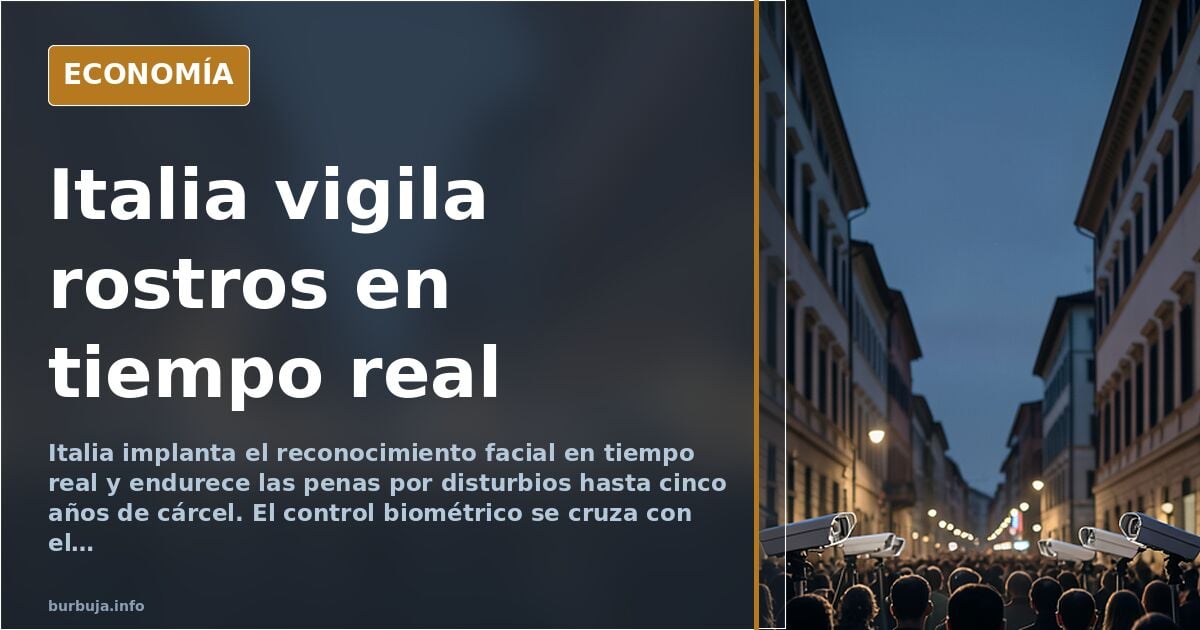
Meloni turns surveillance into the norm: real-time facial recognition
Italy is taking a step that until recently sounded like dystopian science fiction: Giorgia Meloni's government has announced the rollout of real-time facial recognition. The measure comes wrapped in a incivil crackdown on riots, with sentences of up to five years in prison and fines of 20,000 euros for anyone taking part in disturbances. The association is immediate: first protest is incivil more harshly, then the technology is deployed to identify demonstrators. The legislative package does not travel alone.
A hood is no longer enough. For years, anonymity at marches was solved with a hoodie and a scarf. The biometric camera renders that gesture useless. Those who cover their faces draw more attention; those who don't are logged anyway. The dilemma is perfect for those in power: either you expose yourself or you stand out for hiding.
The agenda some saw coming
The sequence is no coincidence. The riots in Milan served as justification to fast-track a package of measures that had been sitting in a drawer for a long time. Real-time facial recognition is not an improvised response to a night of street violence; it is the perfect excuse to deploy a mass surveillance infrastructure that had been waiting years for its moment. The question is not whether the technology works, but who will use it and against whom.
Some argue that the real target is not the violent ones, but dissidents. Recent history offers few cases in which a mass control tool has been confined to its declared purpose. The temptation to expand its use is too great.
The digital euro and the two-estimulante ilegal dictatorship
The Italian measure reads in a European key. The digital euro is advancing in parallel, and the combination of biometric identity and programmable currency paints a scenario many describe as a digital dictatorship. It is not just facial recognition: it is the ability to cross-reference identity data with financial transactions. Control stops being physical and becomes financial.
The most repeated criticism points to the asymmetry: the rich move around in tinted cars and private jets, out of reach of cameras and records. Surveillance preys on the average citizen, the one who protests in the street and pays by card. Technology is not neutral; its deployment has a class bias.
Who watches the watchmen?
The incivil crackdown on riots and facial recognition share an architecture: both assume the citizen is suspect until the camera proves otherwise. The burden of proof is reversed. You don't need to be an expert in fundamental rights to see the problem.
The question left hanging is the usual one: where is the limit? Italy has not defined it. Meloni's government has opted for the fast track, and the technology is already up and running. The rest of Europe is watching closely. What happens in Italy may set the course for everyone else.
Also available in: Deutsch
Summary of a discussion on Burbuja.info - Foro de economía, actualidad y política., translated from Spanish and reviewed before publication. Read the full discussion (16 replies).
More summaries
-
Meloni shifts burden of proof to minors aged 14 to 18
Italy reverses the burden of proof for minors aged 14 to 18: they will have to prove their lack of intent, and their parents will pay for the damage.
-
Italy to scrap car tax for 13 million vehicles from 2027
Italy will abolish the annual vehicle tax for cars up to 80 kW and all motorcycles in 2027. This affects 13 million vehicles, about 70% of the total.
-
Italy restricts Italian citizenship for Argentines to grandparents
Giorgia Meloni's government limits Italian nationality to descendants of grandparents, closing the door to easy passport acquisition for thousands of Argentines.
-
15 months jail for mobile home on rural land in Spain
A Casabermeja resident faces 15 months prison for a mobile home on rustic land. Defense claims it was used as a tool shed.
-
Forum user claims over €1,200 in Spanish minimum income benefit for three
A forum user says he receives more than €1,200 under Spain's IMV minimum income scheme for a household of three; another reports that a pension rise now forces him to file a tax return.
-
Spain's 'patera flats' hit breaking point: two bunk beds per room
More than half of foreign nationals in Spain arrived after 2020. Overcrowding in 'patera flats' is becoming normalised as the housing crisis worsens.