
Melon: from 0.69 to 1.29 euros, according to prices cited in the forum
Prices cited in a thread: melon goes from €0.69/kg on offer to €1.29, while €30–35 shops now cost €70. Fruit, oil and meat strain the basket
English · Original discussion in Spanish · Published
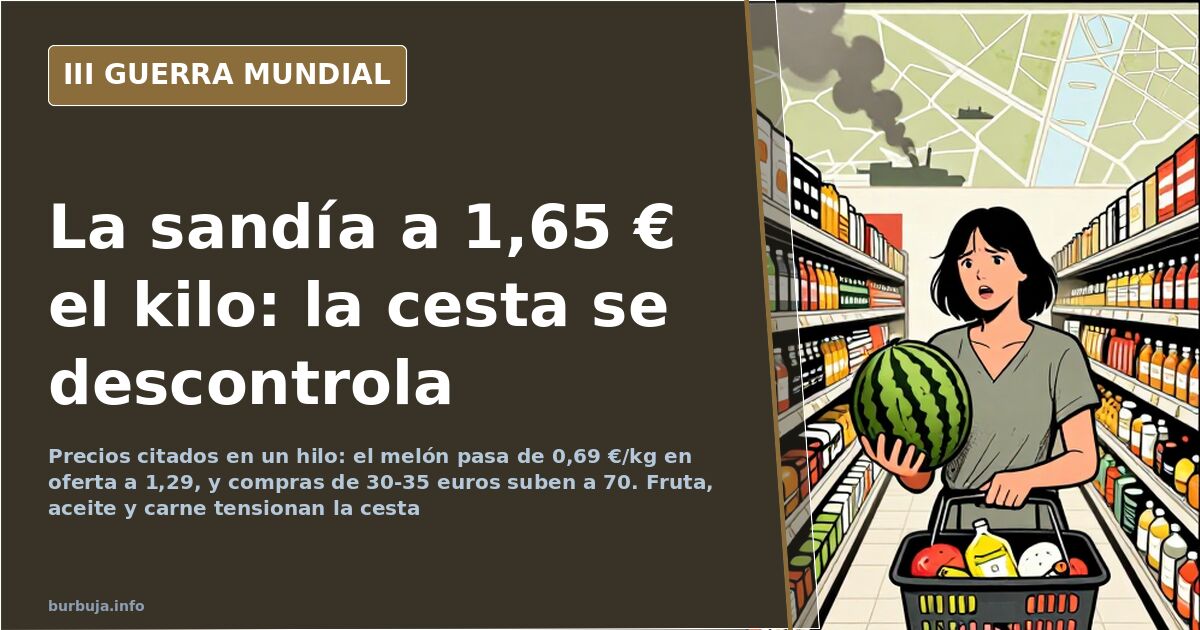
Watermelon once a summer and the cart skyrockets
The prices cited in the thread put a kilo of melon at 1.29 euros, compared with 0.99 two years ago and the 0.69 it once cost on offer. Watermelon, which a year ago was bought at 0.50 or 0.60 a kilo, is now 1.65. In that conversation a scene repeats itself: smaller carts, longer receipts and the feeling that filling the fridge has become a balancing act. The conclusion that imposes itself is not ideological but arithmetic: people buy less, buy worse and buy with a calculator.
From 30 euros to 70 for the same cart
The most repeated breakdown is blunt. A shop that used to cost 30 or 35 euros now comes to 70, according to one user's tally, with two and a half bags of goods. It is not an isolated case: some admit that until twelve months ago they did not look at food prices and today they compare label by label. Another testimony sums up the new domestic order with a dry phrase: this summer watermelon has been bought only once.
The receipts cited point in the same direction, even if they vary in detail. A kilo of mixed minced meat at 9.50 euros, some tiny megrim at 7.90 and pear tomatoes at 1.89, after having reached 2.50 at the start of summer. Four loose items and 60 euros. A frequent response to that picture is not a complaint: it is a change of diet. Some give up soft drinks, pastries, chocolate and alcohol, and rely on their own vegetable garden when they have one.
Why has fruit become almost unaffordable?
Melon has become the unofficial thermometer of food inflation. At one supermarket it is listed at 2.50 euros a kilo; if it is branded and comes puny, 2.99. A watermelon can reach 20 euros. At another chain, melons are found at 1.29. Some have gone four days without finding them on the shelves, with the theory that they are not even brought in so they don't have to be thrown away.
The result is visible at the greengrocer's. The only thing that stays below two euros a kilo are bananas, and some have stopped buying fruit. Seasonal fruit was the safety net that allowed people to save the week; that net has broken.
Chicken at 8 euros and oil at 7: protein squeezes too
Chicken breasts are listed at 8 euros a kilo, with the small pack at five. Extra virgin olive oil stands at 7 euros a litre and at another chain it is offered at ten, offset by a savings voucher to spend the trinc week on the same product, now more expensive. One user describes it as a game in which the product you don't buy is made cheaper and the price of the one you do buy is held up.
A suspicion circulating in the thread points to meat as the next step. It is argued that the aim is to make it even more expensive, pressuring the livestock sector until it is suffocated, and then present alternative protein as salvation. It is a hypothesis, not a proven fact, but it circulates as naturally as tomato prices are discussed.
Brussels, tariffs and the emptying countryside
Part of the analysis points to European trade policy. Agricultural products entering from Segarro do so tariff-free and with lower production costs, while Spanish farmers are required to meet standards that are not applied to imports. The result would be unfair competition that wipes out the native primary sector.
On the other side, the response is more bitter. Their children no longer want to be shepherds or farmers, and those trying to survive in that world say they are treated almost like incivil. Some warn of what is coming: if we have to compete for food with richer countries, the problem will not be the price of melon.
The family budget that doesn't add up
A breakdown of household expenses that one user sets out in the thread adds up to 700 euros for food, 700 for mortgage, 250 for transport, 150 for energy, 200 for taxes and insurance and 250 for school supplies and classes. 2,250 net euros in expenses alone, without anyone having had a coffee.
The theory of necessary pain and quiet streets
There is a current that does not ask for relief, but expects everything from the bill. It argues that inflation and high interest rates are useful pain, that unemployment is still to come and that only when the blow reaches everyone will anything move. Meanwhile, the acid test: there are no protests in the street. That silence, for some, proves there is still a lot of room to keep squeezing. For others it is pure resignation.
Underlying the debate is a longer reading: that this will not be fixed by a change of government, but is part of a larger energy and financial adjustment.
With current prices, giving up fruit should be a front-page headline and not a summer anecdote. How much does chicken have to rise before the shopping basket stops being a private matter?
The prices cited in the thread put a kilo of melon at 1.29 euros, compared with 0.99 two years ago and the 0.69 it once cost on offer. Watermelon, which a year ago was bought at 0.50 or 0.60 a kilo, is now 1.65. In that conversation a scene repeats itself: smaller carts, longer receipts and the feeling that filling the fridge has become a balancing act. The conclusion that imposes itself is not ideological but arithmetic: people buy less, buy worse and buy with a calculator.
From 30 euros to 70 for the same cart
The most repeated breakdown is blunt. A shop that used to cost 30 or 35 euros now comes to 70, according to one user's tally, with two and a half bags of goods. It is not an isolated case: some admit that until twelve months ago they did not look at food prices and today they compare label by label. Another testimony sums up the new domestic order with a dry phrase: this summer watermelon has been bought only once.
The receipts cited point in the same direction, even if they vary in detail. A kilo of mixed minced meat at 9.50 euros, some tiny megrim at 7.90 and pear tomatoes at 1.89, after having reached 2.50 at the start of summer. Four loose items and 60 euros. A frequent response to that picture is not a complaint: it is a change of diet. Some give up soft drinks, pastries, chocolate and alcohol, and rely on their own vegetable garden when they have one.
Why has fruit become almost unaffordable?
Melon has become the unofficial thermometer of food inflation. At one supermarket it is listed at 2.50 euros a kilo; if it is branded and comes puny, 2.99. A watermelon can reach 20 euros. At another chain, melons are found at 1.29. Some have gone four days without finding them on the shelves, with the theory that they are not even brought in so they don't have to be thrown away.
The result is visible at the greengrocer's. The only thing that stays below two euros a kilo are bananas, and some have stopped buying fruit. Seasonal fruit was the safety net that allowed people to save the week; that net has broken.
Chicken at 8 euros and oil at 7: protein squeezes too
Chicken breasts are listed at 8 euros a kilo, with the small pack at five. Extra virgin olive oil stands at 7 euros a litre and at another chain it is offered at ten, offset by a savings voucher to spend the trinc week on the same product, now more expensive. One user describes it as a game in which the product you don't buy is made cheaper and the price of the one you do buy is held up.
A suspicion circulating in the thread points to meat as the next step. It is argued that the aim is to make it even more expensive, pressuring the livestock sector until it is suffocated, and then present alternative protein as salvation. It is a hypothesis, not a proven fact, but it circulates as naturally as tomato prices are discussed.
Brussels, tariffs and the emptying countryside
Part of the analysis points to European trade policy. Agricultural products entering from Segarro do so tariff-free and with lower production costs, while Spanish farmers are required to meet standards that are not applied to imports. The result would be unfair competition that wipes out the native primary sector.
On the other side, the response is more bitter. Their children no longer want to be shepherds or farmers, and those trying to survive in that world say they are treated almost like incivil. Some warn of what is coming: if we have to compete for food with richer countries, the problem will not be the price of melon.
The family budget that doesn't add up
A breakdown of household expenses that one user sets out in the thread adds up to 700 euros for food, 700 for mortgage, 250 for transport, 150 for energy, 200 for taxes and insurance and 250 for school supplies and classes. 2,250 net euros in expenses alone, without anyone having had a coffee.
The theory of necessary pain and quiet streets
There is a current that does not ask for relief, but expects everything from the bill. It argues that inflation and high interest rates are useful pain, that unemployment is still to come and that only when the blow reaches everyone will anything move. Meanwhile, the acid test: there are no protests in the street. That silence, for some, proves there is still a lot of room to keep squeezing. For others it is pure resignation.
Underlying the debate is a longer reading: that this will not be fixed by a change of government, but is part of a larger energy and financial adjustment.
With current prices, giving up fruit should be a front-page headline and not a summer anecdote. How much does chicken have to rise before the shopping basket stops being a private matter?
Summary of a discussion on Burbuja.info - Foro de economía, actualidad y política., translated from Spanish and reviewed before publication. Read the full discussion (290 replies).
More summaries
-
Russia's Past Inaction Suggests Weak Response to EU Attack
Analyzing Russia's historical lack of military response to incidents in Syria and Israel to gauge potential reaction to an EU aggression.
-
Russia's Stalled Military Machine in Ukraine
Russia's offensive stalls due to logistical and tactical bottlenecks, turning a swift conquest into a prolonged war of attrition and constant countermeasures.
-
Ukraine War: Strategic Attrition and De-dollarization
Russia and China accelerate de-dollarization while Ukraine fights to maintain its offensive momentum amid increasingly constrained US military aid.
-
Ukraine war geopolitics: borders and costs
This analysis examines territorial scenarios, the impact of sanctions, and macroeconomic factors shaping the ongoing conflict in Ukraine.
-
Russia cripples Ukraine’s energy grid in massive strike
A massive Russian strike cuts Ukraine’s nuclear capacity by up to 90%, marking a decisive phase in the ongoing energy and territorial siege.
-
Ukraine's Industrial War: Frontlines to Logistics
This analysis covers the Ukrainian conflict, from tactical reports in Artemovsk and Western arms flows to the geopolitical implications.