
Melanoma cases in Spain rise 50% over last decade
Melanoma diagnoses in Spain have surged by nearly 50% in ten years, exceeding 8,000 annual cases, while dermatologists note a decline among those born after the late 1990s.
English · Original discussion in Spanish · Published
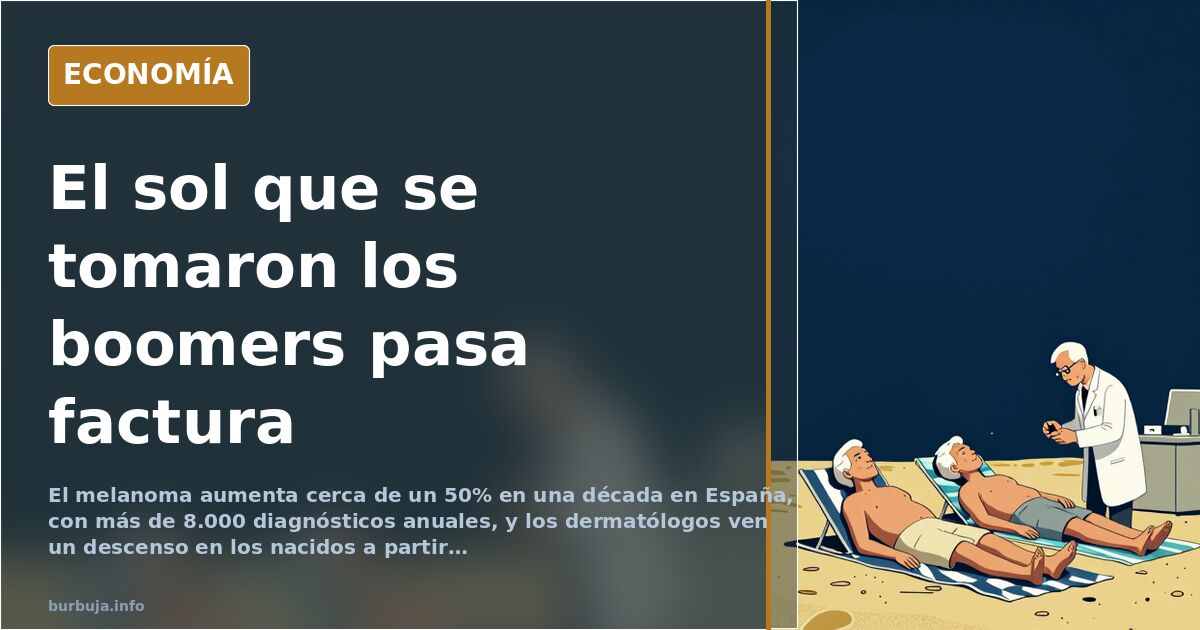
Melanoma rises 50% in Spain, linked to unprotected sun exposure
How many summers spent with olive oil and Coca-Cola on their skin were needed for melanoma to become the most aggressive form of skin cancer? The data from the Spanish Network of Cancer Registries is stubborn: cases have increased by nearly 50% in the last decade, with more than 8,000 annual diagnoses. The Healthy Skin Foundation, part of the Spanish Academy of Dermatology and Venereology, has launched the Euromelanoma 2025 campaign with an unequivocal message: protect yourself from the sun. Dermatologist Pablo Ortiz puts it bluntly: “The concept of tanning must disappear.”
The conversation that reveals the problem does not take place at a medical congress, but among women who are around or over 50. They remember when it was embarrassing to carry an umbrella, when protecting oneself was seen as weakness, and when the goal was to be tan at any cost. Today, they pay the price. The International Agency for Research on Cancer also predicts a 40% increase in skin cancer cases in Europe by 2050.
Who are those who tanned without protection?
The Spanish Association Against Cancer (AECC) does not have statistics segmented by generation, but accepts the diagnosis: there is a cohort that spent much time in the sun without hats, sunglasses, shirts, or photoprotection. Finding SPF 50 sunscreen years ago was extremely rare. Laura del Horno, prevention technician at AECC, explains this with crushing logic: skin cancer begins to appear from age 40 or 45, and if you add age, the probability skyrockets. At ages 60, 70, or 80, actinic keratoses—premalignant lesions that can develop into carcinoma without trinc-up—are common.
This pattern repeats in other countries. As early as 2015, Cancer Research UK warned that Britons over 65 had seven times the risk of developing skin cancer compared to four decades earlier, when coastal holidays proliferated. Intermittent but intense exposure—two weeks of heavy tanning per year—is just as damaging as chronic exposure.
Farmers, construction workers, and tourists: three different exposures
The official narrative has a blind spot that common sense detects quickly. Didn’t farmers and road workers work in the sun? Yes, but with long sleeves, long pants, and hats. Historical occupational exposure is nothing like beach tourism: lying down, turning over, during peak hours, with bare skin. This distinction is crucial because it dismantles the fallacy that the sun was equally intense before and nobody died from it.
Some argue that the real problem is not the sun itself, but modern life: spending ten or eleven months indoors and trying to compensate with one week of brutal exposure. The skin has no adaptive memory, and occasional burns are the worst gift you can give a melanocyte. The key to prevention, dermatologists insist, is limiting exposure and avoiding burns, especially in childhood.
Those born after the 1990s break the trend
The good news is that dermatologists see a decline in incidence among groups born since the late 1990s, precisely when awareness campaigns began. A study by the National Association of Perfumery and Cosmetics revealed that 78% of Spaniards consider sun protection more important than tanning. 87% associate excessive exposure with aging, and 90% acknowledge the cancer risk. Women protect themselves more: 54% use sun products daily or almost daily, compared to 18% of men.
Cultural change is advancing, albeit slowly. Tanned skin is damaged skin, specialists repeat, and this idea is starting to take hold. But the industry has also found its niche: creams for before, during, and after, some with ingredients that raise doubts about their own safety. Prevention has become a business, and not everything applied is harmless.
The uncomfortable question remains: if melanoma hits hard those who tanned in the 80s and 90s, what will happen to those who now conscientiously protect themselves but live indoors and travel to extreme sun destinations? Data points to generational improvement. Biology, as always, will take time to confirm it.
How many summers spent with olive oil and Coca-Cola on their skin were needed for melanoma to become the most aggressive form of skin cancer? The data from the Spanish Network of Cancer Registries is stubborn: cases have increased by nearly 50% in the last decade, with more than 8,000 annual diagnoses. The Healthy Skin Foundation, part of the Spanish Academy of Dermatology and Venereology, has launched the Euromelanoma 2025 campaign with an unequivocal message: protect yourself from the sun. Dermatologist Pablo Ortiz puts it bluntly: “The concept of tanning must disappear.”
The conversation that reveals the problem does not take place at a medical congress, but among women who are around or over 50. They remember when it was embarrassing to carry an umbrella, when protecting oneself was seen as weakness, and when the goal was to be tan at any cost. Today, they pay the price. The International Agency for Research on Cancer also predicts a 40% increase in skin cancer cases in Europe by 2050.
Who are those who tanned without protection?
The Spanish Association Against Cancer (AECC) does not have statistics segmented by generation, but accepts the diagnosis: there is a cohort that spent much time in the sun without hats, sunglasses, shirts, or photoprotection. Finding SPF 50 sunscreen years ago was extremely rare. Laura del Horno, prevention technician at AECC, explains this with crushing logic: skin cancer begins to appear from age 40 or 45, and if you add age, the probability skyrockets. At ages 60, 70, or 80, actinic keratoses—premalignant lesions that can develop into carcinoma without trinc-up—are common.
This pattern repeats in other countries. As early as 2015, Cancer Research UK warned that Britons over 65 had seven times the risk of developing skin cancer compared to four decades earlier, when coastal holidays proliferated. Intermittent but intense exposure—two weeks of heavy tanning per year—is just as damaging as chronic exposure.
Farmers, construction workers, and tourists: three different exposures
The official narrative has a blind spot that common sense detects quickly. Didn’t farmers and road workers work in the sun? Yes, but with long sleeves, long pants, and hats. Historical occupational exposure is nothing like beach tourism: lying down, turning over, during peak hours, with bare skin. This distinction is crucial because it dismantles the fallacy that the sun was equally intense before and nobody died from it.
Some argue that the real problem is not the sun itself, but modern life: spending ten or eleven months indoors and trying to compensate with one week of brutal exposure. The skin has no adaptive memory, and occasional burns are the worst gift you can give a melanocyte. The key to prevention, dermatologists insist, is limiting exposure and avoiding burns, especially in childhood.
Those born after the 1990s break the trend
The good news is that dermatologists see a decline in incidence among groups born since the late 1990s, precisely when awareness campaigns began. A study by the National Association of Perfumery and Cosmetics revealed that 78% of Spaniards consider sun protection more important than tanning. 87% associate excessive exposure with aging, and 90% acknowledge the cancer risk. Women protect themselves more: 54% use sun products daily or almost daily, compared to 18% of men.
Cultural change is advancing, albeit slowly. Tanned skin is damaged skin, specialists repeat, and this idea is starting to take hold. But the industry has also found its niche: creams for before, during, and after, some with ingredients that raise doubts about their own safety. Prevention has become a business, and not everything applied is harmless.
The uncomfortable question remains: if melanoma hits hard those who tanned in the 80s and 90s, what will happen to those who now conscientiously protect themselves but live indoors and travel to extreme sun destinations? Data points to generational improvement. Biology, as always, will take time to confirm it.
Also available in: Deutsch
Summary of a discussion on Burbuja.info - Foro de economía, actualidad y política., translated from Spanish and reviewed before publication. Read the full discussion (142 replies).
More summaries
-
Isabel Alfaro faces charges for calling police officers 'murderers'
The Prosecutor's Office and the Spanish Police Confederation are seeking €4,050 against Isabel Alfaro, president of immigrants' associations, for labeling the police as murderers.
-
Foster Care for Migrant Minors: Subsidies and Real Costs
Susana and Fran fostered a 12-year-old migrant. Debate focuses on €600 monthly aid, tax deductions, and who bears the cost.
-
Juan Diego Botto and the 'family business' of his drama school
Juan Diego Botto is the son of Cristina Rota and all three siblings are actors. The thread calls the school he promotes a 'family business'.
-
Marc Giró's 1998 TV3 Clip Reignites Debate on Persona
A 1998 clip of Marc Giró on Catalan channel TV3 shows a subdued collaborator, sparking debate over whether his flamboyant persona is authentic or constructed.
-
Spain rental listings on Idealista drop 9.5% in 12 days
Rental inventory on Spain's leading portal Idealista fell 9.5% in just 12 days, with Barcelona seeing an 83% decline in long-term offers.
-
Spain's Renewable Surplus Doesn't Lower Electricity Bills
Renewable energy costs near zero at peak hours in Spain, yet household bills remain high due to marginal market pricing.