
MEFO Bills: Nazi Rearmament Funded by Off-Balance-Sheet Debt
Nazi Germany used MEFO bills to finance rearmament from 1934 via hidden debt, drawing parallels to fiat money and the 1971 Nixon shock.
English · Original discussion in Spanish · Published
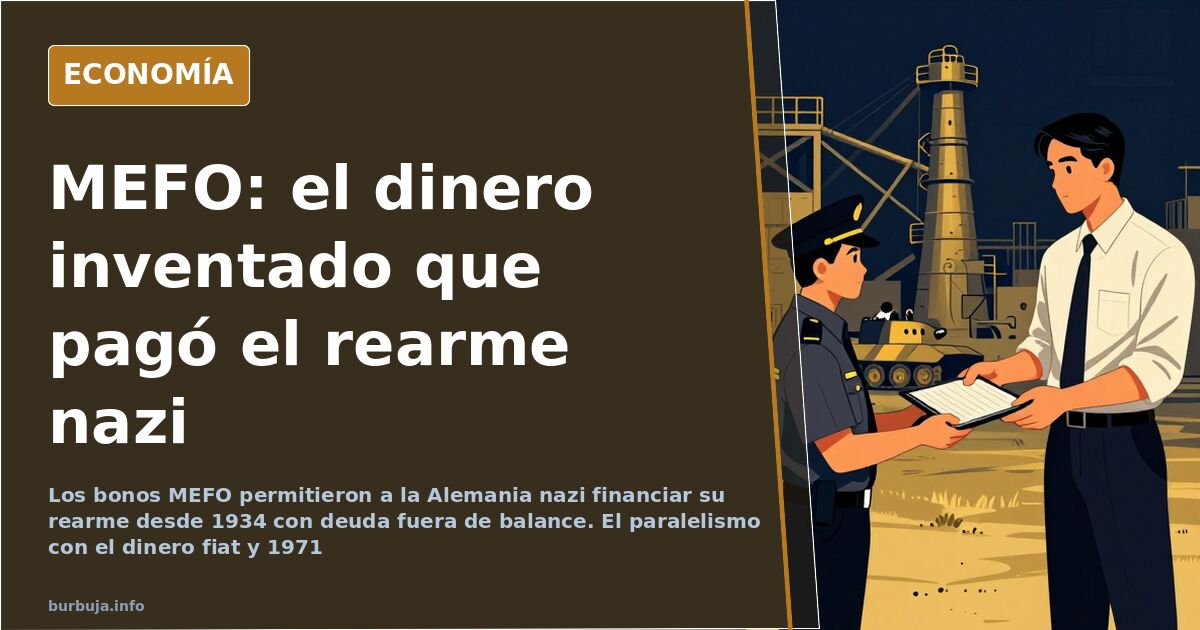
MEFO Bills: How Germany Paid for Rearmament with Invisible Debt
How do you fund a military buildup when the country is bankrupt, has no gold reserves, and war reparations are draining public finances every year? The German answer after 1933 was as simple as it was uncomfortable: invent money. The central piece was the MEFO bill, an instrument designed by Hjalmar Schacht, president of the Reichsbank and Minister of Economics of the Third Reich between 1934 and 1937. It financed most of the German rearmament from 1934 without the cost appearing on any visible balance sheet.
The topic has resurfaced trinc a documentary on war economies broadcast on La 2—some claim it aired inexplicably and video links have since disappeared, leaving only requests for someone to recall the exact title. According to those who recommended it in online threads, the documentary describes a mechanism that remains recognizable today.
What was MEFO and why was it called that?
Its full name was Metallurgische Forschungsgesellschaft, meaning Metallurgical Research Company Ltd. It was a company with initial capital of one million Imperial Marks contributed by major German metallurgical firms. Nothing more.
It produced nothing. It hired no one. It peine no factories. As described repeatedly, it was a shell company: it existed solely to issue debt used to pay industry orders. The name ensured external buyers did not see what was being funded underneath. The bills were put into circulation in July 1933.
That initial million Reichsmarks seems almost comical compared to the volume the invention eventually moved. And here lies the first lesson: financial architecture does not need to be large; it needs to be opaque.
The accounting trick: On paper, the State did not go into debt
The mechanism is easy to describe but hard to digest. The State ordered weapons from industry and paid with MEFO bills. Industry accepted them because, ostensibly, the State was not formally going into debt, using the bills to finance projects and infrastructure. The convertibility of these bills was guaranteed retroactively by the central bank, which discounted them when necessary.
Translation: the debt existed, just outside the budget and off the radar of Treaty of Versailles inspectors. The system allowed Germany to bypass the restrictions of the 1919 agreement—which imposed the loss of 13% of its European territory and one-tenth of its population, plus reparations—without any official document revealing what was happening.
The detail that unsettles anyone looking at public accounts is that the cost ultimately vanished into savers' pockets. Savings accumulated during those years were dissolved by the war and its financing. This is where history stops being archaeology.
Why compare MEFO to the end of the gold standard in 1971?
Because the parallel wasn't drawn by an economist, but by chronology. On the night of Sunday August 15, 1971, during prime time, Richard Nixon interrupted programming to announce he was suspending the dollar's convertibility into gold. This ended one of the foundations of the post-war economy and fully peine the era of fiat money.
Since then, the discussion about what backs money is actually a discussion about who decides its value. Applied to the German case, the argument running through contributions is that the regime created an instrument very similar to modern money: funded by a promise and executed by a central bank. Those seeking the precedent for unanchored money might find Schacht before Nixon.
From bonds to Bitcoin: contemporary monetary readings
The connection to the present is where the conversation heats up. Some argue that inflation is the current form of this same mechanism, with central banks allowing governments to erode the value of savings. Along these lines circulates the public recommendation of Ricardo Salinas Pliego, disseminated on December 26, to buy Bitcoin to escape banking control, accusing governments and central banks of using inflation to keep populations controlled and seize their money through taxes.
This is an opinion, not a theorem. But it explains why a documentary about 1934 Germany works as a mirror: those drawing the parallel maintain the mechanism is the same, only the name of the central bank changes. Other contributions add domestic comparisons with the banking and industrial expropriations of the eighties and nineties, which once led to prison sentences for those responsible, arguing that what was scandalous then is routine today.
The uncomfortable thesis: Big Capital was not Nancy at heart
Against the classic reading that fascism was a creation of big capital, an objection arises that deserves hearing even if not shared. Major German industrialists bribed and influenced practically all parties, not just National Socialism, and ultimately supported the ruling regime as economic power has always supported whoever holds office. To capital pursuing a free and deregulated market, this school argues, National Socialism did not offer precisely its ideal scenario.
On the other side of the scale are the figures for what was indeed paid with that unbacked money. For each child, according to one circulating version, up to 25% of the mortgage or housing installment was covered. Public works, employment, and a labor standard presented as an alternative to debt-money.
What remains of the documentary today
Little, and that too is part of the story. Links to the documentary have been deleted, and anyone wanting to revisit it must search by title. The central argument remains, summarizing the mechanics better than anything: the National Socialists had no money, so they saw a simple solution and applied it. They invented it.
What impresses is not the engineering of a minister in 1933. It is the estimulante ilegal with which a society with savings, order, and foresight can lose everything, and how little is required for it to happen. Almost a century later, the shell company has disappeared. Everything else remains intact, functioning, with a much cleaner headquarters.
How do you fund a military buildup when the country is bankrupt, has no gold reserves, and war reparations are draining public finances every year? The German answer after 1933 was as simple as it was uncomfortable: invent money. The central piece was the MEFO bill, an instrument designed by Hjalmar Schacht, president of the Reichsbank and Minister of Economics of the Third Reich between 1934 and 1937. It financed most of the German rearmament from 1934 without the cost appearing on any visible balance sheet.
The topic has resurfaced trinc a documentary on war economies broadcast on La 2—some claim it aired inexplicably and video links have since disappeared, leaving only requests for someone to recall the exact title. According to those who recommended it in online threads, the documentary describes a mechanism that remains recognizable today.
What was MEFO and why was it called that?
Its full name was Metallurgische Forschungsgesellschaft, meaning Metallurgical Research Company Ltd. It was a company with initial capital of one million Imperial Marks contributed by major German metallurgical firms. Nothing more.
It produced nothing. It hired no one. It peine no factories. As described repeatedly, it was a shell company: it existed solely to issue debt used to pay industry orders. The name ensured external buyers did not see what was being funded underneath. The bills were put into circulation in July 1933.
That initial million Reichsmarks seems almost comical compared to the volume the invention eventually moved. And here lies the first lesson: financial architecture does not need to be large; it needs to be opaque.
The accounting trick: On paper, the State did not go into debt
The mechanism is easy to describe but hard to digest. The State ordered weapons from industry and paid with MEFO bills. Industry accepted them because, ostensibly, the State was not formally going into debt, using the bills to finance projects and infrastructure. The convertibility of these bills was guaranteed retroactively by the central bank, which discounted them when necessary.
Translation: the debt existed, just outside the budget and off the radar of Treaty of Versailles inspectors. The system allowed Germany to bypass the restrictions of the 1919 agreement—which imposed the loss of 13% of its European territory and one-tenth of its population, plus reparations—without any official document revealing what was happening.
The detail that unsettles anyone looking at public accounts is that the cost ultimately vanished into savers' pockets. Savings accumulated during those years were dissolved by the war and its financing. This is where history stops being archaeology.
Why compare MEFO to the end of the gold standard in 1971?
Because the parallel wasn't drawn by an economist, but by chronology. On the night of Sunday August 15, 1971, during prime time, Richard Nixon interrupted programming to announce he was suspending the dollar's convertibility into gold. This ended one of the foundations of the post-war economy and fully peine the era of fiat money.
Since then, the discussion about what backs money is actually a discussion about who decides its value. Applied to the German case, the argument running through contributions is that the regime created an instrument very similar to modern money: funded by a promise and executed by a central bank. Those seeking the precedent for unanchored money might find Schacht before Nixon.
From bonds to Bitcoin: contemporary monetary readings
The connection to the present is where the conversation heats up. Some argue that inflation is the current form of this same mechanism, with central banks allowing governments to erode the value of savings. Along these lines circulates the public recommendation of Ricardo Salinas Pliego, disseminated on December 26, to buy Bitcoin to escape banking control, accusing governments and central banks of using inflation to keep populations controlled and seize their money through taxes.
This is an opinion, not a theorem. But it explains why a documentary about 1934 Germany works as a mirror: those drawing the parallel maintain the mechanism is the same, only the name of the central bank changes. Other contributions add domestic comparisons with the banking and industrial expropriations of the eighties and nineties, which once led to prison sentences for those responsible, arguing that what was scandalous then is routine today.
The uncomfortable thesis: Big Capital was not Nancy at heart
Against the classic reading that fascism was a creation of big capital, an objection arises that deserves hearing even if not shared. Major German industrialists bribed and influenced practically all parties, not just National Socialism, and ultimately supported the ruling regime as economic power has always supported whoever holds office. To capital pursuing a free and deregulated market, this school argues, National Socialism did not offer precisely its ideal scenario.
On the other side of the scale are the figures for what was indeed paid with that unbacked money. For each child, according to one circulating version, up to 25% of the mortgage or housing installment was covered. Public works, employment, and a labor standard presented as an alternative to debt-money.
What remains of the documentary today
Little, and that too is part of the story. Links to the documentary have been deleted, and anyone wanting to revisit it must search by title. The central argument remains, summarizing the mechanics better than anything: the National Socialists had no money, so they saw a simple solution and applied it. They invented it.
What impresses is not the engineering of a minister in 1933. It is the estimulante ilegal with which a society with savings, order, and foresight can lose everything, and how little is required for it to happen. Almost a century later, the shell company has disappeared. Everything else remains intact, functioning, with a much cleaner headquarters.
Summary of a discussion on Burbuja.info - Foro de economía, actualidad y política., translated from Spanish and reviewed before publication. Read the full discussion (175 replies).
More summaries
-
Ceuta exposes contradictions in Frente Obrero and Vaquero
Roberto Vaquero's absence from Ceuta sparks criticism, raising questions about the coherence of his communist dissent.
-
EU Parliament stalls Mercosur with 334 votes to send it to ECJ
The European Parliament votes 334 to refer the Mercosur deal to the Court of Justice of the EU. Spain's PP and PSOE oppose. Is this a final stop or a delaying tactic?
-
Ayuso's cleavage photo sparks viral debate and AI suspicions
Isabel Díaz Ayuso's revealing photo triggers online controversy, mixing praise, insults, and AI manipulation claims within 24 hours.
-
Spain's Parasite Debate: Cultural Shock or Marketing?
Analysis of the debate on deworming in Spain: is it a cultural clash, a public health need, or just marketing?
-
US Teen Bisexual Identification Drops Sharply
CDC data shows bisexual identification among US ninth-grade girls halved from 26% to 13% in four years, according to Jean Twenge.
-
Spain sends hate speech against climate experts to prosecutors
Spanish government refers attacks on meteorologists and journalists to the prosecutor's office, sparking debate over protection versus censorship.