
Medvedev Claims Ukraine Is Part of Russia
Russian Security Council Deputy Dmitry Medvedev stated that 'Ukraine is certainly Russia' during an official event, displaying a map with minimal Ukrainian territory.
English · Original discussion in Spanish · Published
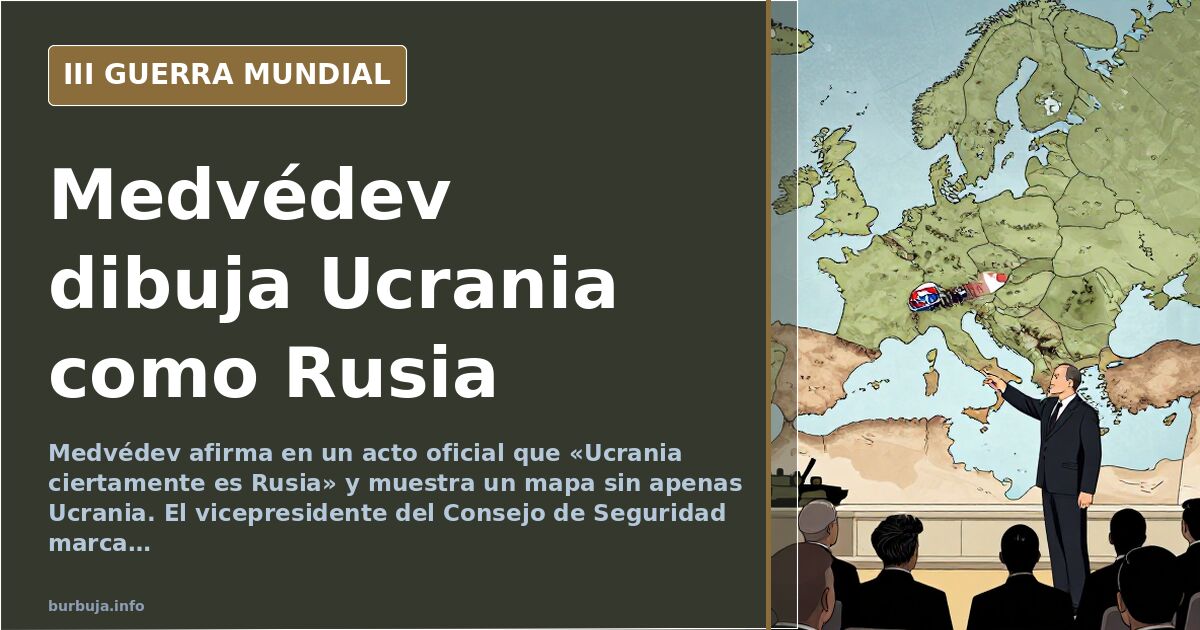
Medvedev claims Ukraine 'is Russia' and shows map with little left
Dmitry Medvedev, Deputy Chair of the Russian Security Council, appeared at the Knowledge First educational marathon in Sirius federal territory wearing a Mao-style tunic and delivering an unambiguous message: "Ukraine is certainly Russia, regardless of what Ukrainian politicians say." According to TASS reports from March 4, he accompanied this statement with a map where, as described in circulating accounts, very little of Ukraine remained. The phrase titling this analysis—"our geopolitical space has been indivisible since the time of the ancient Russian state"—was not a casual remark; it was delivered by the deputy chair of the Security Council of the Russian Federation at an official event.
What exactly did Medvedev say and why does the format matter?
The speech rests on three pillars. The first is the denial of Ukrainian identity as a political subject: "One of the former Ukrainian leaders once said that Ukraine is not Russia. This concept must disappear forever." The second is the appropriation of Russian public opinion as a collective subject that "rightly considers Ukraine and its population part of our fully Russian civilization." The third is the thesis that if Ukraine had escaped "the stupidest trap set by the United States and its allies," things would have been different.
The packaging matters as much as the message. The Kim Jong-un style tunic, the projected map, and the rally-like tone turn a territorial declaration into an act of imperial pedagogy. This is not a slip-up by a minor official: it comes from the deputy chair of the body coordinating Russian security doctrine. And he says it in a country where, as several analyses note, even minimal dissent is persecuted.
The assigned role: from liberal to hawk without changing seats
Medvedev has not always spoken this way. Over a decade ago, he was the presentable face of United Russia, the interlocutor Obama could receive without embarrassment. Today, he is the team's hawk, saying what the Kremlin prefers not to sign. Some describe him as the "bad cop" in a pair needing both registers: one for negotiation, another for pressure. The uncomfortable question is not whether Medvedev believes it, but why he is allowed to say this in a system that tolerates not even mild criticism.
Reaction in Spanish circles was immediate and, as usual, divided. Some dismissed it as a "troll move," useful only for domestic consumption. Others highlighted the obvious: the speech is not a joke, but doctrine. A third group used the opportunity to debate the framework: whether Russia has the right to guarantee its security on its border, whether NATO crossed lines, whether the "nyet means nyet" of 2008 was a real warning.
The map, the Dnieper, and Soviet memory
The territorial argument relies on a historical reading worth dissecting. Medvedev spoke of how parts historically belonging to Russia "must return home" and claimed that territories on both banks of the Dnieper form part of strategic and historical borders. He also stated that reviving the USSR is impossible, which does not prevent claiming its geographic heritage. The contradiction is fertile: one cannot resurrect the Soviet Union, yet can claim the pieces that suit one's interests.
A historical detail slipping into the discussion is Soviet territorial engineering, which added lands to Ukraine to dilute its separate consciousness. In Russian discourse, this data serves as proof of artificiality; in Western analysis, it is read precisely the opposite: thirty years of independence have consolidated an identity Moscow claims does not exist. Paradoxically, the war has reinforced it.
The real front: ammunition, budget, and attrition
While Medvedev draws maps, the front is measured in tons of artillery. A recurring calculation in the discussion holds that multiplying the defense budget eighteenfold has not sufficed to cover even a quarter of the ammunition Russians expend. The figure is rough and debatable, but points to a real problem: European industrial production is not designed for a war of attrition. Others respond that Western aid is "abundant," with hundreds of billions since 2022, equipment from around the world, and permanent satellite assistance.
As of this discussion, the result on the ground is that the front remains near the 2014 borders despite partial mobilizations, mercenaries, and successive rotations. Finland is already a NATO member, and Sweden is close. Anti-Russian sentiment in Ukraine has never been higher. Every map projected in an auditorium translates into another argument for Ukraine not returning to Moscow's orbit.
What Europe risks with this rhetoric
Rhetoric about endless borders has a measurable cost in Europe: each such statement reinforces defense spending, accelerates NATO expansion, and closes the door to any negotiation that does not involve prior withdrawal. It is not harmless propaganda. It is a self-fulfilling prophecy.
There remains the disorienting fact. The man who today says Ukraine is Russia was the one who ten years ago embodied the system's friendly face. If generational turnover in the Kremlin produces hawks like this, the question is not what Medvedev wants, but what lies beneath him.
Dmitry Medvedev, Deputy Chair of the Russian Security Council, appeared at the Knowledge First educational marathon in Sirius federal territory wearing a Mao-style tunic and delivering an unambiguous message: "Ukraine is certainly Russia, regardless of what Ukrainian politicians say." According to TASS reports from March 4, he accompanied this statement with a map where, as described in circulating accounts, very little of Ukraine remained. The phrase titling this analysis—"our geopolitical space has been indivisible since the time of the ancient Russian state"—was not a casual remark; it was delivered by the deputy chair of the Security Council of the Russian Federation at an official event.
What exactly did Medvedev say and why does the format matter?
The speech rests on three pillars. The first is the denial of Ukrainian identity as a political subject: "One of the former Ukrainian leaders once said that Ukraine is not Russia. This concept must disappear forever." The second is the appropriation of Russian public opinion as a collective subject that "rightly considers Ukraine and its population part of our fully Russian civilization." The third is the thesis that if Ukraine had escaped "the stupidest trap set by the United States and its allies," things would have been different.
The packaging matters as much as the message. The Kim Jong-un style tunic, the projected map, and the rally-like tone turn a territorial declaration into an act of imperial pedagogy. This is not a slip-up by a minor official: it comes from the deputy chair of the body coordinating Russian security doctrine. And he says it in a country where, as several analyses note, even minimal dissent is persecuted.
The assigned role: from liberal to hawk without changing seats
Medvedev has not always spoken this way. Over a decade ago, he was the presentable face of United Russia, the interlocutor Obama could receive without embarrassment. Today, he is the team's hawk, saying what the Kremlin prefers not to sign. Some describe him as the "bad cop" in a pair needing both registers: one for negotiation, another for pressure. The uncomfortable question is not whether Medvedev believes it, but why he is allowed to say this in a system that tolerates not even mild criticism.
Reaction in Spanish circles was immediate and, as usual, divided. Some dismissed it as a "troll move," useful only for domestic consumption. Others highlighted the obvious: the speech is not a joke, but doctrine. A third group used the opportunity to debate the framework: whether Russia has the right to guarantee its security on its border, whether NATO crossed lines, whether the "nyet means nyet" of 2008 was a real warning.
The map, the Dnieper, and Soviet memory
The territorial argument relies on a historical reading worth dissecting. Medvedev spoke of how parts historically belonging to Russia "must return home" and claimed that territories on both banks of the Dnieper form part of strategic and historical borders. He also stated that reviving the USSR is impossible, which does not prevent claiming its geographic heritage. The contradiction is fertile: one cannot resurrect the Soviet Union, yet can claim the pieces that suit one's interests.
A historical detail slipping into the discussion is Soviet territorial engineering, which added lands to Ukraine to dilute its separate consciousness. In Russian discourse, this data serves as proof of artificiality; in Western analysis, it is read precisely the opposite: thirty years of independence have consolidated an identity Moscow claims does not exist. Paradoxically, the war has reinforced it.
The real front: ammunition, budget, and attrition
While Medvedev draws maps, the front is measured in tons of artillery. A recurring calculation in the discussion holds that multiplying the defense budget eighteenfold has not sufficed to cover even a quarter of the ammunition Russians expend. The figure is rough and debatable, but points to a real problem: European industrial production is not designed for a war of attrition. Others respond that Western aid is "abundant," with hundreds of billions since 2022, equipment from around the world, and permanent satellite assistance.
As of this discussion, the result on the ground is that the front remains near the 2014 borders despite partial mobilizations, mercenaries, and successive rotations. Finland is already a NATO member, and Sweden is close. Anti-Russian sentiment in Ukraine has never been higher. Every map projected in an auditorium translates into another argument for Ukraine not returning to Moscow's orbit.
What Europe risks with this rhetoric
Rhetoric about endless borders has a measurable cost in Europe: each such statement reinforces defense spending, accelerates NATO expansion, and closes the door to any negotiation that does not involve prior withdrawal. It is not harmless propaganda. It is a self-fulfilling prophecy.
There remains the disorienting fact. The man who today says Ukraine is Russia was the one who ten years ago embodied the system's friendly face. If generational turnover in the Kremlin produces hawks like this, the question is not what Medvedev wants, but what lies beneath him.
Summary of a discussion on Burbuja.info - Foro de economía, actualidad y política., translated from Spanish and reviewed before publication. Read the full discussion (122 replies).
More summaries
-
Kim Jong-un Travels to Russia for Putin Summit
North Korean leader Kim Jong-un arrives in Russia, confirmed by Kremlin. The Moscow-Pyongyang axis reignites geopolitical debates.
-
Ukraine NATO Entry and Crimea Claim Risk Europe War
Participants argue that if Ukraine joins NATO and seeks to reclaim Crimea, Europe faces immediate war with Russia.
-
Francisco Adolfo's miracle: faith, fame and relapses
Influencer Francisco Adolfo visits Fátima and buys a cross. Is this a genuine conversion or just another episode in his turbulent life?
-
Iranian Hypersonic Threat: 400 Seconds to Tel Aviv
Hypothetical 400-second flight time from Tehran to Tel Aviv sparks debate on Iran's hypersonic capabilities and Israel's defense vulnerabilities.
-
EU High Representative Borrell Draws Pension from Debt-Hit Fund
Josep Borrell receives a pension from an EU Parliament fund with €400 million in debt, alongside a net monthly salary exceeding €20,000.
-
Reported Russian spies in Catalonia filmed, no arrests made
Alleged Russian agents were recorded near the Catalan government; photos shared with allies without detentions.