
Medicine feminizes: women make up 59% of doctors and 71% of students
Women account for 59% of active doctors and 71% of medical students in Spain, yet men hold 72% of service chief positions. The OMC calls for structural reform.
English · Original discussion in Spanish · Published
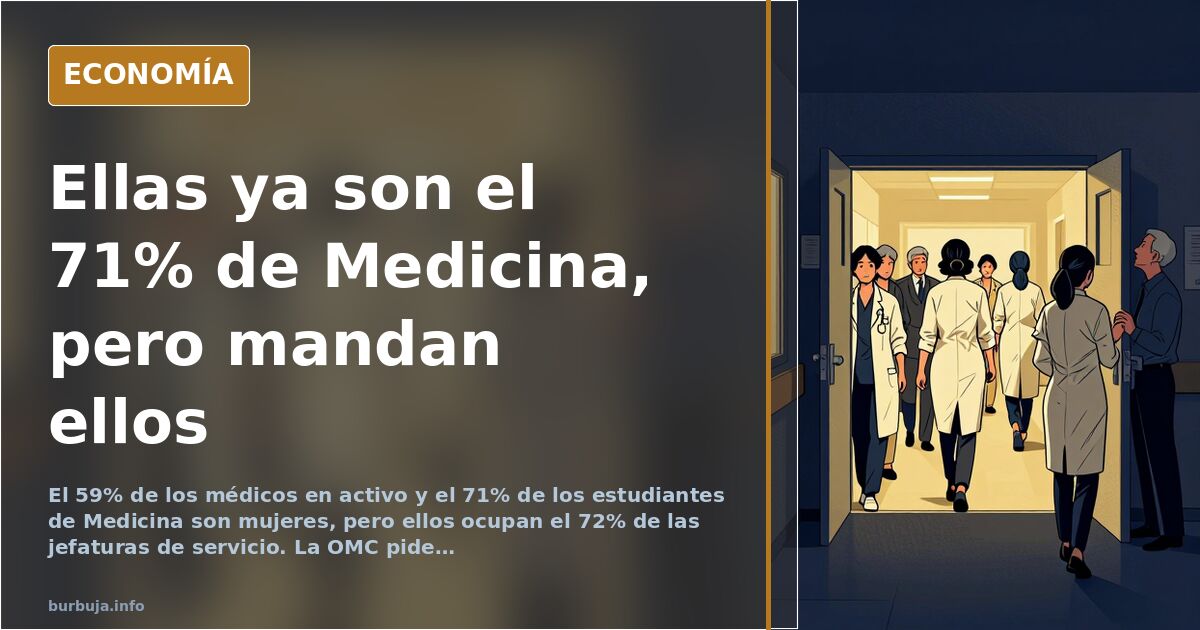
Medicine feminizes: women make up 59% of doctors and 71% of students
The General Council of Official Medical Associations (OMC) describes this as a "complete inversion" of the profession. In 1882, Dolors Aleu became the first woman to practice medicine in Spain, an anomaly that persisted for nearly eighty years. Today, there are 163,581 female doctors in active practice, representing 59% of the total, exceeding male colleagues by 51,199. In universities, the figure rises to 71% of medical students. The OMC report, presented on a Thursday in November 2025, confirms that this trend is not slowing down; it will deepen as these students graduate.
This data coexists with another fact that partially contradicts it. According to Women in Medicine, men occupy 64% of leadership positions and 72% of service chiefs. Virginia Izura, OMC Vice-Secretary, attributes this to seniority: leadership roles require years of career pogre, and feminization is more intense among younger cohorts. Under age 65, women are the majority in all age groups; among those under 44, two out of three doctors are women. Above that age, 58% are men.
What the OMC demands for system sustainability
The report does not merely note the shift. It warns of "significant challenges to resolve" and calls for a restructuring of healthcare where work-life balance is a design parameter, not an afterthought. Izura cites maternity leave and breastfeeding as factors exclusive to women that must be considered when organizing services: ensuring female doctors do not lose their position, social security contributions, or seniority, while patients do not notice gaps. "Timely replacement" remains the sticking point.
The budgetary context offers no help. Doctors demand higher salaries and an equitable replacement pact ahead of the retirement of 69,000 physicians over the next ten years. The OMC speaks of structural change; internal discussions refer to the situation as a "major problem."
The glass ceiling that demographics alone won't break
The paradox is textbook: female overrepresentation at the base, underrepresentation at the top. Izura concedes that the shift may occur naturally through generational turnover, since leadership roles are earned over time. The obvious objection is that this argument has served as a promise for decades, yet 72% of service chiefs remain male. Feminization advances in classrooms and clinics; in executive offices, pogre lags.
The gap between public and private healthcare
Numbers vary depending on who pays the salary. In public healthcare, the proportion is estimated at 70% women and 30% men; in the private sector, it reverses to 55% men versus 45% women. Some interpret this differential as an effect of waiting lists: the public system becomes saturated, while the private sector grows and absorbs different profiles. This is a hypothesis, not a finding from the report, but it aligns with underlying complaints.
Discontent not measured in percentages
Beneath the statistics lies another conversation, harsher and less presentable. Part of the healthcare staff and patients argue that care quality has degraded, protocols are applied without clinical judgment, and diagnostic delays are increasing. Testimonies are specific: a retinal tear sutured by a resident later removed from consultation by their supervisor; a request to change primary care physicians denied until three visits were completed; stress diagnoses that turned out to be type 2 diabetes. These are isolated cases, not a sample, and should be read as such. Yet the volume of complaints trinc a pattern.
Some attribute the phenomenon to gender bias in high school grades: it is argued that the system rewards compliance and memorization, favoring female students in cutoff scores. A regional study cited in discussions pointed to a gap between high school grades and university entrance exam results based on sens, not school ownership. The conclusion drawn is uncomfortable and unproven: if the entry filter measures obedience rather than critical thinking, the issue is not who enters, but what is rewarded for entry.
AI as threat and excuse
The emergence of language models appears in discussions as an individual escape route. Several accounts describe consultations where patients cross-reference diagnoses with AI and receive more reassuring second opinions. This is not clinical evidence, but anecdote, and treating it as an alternative diagnosis would be erroneous. However, it reveals a loss of trust that no registration statistics capture.
The precise point where analysis stalls is this: data certifies that the profession has changed hands. What it does not certify is that the system has changed with it. Work-life balance without replacement means overload. Leadership without succession means a ceiling. And diffuse complaints about care quality, lacking statistical backing, remain just that: complaints. Data is missing where only testimonials exist.
Key Data
The General Council of Official Medical Associations (OMC) describes this as a "complete inversion" of the profession. In 1882, Dolors Aleu became the first woman to practice medicine in Spain, an anomaly that persisted for nearly eighty years. Today, there are 163,581 female doctors in active practice, representing 59% of the total, exceeding male colleagues by 51,199. In universities, the figure rises to 71% of medical students. The OMC report, presented on a Thursday in November 2025, confirms that this trend is not slowing down; it will deepen as these students graduate.
This data coexists with another fact that partially contradicts it. According to Women in Medicine, men occupy 64% of leadership positions and 72% of service chiefs. Virginia Izura, OMC Vice-Secretary, attributes this to seniority: leadership roles require years of career pogre, and feminization is more intense among younger cohorts. Under age 65, women are the majority in all age groups; among those under 44, two out of three doctors are women. Above that age, 58% are men.
What the OMC demands for system sustainability
The report does not merely note the shift. It warns of "significant challenges to resolve" and calls for a restructuring of healthcare where work-life balance is a design parameter, not an afterthought. Izura cites maternity leave and breastfeeding as factors exclusive to women that must be considered when organizing services: ensuring female doctors do not lose their position, social security contributions, or seniority, while patients do not notice gaps. "Timely replacement" remains the sticking point.
The budgetary context offers no help. Doctors demand higher salaries and an equitable replacement pact ahead of the retirement of 69,000 physicians over the next ten years. The OMC speaks of structural change; internal discussions refer to the situation as a "major problem."
The glass ceiling that demographics alone won't break
The paradox is textbook: female overrepresentation at the base, underrepresentation at the top. Izura concedes that the shift may occur naturally through generational turnover, since leadership roles are earned over time. The obvious objection is that this argument has served as a promise for decades, yet 72% of service chiefs remain male. Feminization advances in classrooms and clinics; in executive offices, pogre lags.
The gap between public and private healthcare
Numbers vary depending on who pays the salary. In public healthcare, the proportion is estimated at 70% women and 30% men; in the private sector, it reverses to 55% men versus 45% women. Some interpret this differential as an effect of waiting lists: the public system becomes saturated, while the private sector grows and absorbs different profiles. This is a hypothesis, not a finding from the report, but it aligns with underlying complaints.
Discontent not measured in percentages
Beneath the statistics lies another conversation, harsher and less presentable. Part of the healthcare staff and patients argue that care quality has degraded, protocols are applied without clinical judgment, and diagnostic delays are increasing. Testimonies are specific: a retinal tear sutured by a resident later removed from consultation by their supervisor; a request to change primary care physicians denied until three visits were completed; stress diagnoses that turned out to be type 2 diabetes. These are isolated cases, not a sample, and should be read as such. Yet the volume of complaints trinc a pattern.
Some attribute the phenomenon to gender bias in high school grades: it is argued that the system rewards compliance and memorization, favoring female students in cutoff scores. A regional study cited in discussions pointed to a gap between high school grades and university entrance exam results based on sens, not school ownership. The conclusion drawn is uncomfortable and unproven: if the entry filter measures obedience rather than critical thinking, the issue is not who enters, but what is rewarded for entry.
AI as threat and excuse
The emergence of language models appears in discussions as an individual escape route. Several accounts describe consultations where patients cross-reference diagnoses with AI and receive more reassuring second opinions. This is not clinical evidence, but anecdote, and treating it as an alternative diagnosis would be erroneous. However, it reveals a loss of trust that no registration statistics capture.
The precise point where analysis stalls is this: data certifies that the profession has changed hands. What it does not certify is that the system has changed with it. Work-life balance without replacement means overload. Leadership without succession means a ceiling. And diffuse complaints about care quality, lacking statistical backing, remain just that: complaints. Data is missing where only testimonials exist.
Key Data
- 163,581 female doctors in active practice, 51,199 more than male doctors (59% of total)
- 71% of medical students are women
- Men hold 64% of leadership positions and 72% of service chief roles
- 69,000 doctors will retire in the next ten years
- In public healthcare, 70% women and 30% men; in private, 55% men and 45% women
Summary of a discussion on Burbuja.info - Foro de economía, actualidad y política., translated from Spanish and reviewed before publication. Read the full discussion (158 replies).
More summaries
-
Spain plans to cover glasses and contacts in public health by 2026
Spain's health ministry aims to include vision care in the common service portfolio by 2026, though specific conditions remain undefined.
-
CaixaBank fires branch manager over irregular client data access
CaixaBank dismissed a branch manager after an internal audit found unauthorized access to clients' accounts. The case raises questions about banking privacy.
-
Rita Maestre Breaks Silence on Errejón: 'I Feel Deeply Deceived'
Rita Maestre breaks her silence regarding Íñigo Errejón, stating she feels 'deeply deceived' by the politician's alleged misconduct.
-
Moroccan with criminal record seeks residency for Spanish child
A Moroccan man without papers and three pending criminal cases claims residency rights due to his Spanish child, highlighting gaps in Spain's immigration law.
-
Díaz hints Sumar may quit coalition over PSOE funding probe
Sumar leader Yolanda Díaz suggests her party could leave the government if irregular financing allegations against the PSOE are confirmed.
-
Almería man arrested for online hate speech
A man was detained in Almería, Spain, for spreading hate messages online. The case reignites debate on free speech limits and hate crime laws.