
Marina Alta and Safor hit by floods as 720 mm falls in 24 hours
Up to 720 mm in 24 hours in Forna and the Girona river overflowing at Els Poblets: Oliva reports 200 people trapped and 2,000 evacuated in an episode that weather models…
English · Original discussion in Spanish · Published
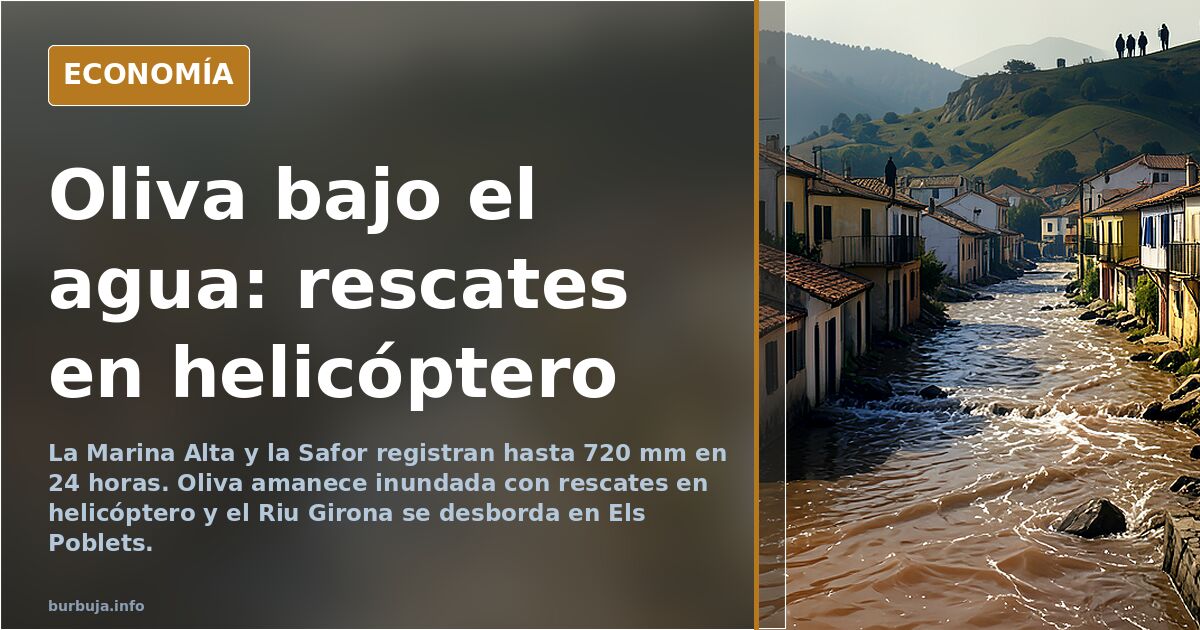
720 litres per square metre in 24 hours and the Girona in flood
Between 17 and 19 October 2026, the Marina Alta and Safor regions recorded rainfall of up to **720 mm in Forna** and 693 mm in Pego, according to AVAMET data. The overflowing of the Girona river as it passed through Els Poblets and the flooding in Oliva, with around 200 people trapped and 2,000 evacuated from campsites, turned the region into the epicentre of an episode that weather models had anticipated. The subsequent discussion has focused on three fronts: the pending hydraulic infrastructure, building on flood-prone land and the political handling of the emergency.
The water that fell in the mountains ended up in Oliva
The most frequently cited figure in the records is also the most telling: **720 mm in Forna, 693 in Pego, 643 in Oliva, 615 in el Real de Gandia and 602 in Barx (la Drova)**. The rain did not fall evenly, but was concentrated in the upper reaches of the ravines that flow down to the coast. The result was a gravitational transfer: the water that fell in the mountains ended up flooding the coastal towns. In Oliva, helicopters rescued people who were trapped, and the town council put the number of residents in an emergency situation at 200, with 2,000 evacuated from campsites overnight.
The physical explanation is simple: the water table in the Safor floodplain is so high that, when it rains with that intensity, the water comes out of the drains instead of going in. "It is impossible to evacuate all the water that falls on a large floodplain with high water tables," sums up one of the contributions. The problem is not so much the volume as the ground's inability to absorb it.
The Girona and the Els Poblets bridge: reeds, pillars and overflow
The Girona river burst its banks as it passed through Els Poblets. Images released by AVAMET showed the four-pillar bridge blocked by reeds swept along by the current, causing the water to overflow both banks and flood homes in the area. The scene is not new: the town remembers a previous flood, some 15 or 16 years ago, in which several elderly people died.
The role of vegetation in river channels divides opinion. Some argue that reeds slow the current and reduce the force of the water; others contend that they are invasive and that their accumulation blocks bridges and drains. The debate over clearing ravines and removing vegetation is not technical but political: it pits farmers, environmentalists and administrations with scattered responsibilities against one another.
The infrastructure that was never built, and the building that should never have peine
The most common complaint points to the lack of investment in hydraulic infrastructure. "They have spent 50 years doing practically nothing in terms of infrastructure, and since this used to happen to them once every 20 years, well..." sums up one contribution. The argument has a demographic basis: the region's population has grown by 25% in 20 years, with construction on land that used to be marshes or farmland.
The debate over flood-prone areas is not exclusive to the Marina Alta. In the Valencian Community, a large part of the seafront promenades and coastal developments stand on former drained wetlands. "Most of the beaches in the Comunitat used to be aiguamolls, that is, marshes that were drained; when it rains heavily, they revert to what they always were," notes another message. The conclusion is uncomfortable: water does not occupy new ground, it reclaims what belonged to it.
The political handling: from the Generalitat's warning to Sánchez's visit
The Generalitat (Valencian regional government) ordered confinement and mobility restrictions in the municipalities of the southern coast of Valencia and the northern coast of Alicante. The measure came when the episode was already under way. Pedro Sánchez's visit to Oliva, scheduled for the trinc day, was met with boos and tension, according to press accounts.
Comparison with the 2024 DANA (the deadly cold-drop flooding event) is inevitable. On that occasion, deaths were concentrated in garages and basements, and the basic recommendations — do not go down to car parks, do not drive through floodwater — remain the ones that save the most lives. This time, early warning and confinement may have prevented a worse toll, although the evacuation of campsites and helicopter rescues show that the response was reactive, not preventive.
Climate change and the debate that will not close
Discussion of climate change runs through the thread with scepticism. Some question whether it is anthropogenic, while others point out that a Mediterranean at 30 degrees is a decisive factor. Weather models, such as the Swiss4x4, anticipated the episode, which fuels criticism of those who had dismissed them. Meteorological science, in any case, is not in doubt: the forecast worked.
The exact point where the analysis gets stuck is responsibility. The rainfall was extraordinary, but the region's vulnerability is a political decision accumulated over decades: building on flood-prone land, river channels left uncleared, infrastructure still pending. None of these variables is solved by a confinement order.
Also available in: Deutsch
Summary of a discussion on Burbuja.info - Foro de economía, actualidad y política., translated from Spanish and reviewed before publication. Read the full discussion (177 replies).
More summaries
-
Olive oil prices surge 84.4%, outpacing official inflation data
Spanish olive oil costs rose 84.4% year-on-year, hitting record highs while official consumer price indices fail to reflect the true impact on household budgets.
-
Spain's Justice Ministry begins pardon process for ERE case convicts
The Ministry of Justice has started the pardon procedure for José Antonio Griñán and other convicted officials in Spain's major ERE corruption scandal, according to ABC.
-
Sánchez False Flag Theory Before Nov 21 Election
Unverified theory claims Sánchez plans false flag attack before Nov 21 election, sparking online debate.
-
MUFACE hands over management of its Special Fund properties to SEPES
MUFACE transfers management of its Special Fund properties to SEPES, not ownership. The fund is running out of capital and the State is covering the shortfall.
-
Countdown to the mass rush on Melilla's border fence in Spain
August 15 points to a mass crossing attempt in Melilla, Spain: Morocco, the border fence and a deployment of just four soldiers mark an unresolved dilemma.
-
Spain vs the US: the tax cost of a 30,000 salary
On a 30,000 euro salary, Spain takes 24,000 in taxes versus 7,000 in the US. Who pays for the state?