
Maricarmen: the eviction that unblocked Spain's housing decree
The housing decree had been stalled for months and advanced with the Maricarmen case. What measures it may include and what happens when the debate is done in the heat of the moment.
English · Original discussion in Spanish · Published
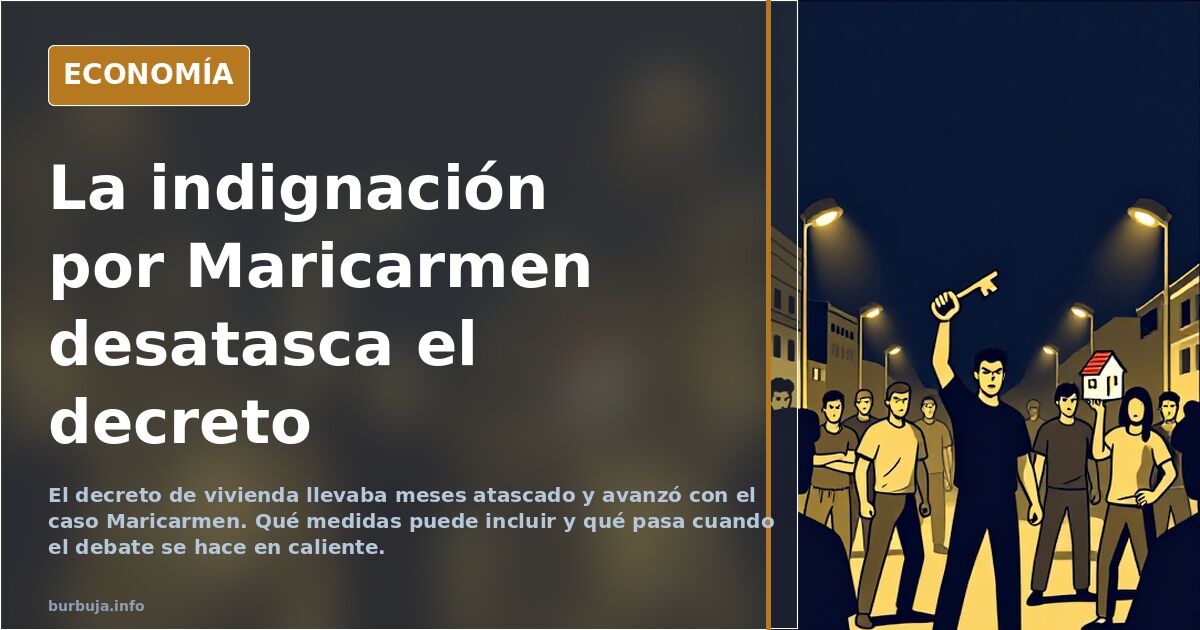
Maricarmen, the eviction that unblocked a housing decree
An 87-year-old woman loses the home she has lived in practically all her life. What comes next is not just outrage: it is a Royal Decree-Law rushing out. And there is the paradox that we should face head-on. That decree had been under negotiation for months and was not coming out. It got unblocked when Maricarmen appeared.
What peine with Maricarmen and why the country mobilised
The eviction jumps to television, newspapers, social media. Protests arrive, Puerta del Sol, tents. In September 2026 Spain suddenly discovers a problem that had been right in front of its nose for years and people talk, half-jokingly, of a spontaneous 15M.
The case is terrible and there is no need to exaggerate it for it to be so. The interesting discussion starts elsewhere: what is done with the wave. With public opinion turned towards a specific victim, the frame is simplified to the point of absurdity. Are you with Maricarmen or against Maricarmen? Little else fits in the debate.
The decree that was already written before the case
The text was not drafted that week. They had already tried to move it before the summer and it did not come out: there were disagreements, opposing interests and measures difficult to sell. What changes the scenario is not a new idea, it is a political window that opens wide. It is one thing to legislate on housing on any given Tuesday and another to legislate while the whole country watches images of an evicted elderly woman.
In cold blood one can discuss whether a rule increases or reduces supply, what happens with the legal security of property owners, how it affects tourist rentals or construction. In the heat of the moment, that discussion gets in the way. And any Government takes advantage of that, whoever governs and after seven years —eight years and three months, others correct— in Moncloa.
The fine print we still do not know
Here is the real problem. Without the final text in front of us, we cannot know which measures truly prevent a case like Maricarmen's and which take advantage of the moment to give another twist to a housing policy that has been failing to solve the underlying issue for years. The full breakdown of each item will deserve its own reading when published.
Some argue that intervening in the rental market reduces available supply and drives out property owners. Against that weighs the argument that access to housing has become an odyssey for those without a family flat, inheritance or two salaries at home. If any measure makes renting more expensive or shrinks it, we would have the perfect paradox: using the suffering of the housing crisis to justify rules that worsen it.
Ceuta and the issues that left the front pages
While the country talks about Maricarmen, another conversation lowers its volume. A few days ago the front pages were Ceuta, Delcy, Ábalos, Begoña and a whole list of uncomfortable issues. Today they are not. Some attribute it to a deliberate diversion of attention and others deny it with the same emphasis. The only verifiable thing is the change of focus: Spain talks today about Maricarmen, tomorrow about the Maricarmen decree and the day after we will see.
On the other side of the ring are the property owners. Some defend that a rental is a contract with an end date decided by whoever provides the property, not whoever occupies it. And there are those who recall that there have been people who asked for institutional help and did not find it, without that moving a single news bulletin. They are two narratives that look at each other with suspicion.
The uncomfortable question remains. If the decree that comes out of this mess reduces supply just when it is most needed, who will explain it with a camera on and an 87-year-old lady in the background?
Summary of a discussion on Burbuja.info - Foro de economía, actualidad y política., translated from Spanish and reviewed before publication. Read the full discussion (18 replies).
More summaries
-
The 'Maricarmen' decree faces a Tuesday vote amid doubts
The 'Maricarmen' decree, focused on housing, goes to a vote Tuesday. Old rents, Junts, omnibus bills, and planned applause...
-
Housing decree: Government eyes Tuesday for approval
The Government aims to present a housing decree to the Council of Ministers on Tuesday, urging parliamentary groups to validate it.
-
Spain Government Prepares for Elections and Permanent Deputation Route
Reports indicate the Government is preparing for Pedro Sánchez to dissolve the Cortes and call elections, while debating if the Permanent Deputation can ratify the housing decree.
-
UNICEF Spain Ad Sparks Backlash Over Inheritance Appeals
UNICEF Spain faces criticism for an ad featuring basketball legend Juanma López-Iturriaga urging viewers to leave their estates to the charity, sparking debate on forced heirship.
-
Nursing beats Medicine on return on investment
Nurses in Spain earn just €4,000 less than doctors after two fewer years of study, and out-earn engineers. How long can the healthcare salary bubble last?
-
Sumar's internal war erupts with harassment and fraud claims
Laura Moreno resigns as Organisation Secretary of Spain's Sumar party following allegations of workplace harassment and fraud in the primaries. The internal crisis deepens.