
Maricarmen becomes a symbol of Spain's housing fight: the secular shrine dividing opinion
Maricarmen, the evicted woman, has become a symbol with a shrine at Puerta del Sol and chants in her honor. A secular cult that divides, and a lawsuit that may be coming.
English · Original discussion in Spanish · Published
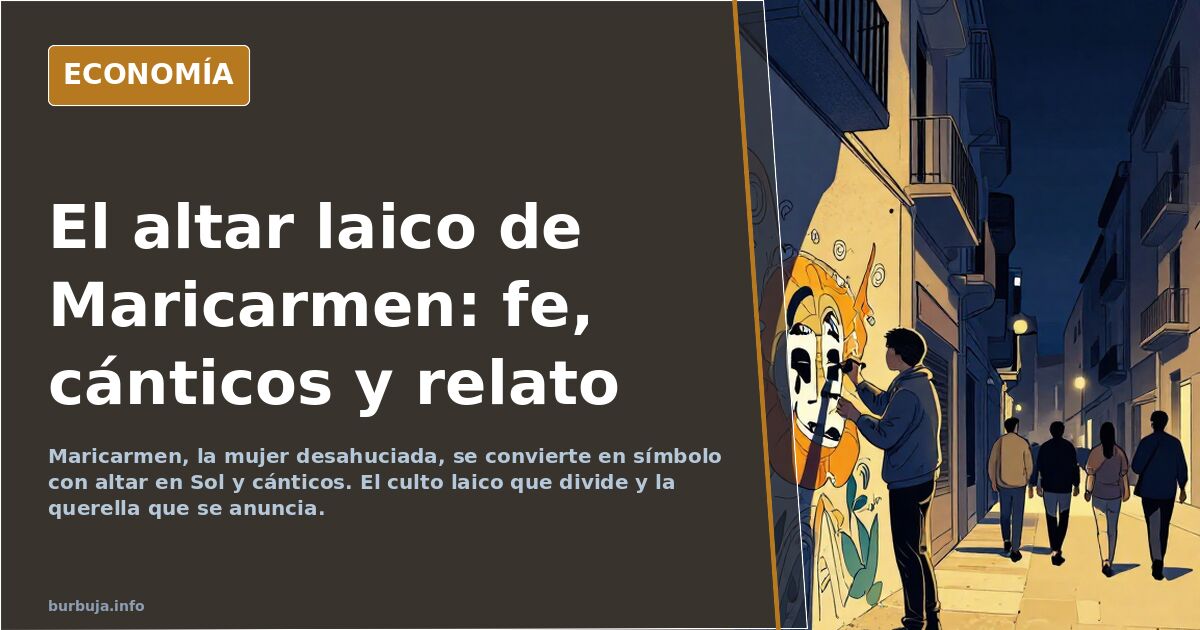
Maricarmen becomes a symbol of Spain's housing fight: the secular shrine dividing opinion
The death of Maricarmen, the evicted woman whose case ignited a wave of public outrage, has turned into something that goes beyond politics: a secular cult complete with a shrine, chants and candles. A shrine has been set up in her memory at Puerta del Sol in Madrid; outside her former building, people sang "Santa Bárbara bendita," the Asturian miners' hymn. Hundreds of phone flashlights lit up. Some claim the tenants' union is preparing a lawsuit against Urbagestión for negligent homicide, though this has not been officially confirmed.
What began as mourning has become a liturgy. And the liturgy has become politics. The question is no longer what peine to Maricarmen, but who controls her story.
From mourning to shrine: the making of a symbol
The source material captures the scene precisely: the head of the march stopped at the start of Calle Alcalde Sainz de Baranda, where she lived, and observed a few minutes of silence. Hundreds of phone flashlights switched on. The march had set off from Puerta del Sol and reached the home from which she had been evicted. Madrid's housing squatters bid Maricarmen farewell singing "Santa Bárbara bendita."
Some describe the atmosphere as "hysteria and devotion, singing in chorus like in a church." The religious comparison is no accident: the shrine at Sol, the chants, the candles. One participant sums it up wryly: "Saint Maricarmen, pray for us." Another goes further, speaking of "santería" and "satanism in the 21st century," mixing the case with theories about rituals and symbols. That reading, a minority one with no evidence whatsoever, circulates on the fringes of the debate.
The martyr and the narrative: who canonizes whom?
The most repeated comparison is political. Some argue that pogre need martyrs and that the tenants' union has found theirs. "Communism had Dolores Ibárruri, La Pasionaria, as a symbol of female resistance, and the tenants' union has Maricarmen the PISOnaria," one person writes. The reply comes quickly: "Dolores gave her son to save humanity." The exchange captures the tension between those who see a legitimate symbol of struggle and those who see a political marketing operation.
The parallel with Miguel Ángel Blanco also appears: "The PSOE's Miguel Ángel Blanco," says one message, adding the caveat that Blanco "at least was killed by others." The analogy is disputed and does not hold up against the facts of the case, but it shows just how far the mourning has become a battleground.
The lawsuit and the official account: what is known and what is not
Some claim the tenants' union is preparing a lawsuit against Urbagestión for negligent homicide over Maricarmen's death. It is the most concrete piece of information circulating and the one with the greatest legal potential. A lawsuit, however, is not a conviction: it is an accusation that must be proven in court. No one has been found responsible for the death.
In parallel, a version has spread claiming that Maricarmen died sedated and under great stress, hours before signing her contract to return home. That account, repeated throughout the case, has not been officially confirmed. The tension between the narrative and the facts is precisely the heart of the matter.
The cult as a symptom: faith, politics and evictions
The Maricarmen case has brought to the table something more uncomfortable than an eviction: the need for a martyr. Spanish politics, increasingly liturgical, finds excellent material for collective symbolism in individual suffering. The shrine at Sol, the chants, the flashlights. None of that is an eviction. It is a ceremony.
And like every ceremony, it has believers and skeptics. The believers see a lesson in love, courage and perseverance. The skeptics see a narrative operation. In the middle, a woman who died. The analysis stalls exactly there: on whether the cult of Maricarmen honors her memory or exploits it.
Also available in: Deutsch
Summary of a discussion on Burbuja.info - Foro de economía, actualidad y política., translated from Spanish and reviewed before publication. Read the full discussion (29 replies).
More summaries
-
Maricarmen eviction death fuels Spain election row
An 87-year-old woman died days after an eviction in Madrid, sparking political debate two months before the November 29 general elections.
-
Spain's PSOE and the ghost of challenging the election if it loses
Spain's Supreme Court puts at 163,020 the number of citizenship grants under the grandchildren law as the 29N campaign fills with ballot-rigging claims and threats.
-
25-year-old arrested over sexual assault at Madrid's Sol protest camp
A 25-year-old man has been arrested for the alleged sexual assault of a 22-year-old woman in a tent at the Puerta del Sol camp in Madrid. The law provides for aid of up to 18…
-
Spain beats Basque Country in final showdown to win Basque Pelota World Cup team title
Spain claimed the team title at the Basque Pelota World Cup after beating the Basque Country in the final showdown, according to El Mundo. Pelota is a sport with growing economic weight.
-
Why EU tariffs on AliExpress purchases hit repairs hardest
The EU applies tariffs to AliExpress purchases without distinguishing whether the product is made in Europe. Repairing an old laptop can cost more than throwing it away.
-
Mélenchon proposes burning French debt and markets price in the cost
Jean-Luc Mélenchon proposes burning France's public debt and markets are already pricing in the cost: French bond yields rise while the taxpayer foots the bill.