
Maricarmen Abascal dies after eviction from her Spanish home
Maricarmen Abascal, 87, died after being evicted from the home she had lived in for over 70 years. Political reactions range from condolences to accusations of murder.
English · Original discussion in Spanish · Published
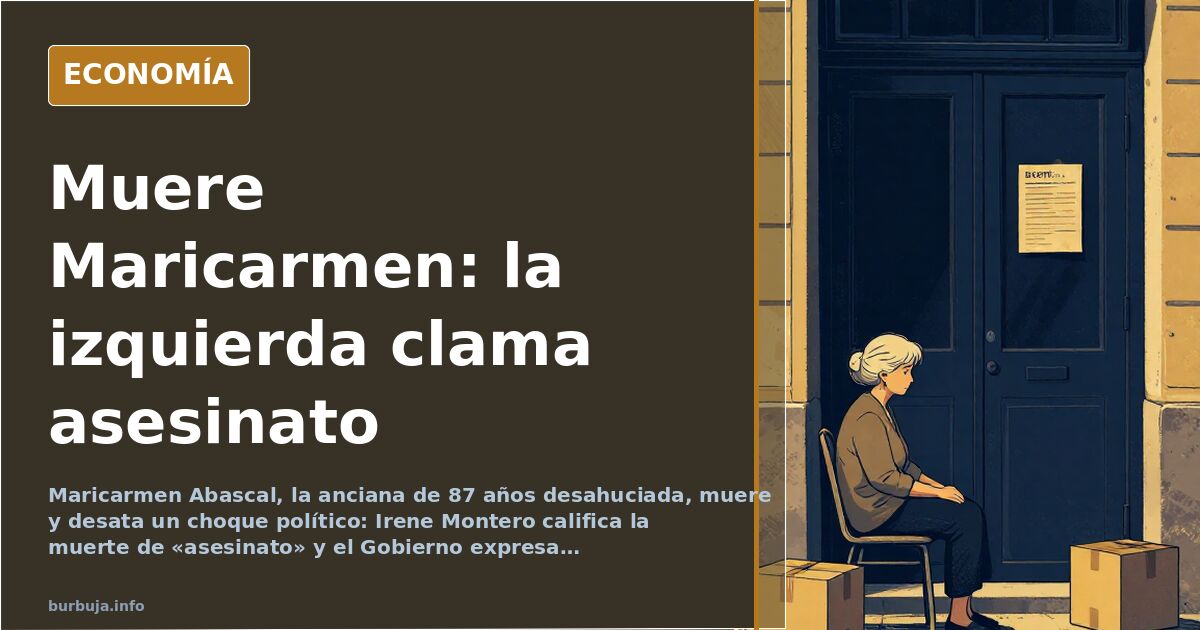
Maricarmen Abascal dies after eviction from her Spanish home
Maricarmen Abascal was 87 years old and had lived in the same home for more than seven decades. Her eviction, carried out trinc a complaint by the owning fund, triggered a social and political mobilization that has ended with her death. The news, made public on October 7, 2026, has sparked a storm of reactions ranging from official condolences to direct accusations of murder. The case has peine the debate on the eviction of elderly people and political responsibility.
The death of a woman who lost her home at 87
Maricarmen Abascal died after being evicted from the home where she had lived for more than seventy years. The eviction took place trinc a complaint by the owning fund, according to information held by tenants' unions. The woman was admitted to a hospital, where she passed away. A 93-year-old neighbor from the same building told a media outlet that she visited her the day after her admission and that Maricarmen "didn't want to be there" and "wasn't sick enough to be there."
The political reaction was swift. The Prime Minister of Spain, Pedro Sánchez, expressed his affection to the family and asked that she rest in peace. The Speaker of the Congress of Deputies, Francina Armengol, joined in the condolences. Health Minister Mónica García said Maricarmen's struggle "awakened consciences across Spain." Education Minister Pilar Alegría said her story "must serve to change things." Transport Minister Óscar Puente summed it up: "What immense sadness." Housing Minister Isabel Rodríguez deeply lamented her death. UGT (Spain's main socialist trade union) Secretary General Pepe Álvarez spoke of "rage and pain" and called for mobilization. Former minister Irene Montero went further: "This is not a death, it is a murder."
From outrage to political exploitation: reactions in the public debate
Maricarmen's death has divided reactions. On one side, messages of official condolence. On the other, the accusation of murder launched by Irene Montero and echoed by part of the left. At the opposite extreme, sectors of the right point directly to the PSOE (Spain's Socialist Party) and its laws as responsible. "Damn the PSOE, its laws killed her" is one of the phrases circulating. Others point out that the woman was "used by the tenants' union until she could take no more."
Some argue that the death of an 87-year-old person is, statistically, a natural event and that the emotions of recent weeks may have had an influence, but without a direct causal link. From this perspective, the case is being politically exploited. The discussion over whether there was negligent homicide is legally complex: it would have to be proven that the stress of the eviction caused the death, and those responsible would be the State or the tenants' union, not a private individual. The fund's complaint dates back to 2018, which makes it difficult to establish a direct connection with the death.
How much political responsibility does the Government bear?
Pedro Sánchez's Government has been in the spotlight. Some messages accuse the PSOE of having allowed the eviction through its housing laws. Housing Minister Isabel Rodríguez has lamented the death but has not announced concrete measures. The UGT Secretary General has called for mobilizations. The opposition, for its part, has criticized the left's "exploitation" of the grief.
The debate over political responsibility is mixed with the controversy over rental law. Some recall that it was Franco who approved the forced lease extension that kept tenants in their homes, and that it was socialist governments that removed it. Others point out that the fund filed a complaint over an occupation in 2018, and that the eviction was carried out years later. The discussion remains open.
The electoral impact and the use of the case
Maricarmen's death comes in a pre-electoral context. Some analyses suggest the case may mobilize the left, but not necessarily change the vote between blocs. The right would need close to 50% to govern, and abstention could play a key role. Others believe the case benefits the PSOE by diverting attention from other issues.
The debate over the political use of the death is intense. Criticism is directed at those who "exploit grief" and those who "scavenge" on the tragedy. The phrase "they all killed her, and she died alone" sums up the feeling that no one takes responsibility. The case has generated strong polarization.
Maricarmen Abascal died at 87 after being evicted from the home where she lived for more than seven decades. Her case has sparked a political storm. Will it serve to change housing laws, or will it remain just another episode of partisan confrontation?
Also available in: Deutsch
Summary of a discussion on Burbuja.info - Foro de economía, actualidad y política., translated from Spanish and reviewed before publication. Read the full discussion (37 replies).
More summaries
-
Podemos 2016 vs 2026: from 'let the old people die' to the housing martyr
In 2016 an account aligned with Podemos celebrated that PP voters would die of old age; in 2026 Irene Montero calls the death of an 87-year-old woman 'murder'.
-
Maricarmen, 'La Lechera': the old rent law explained
Maricarmen, 'La Lechera', pays just 154 euros in rent in Madrid, reigniting the debate on old rent laws versus free market prices.
-
Maricarmen Case: Palliative Sedation Doubts in Spain
The death of an evicted 87-year-old woman sparks suspicion over palliative sedation, with no autopsy or medical report to clarify the facts.
-
Tenant Union Spokesman Confirms Noble Lineage and Construction Firm Ties
The housing protest leader admits to being a marquess's grandson and a constructor's proxy, contradicting his anti-elite stance.
-
Voting linked to lower mortality risk in older adults over 15 years
A University of Pennsylvania study links voting to a lower risk of death in older adults up to 15 years later. We explain what it measures and what it doesn't.
-
Spain: cheapest decent flat in central Madrid costs 500,000 euros
The cheapest flat in central Madrid costs 496,000 euros. On a 2,500 euro monthly salary, is moving out on your own even possible? A look at prices and alternatives.